
The U.S. Jobs Outlook: What Employers and Job Seekers Should Know in September 2025
TL;DR FAQ: The September 2025 U.S. Jobs Outlook
▼ Q: Why is the U.S. job market cooling in late 2025?
A: August 2025 BLS data showed only 22,000 jobs added, with unemployment climbing to 4.3%—the highest in over two years. Payroll revisions cut 258,000 jobs from prior months, marking the first net job losses since 2020. Employers are cautious, revising workforce needs as economic headwinds grow.
▼ Q: Which industries are still hiring despite the slowdown?
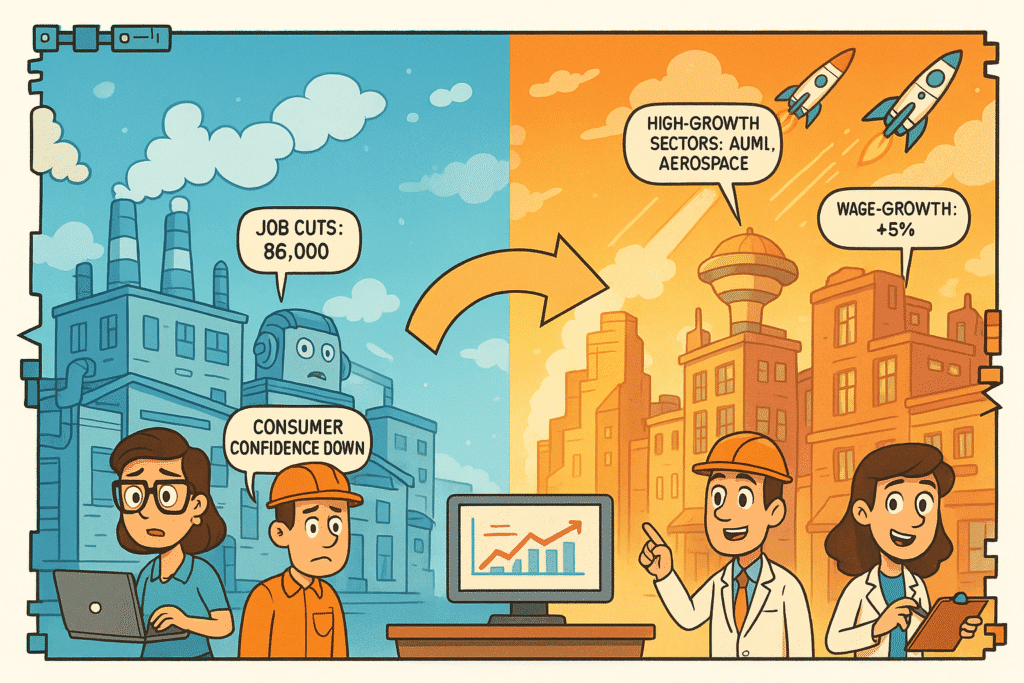
A: High-demand sectors include advanced manufacturing & aerospace (wage growth above 5%), semiconductors & technology (domestic chip investments), healthcare (driven by demographics), and infrastructure/renewable energy projects. These niches are absorbing specialized engineering, tech, and life sciences talent.
▼ Q: What warning signs should employers and job seekers watch?
A: Job openings dropped to 7.18 million in July, the lowest in 10 months. August saw 86,000 job cuts (+39% vs. July), and Black unemployment rose to 7.2%—a leading stress indicator. Healthcare openings declined by 181,000, signaling uneven demand.
▼ Q: How is worker confidence shifting in 2025?
A: Federal Reserve data shows the probability of finding a new job after loss dropped to 44.9% (lowest since 2013). Voluntary quits fell to 18.9%, while nearly 40% of workers now expect higher unemployment within 12 months. Confidence has dropped fastest among six-figure earners.
▼ Q: What are staffing firms reporting about real-time hiring?
A: Staffing hours fell 4% year-over-year, with professional staffing down 5% and temporary help shrinking by nearly 10,000 jobs. Still, Statement of Work projects in the Americas are valued at $3.33 trillion, showing strong contingent workforce demand into 2026.
▼ Q: Where are employers finding pockets of optimism?
A: At the ground level, requisition volume is ticking up after a slow summer. Hiring managers report selective but steady demand for AI/ML engineers, cybersecurity specialists, process engineers, regulatory affairs staff, and production experts. This often signals official data will improve in 30–60 days.
▼ Q: How should job seekers and employers adjust strategy now?
A: Employers should focus hiring on revenue-driving or efficiency-supporting roles and consider contract-to-hire models. Job seekers should upskill in AI, compliance, and advanced manufacturing processes, targeting high-investment sectors. Both sides should invest in retention and referral networks as costs to replace talent remain elevated.
The labor market is sending mixed signals as we enter the final quarter of 2025. While national employment data shows clear cooling, specialized industries continue to demonstrate resilience. At STEM Search Group, we see both the challenges and opportunities emerging across technology, engineering, manufacturing, life sciences, and healthcare sectors.
August Employment: The Numbers Tell a Story
The August 2025 BLS Employment Situation Summary revealed a significant slowdown in job creation, but the full picture requires careful analysis.
Key August Metrics:
- Job additions dropped to just 22,000, well below expectations
- Unemployment rate climbed to 4.3%, the highest level in over two years
- Previous months saw substantial revisions: May and June payrolls were revised downward by 258,000 jobs combined
- June marked the first month of net job losses since 2020
These revisions, while part of the normal BLS process, represent some of the largest adjustments we’ve seen in recent years.
Where Opportunity Remains Strong
Despite the overall cooling, several sectors continue to show robust demand, particularly in areas where specialized skills command premium compensation.
High-Growth Sectors:
- Advanced Manufacturing & Aerospace: Wage growth exceeding 5% year-over-year, driven by defense contracts and commercial aviation recovery
- Semiconductors & Technology: Continued investment in domestic chip production creating sustained demand for engineering talent
- Healthcare Services: While August showed some cooling, long-term demographic trends support continued growth
- Infrastructure & Construction: Data services and renewable energy projects maintaining above-average hiring rates
Investment Momentum: The flow of capital into energy transition, EV battery production, and advanced manufacturing through recent trade agreements continues to create opportunities for technical professionals and the companies that employ them.
Market Warning Signs Require Attention
Several indicators suggest employers and job seekers should remain cautious in their planning.
Employment Market Pressures:
- Job openings fell to 7.18 million in July, marking a 10-month low
- For the first time since 2021, unemployed workers outnumbered available positions
- August saw nearly 86,000 job cuts, representing a 39% increase from July
- Labor force participation continues declining due to demographic shifts and policy changes
Sector-Specific Challenges:
- Healthcare and social assistance openings dropped by 181,000
- Arts and recreation sector reduced openings by 62,000
- Mining and logging cut 13,000 positions
- Black unemployment reached 7.2%, often an early indicator of broader market stress
Consumer Confidence: The Psychology of Employment
The Federal Reserve’s August Consumer Expectations Survey reveals shifting worker sentiment that may predict future market conditions.
Worker Confidence Metrics:
- Probability of finding new employment after job loss fell to 44.9% (lowest since 2013)
- Likelihood of voluntary job changes dropped to 18.9%
- Expected job loss probability increased to 14.5%
- Nearly 40% of respondents expect higher unemployment within 12 months
Income Bracket Analysis: High-income earners (six-figure salaries) showed the steepest decline in confidence about securing new positions, though they remain less concerned about job security compared to households earning under $50,000.
Staffing Industry Intelligence: Real-Time Market Signals
Industry-specific data from Staffing Industry Analysts provides additional context for understanding current market dynamics.
Recent Developments:
- September payroll revisions removed 911,000 jobs from previous reports, the largest markdown since 2000
- Staffing hours declined 4% year-over-year, with professional staffing down 5%
- Temporary help services employment dropped by nearly 10,000 positions in August
- ManpowerGroup reports 45% of firms plan to maintain current workforce levels through Q4
Forward-Looking Indicators:
- Statement of Work projects in the Americas valued at $3.33 trillion, indicating substantial contingent work demand
- U.S. staffing revenue projected to decline 3% in 2025 before recovering to 2% growth in 2026
- AI integration accelerating across staffing platforms, reshaping talent acquisition processes
The Ground-Level Perspective: What We’re Seeing
While macro data provides important context, real-time market intelligence often reveals trends before they appear in official statistics.
Current Recruiting Signals: Our conversations with hiring managers and industry partners suggest a cautiously optimistic shift. Requisition volume has increased following what many described as a challenging summer hiring period. This uptick in job orders typically precedes improvements in official employment data by 30-60 days.
Industry-Specific Observations:
- Technology: Selective hiring continues for AI/ML engineers, cybersecurity specialists, and cloud infrastructure architects, with startups showing renewed activity in Q4
- Engineering (Non-Tech): Manufacturing and aerospace clients are actively recruiting for process engineers, quality assurance managers, and automation specialists
- Manufacturing: Strong demand for production engineers, supply chain analysts, and lean manufacturing experts as companies optimize operations
- Life Sciences: Sustained hiring for regulatory affairs professionals, clinical research associates, and biostatisticians despite broader market cooling
- Healthcare: Specialized roles in medical device engineering, healthcare IT, and clinical operations remain competitive
- Scientific Roles: Research and development positions in materials science, environmental consulting, and laboratory management showing consistent demand
Strategic Recommendations
For Employers: Focus hiring efforts on roles that directly support revenue generation or operational efficiency. Consider contract-to-hire arrangements to maintain flexibility while accessing specialized talent. Invest in employee retention programs, as replacement costs continue rising across technical disciplines.
For Job Seekers: Target industries with sustained investment momentum rather than chasing short-term openings. Develop skills in high-demand areas like AI implementation, regulatory compliance, and advanced manufacturing processes. Maintain professional networks actively, as referrals remain the most effective path to quality opportunities.
Looking Forward: Balanced Optimism
The current employment landscape requires nuanced interpretation. While national indicators show clear cooling, pockets of opportunity remain robust, particularly in specialized technical fields. The key is distinguishing between temporary market adjustments and fundamental shifts in demand.
At STEM Search Group, we’re seeing early signs of recovery in requisition volume and client conversations. This suggests that while official data may continue showing weakness in the near term, the foundation for improved hiring activity is already being established.
STEM Search Group specializes in connecting niche executives and individual contributor (IC) professionals with opportunities across technology, engineering, manufacturing, life sciences, and healthcare sectors. Whether you’re planning strategic hires or exploring career advancement, we provide the market intelligence and industry connections to support informed decision-making.
Ready to discuss your hiring strategy or career goals? Connect with our team here.
Sources:
- Resource: U.S. Bureau of Labor Statistics (BLS) – Employment Situation: https://www.bls.gov/news.release/empsit.nr0.htm
- Resource: U.S. Bureau of Labor Statistics (BLS) – Job Openings and Labor Turnover Survey (JOLTS): https://www.bls.gov/jlt/
- Resource: Federal Reserve Bank of New York – Survey of Consumer Expectations (SCE): https://www.newyorkfed.org/microeconomics/sce
- Resource: The Conference Board – Employment Trends Index: https://www.conference-board.org/topics/employment-trends-index
- Resource: Staffing Industry Analysts (SIA) – U.S. Staffing Industry News & Research: https://www2.staffingindustry.com
- Resource: SIA | Bullhorn Staffing Indicator: https://staffingindustry.com/bullhorn-staffing-indicator
- Resource: SIA – Staffing Industry Forecasts: https://www2.staffingindustry.com/Research/Research-Reports
- Resource: Bloomberg – U.S. Economy and Jobs Coverage: https://www.bloomberg.com/economics
- Resource: Reuters – U.S. Business and Economic News: https://www.reuters.com/business/
- Resource: CNBC – Economy Coverage: https://www.cnbc.com/economy/
- Resource: STEM Search Group Blog – “It’s Not All Doom & Gloom”: https://stemsearchgroup.com/its-not-all-doom-gloom-looking-at-the-us-job-market-and-economy-over-the-last-90-days-and-beyond/