
The Donut Lab Solid-State Battery: They Called It a Scam. Then the Test Results Came Back.
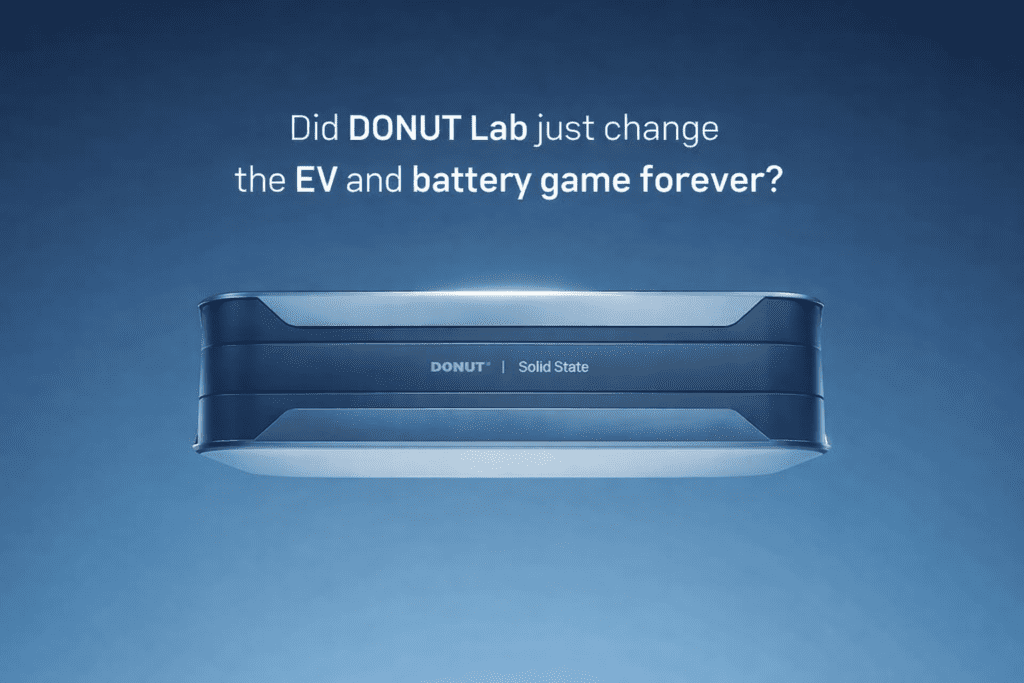
TL;DR FAQ: Is Donut Lab’s Solid-State Battery a Scam or a Breakthrough?
▼ Q: What did Donut Lab claim at CES 2026, and why did the industry call it a scam?
A: At CES in January 2026, Donut Lab announced a production-ready all-solid-state battery available to OEMs immediately, claiming 400 Wh/kg energy density, 0–100% charging in minutes, 100,000-cycle lifespan, 99% capacity retention at -22°F (-30°C), no flammable electrolyte, and lower costs than lithium-ion — all without cobalt, nickel, or rare earth materials. Because the claims improved every major battery metric simultaneously, industry figures — including Svolt’s chairman — called it vaporware or a scam. That skepticism was rational given a decade of overpromised battery breakthroughs.
▼ Q: What did independent testing actually find?
A: On February 23, 2026, VTT — Finland’s state research institution and one of Europe’s most respected independent labs — released the first results. The Donut Lab cell reached 80% charge in 4.5 minutes at an 11C charge rate and 100% in just over seven minutes. Post-charge capacity availability was 98.4–99.6%. The one notable nuance: at maximum charge speed, the cell hit a 90°C (194°F) safety threshold, meaning real-world vehicle applications will require thermal management — standard engineering, not a disqualifier. Energy density, cold weather, and cycle life results are still pending.
▼ Q: How does Donut Lab’s claimed energy density compare to today’s EV batteries?
A: Current mass-produced EV cells sit at roughly 270–290 Wh/kg. Toyota’s future roadmap targets 300–350 Wh/kg later this decade. Donut Lab claims 400 Wh/kg in a production-ready cell — approximately 40% more range at the same pack weight, or equivalent range from a significantly smaller, lighter battery. This is the single most important number in the validation sequence. If the mid-March 2026 VTT report confirms it, the competitive landscape shifts quickly.
▼ Q: Why does the supply chain angle matter as much as the performance claims?
A: Today’s battery supply chain depends heavily on cobalt from the Democratic Republic of Congo and refining capacity concentrated in China, with similar exposure in nickel and rare earths. A chemistry that eliminates cobalt, nickel, and rare earth materials entirely changes the geopolitical equation for EV manufacturing. For U.S. manufacturers, it means reduced dependence on supply chains they don’t control. For emerging manufacturers, it lowers the barrier to entry. This makes Donut Lab’s story as much a strategic and national security story as an engineering one.
▼ Q: What is Donut Lab actually building beyond the battery itself?
A: The battery is the headline, but the platform is the product. Donut Lab is developing a vertically integrated EV stack that includes in-wheel motors, battery, control hardware, and a software simulation layer that allows manufacturers to model the full vehicle before physical production. The company is targeting startups, mid-sized OEMs, heavy transport, and defense applications through its Global Innovators Program. Verge Motorcycles is the first production example. For manufacturers, the appeal is timeline compression — fewer development phases, faster market entry.
▼ Q: Why does being based in Finland give Donut Lab a structural advantage in validation?
A: Finland’s innovation ecosystem tightly integrates universities, applied research institutions, and state-backed labs. For a 22-person team making extraordinary claims, direct access to VTT meant Donut Lab could commission credible third-party validation without raising large capital rounds or building proprietary test facilities. Finland’s national focus on energy independence, green technology, and exportable innovation also aligns naturally with a battery breakthrough, reducing the friction from legacy energy lobbying and short-term VC exit pressure that often slows deep-tech validation elsewhere.
▼ Q: What milestones should people watch for in the next 60 days, and what would confirm this is real?
A: VTT’s validation is structured across four stages. Stage 2 (mid-March 2026) covers energy density, including the 400 Wh/kg claim. Stage 3 (late March 2026) tests cold weather performance at -22°F (-30°C). Stage 4 (April 2026) uses accelerated protocols to evaluate the 100,000-cycle assertion. If those reports hold, the technical debate closes fast. The definitive market signal, however, won’t be another lab result — it will be the first Tier 1 automaker that publicly announces a Donut Lab partnership. That converts a validation story into a competitive repositioning event, with immediate downstream implications for power electronics, advanced manufacturing, domestic battery production, and thermal engineering hiring.
▼ Q: Which industries face the biggest disruption if Donut Lab’s battery scales to production?
A: Automakers with deep lithium-ion investments face compressed transition timelines — a new entrant could leapfrog current specs in range, charging speed, and longevity before legacy platforms catch up. Gas station operators face an existential behavioral shift: a five-to-ten minute full charge erases the last practical advantage of combustion refueling, making electrical infrastructure upgrades non-optional. Incumbent battery manufacturers that dismissed the claims publicly now face a binary choice — partner early or defend aging assets. On the supply side, combustion-related supply chains face steady, model-cycle-by-model-cycle erosion. And for workforce and hiring, the ripple effects land in power electronics, high-capacity charging infrastructure, thermal engineering, control systems, and domestic advanced manufacturing — sectors that will need to scale faster than most current talent pipelines are built to support.
If you have followed solid-state batteries for the past decade, you have seen this movie before.
A startup announces a breakthrough. The numbers look unbelievable. The timeline says two or three years. Then the timeline slips. The specs get revised. The press cycle moves on.
So when Donut Lab walked onto the CES stage in January 2026 and said they had a production-ready all-solid-state battery available to OEMs right now, most of the industry did not clap. They crossed their arms.
Forums called it vaporware. Svolt’s chairman called it a scam. Established battery manufacturers said the performance claims were physically impossible.
That reaction was not irrational. It was earned by history.
Then Donut Lab sent the battery to VTT, Finland’s state research institution.
And the data came back.
Why People Doubted It
Before January 2026, the industry had a ceiling.
Energy density: mass-produced EV cells were sitting around 270 to 290 Wh/kg. Some lab-validated cells pushed higher, but not in production vehicles. Toyota’s roadmap targets 300 to 350 Wh/kg later this decade.
Donut Lab claimed: 400 Wh/kg in a production-ready cell.
That would mean roughly 40 percent more range at the same pack weight, or the same range from a significantly smaller and lighter battery.
Charging speed: today’s fastest production EVs can add roughly 60 to 70 miles (95 to 113 km) in five minutes under ideal conditions, typically charging from low state of charge to about 80 percent.
Donut Lab claimed: 0 to 100 percent charging in minutes, safely, on a daily basis.
Cycle life: most lithium-ion packs are rated for 1,000 to 1,500 cycles. Many EV warranties cover 8 years or 100,000 miles (160,000 km) because noticeable degradation becomes a factor beyond that window.
Donut Lab claimed: 100,000 cycles. At one charge per day, that equates to roughly 273 years of theoretical life. In practical terms, the battery stops being a wear item.
Cold weather: standard lithium-ion batteries can lose 20 to 40 percent of usable range at 14°F (-10°C). Charging in deep cold often requires preconditioning to avoid damage.
Donut Lab claimed: 99 percent capacity retention at -22°F (-30°C) and consistent performance up to 212°F (100°C) on the high end.
Safety: lithium-ion batteries use flammable liquid electrolytes. Above roughly 140 to 175°F (60 to 80°C), the risk of thermal runaway increases significantly. EV fires are rare compared to combustion vehicles, but when they occur, they are difficult to extinguish.
Donut Lab claimed: no flammable liquid electrolyte and no cascading thermal runaway chain reaction.
Cost: this is where most battery breakthroughs collapse.
Donut Lab claimed: lower structural cost than lithium-ion from day one, avoiding cobalt, nickel, and rare earth materials entirely.
When a company says it improves energy density, charging speed, safety, longevity, cold weather performance, and cost at the same time, skepticism is not optional.
It is responsible.
What the Lab Actually Found
After the CES backlash, Donut Lab stopped debating and commissioned independent testing.
On February 23, 2026, VTT released the first set of results focused on charging speed and thermal behavior under aggressive conditions.
The cell reached 80 percent in 4.5 minutes at an 11C charge rate. It reached 100 percent in just over seven minutes.
After charging, 98.4 to 99.6 percent of stored capacity was available for use.
Now the important nuance:
At the highest charge rate, the cell reached a 90°C (194°F) safety threshold.
So this is not “no heat.” Real-world vehicle applications will require thermal management at maximum charge speeds.
That is engineering, not disqualification.
The next reports will cover energy density, cold weather performance, and cycle life.
The 400 Wh/kg energy density claim is the major inflection point. If that clears independent validation, the tone of this discussion changes quickly.
How Being in Finland Helped
There is a practical reason this story came out of Helsinki.
Finland has a tightly coordinated innovation ecosystem. Universities, applied research institutions, startups, and state-backed labs work closely together. For a 22-person team trying to validate a breakthrough battery, that proximity matters.
VTT is one of Europe’s most respected independent research institutions. Donut Lab did not have to rely solely on internal data or raise large amounts of capital to build its own validation facilities. It could go directly to a credible third party.
That shortens the distance between bold claim and measurable proof.
There is also less structural friction. Donut Lab was not launching into a market dominated by heavy legacy energy lobbying or immediate VC pressure tied to rapid exit timelines. Finland’s broader focus on energy independence, green technology, and exportable innovation aligns naturally with a battery breakthrough.
That alignment does not guarantee success.
But it removes some of the constraints that often slow deep-technology validation elsewhere.
This Is Bigger Than a Motorcycle
The battery is the headline. The platform is the play.
Donut Lab is building a vertically integrated EV stack: in-wheel motors, battery, control hardware, and a software layer that lets manufacturers simulate the full vehicle before physical production.
For startups and mid-sized OEMs, that is attractive for one simple reason:
It compresses timelines.
Verge Motorcycles is the first production example, but the company is also targeting heavy transport, defense applications, and modular platforms through its Global Innovators Program.
If the battery performs as claimed, it is not just an upgrade.
It is a shortcut.
The Supply Chain Angle Nobody Can Ignore
The material shift may be the most important part of this story.
The current battery supply chain leans hard on cobalt from the DRC and refining capacity in China, with similar concentration risks around nickel and rare earths.
A chemistry that avoids cobalt, nickel, and rare earth materials changes the geopolitical map.
For US manufacturers, that means less dependence on supply chains they do not control. For emerging manufacturers, it lowers the barrier to entry. For countries built around mineral processing leverage, it creates long-term pressure.
This is not just an engineering story. It is a strategic one.
Who Needs to Pay Attention
If these validation reports keep clearing, a few groups need to move quickly.
Automakers with large lithium-ion investments: if this scales, it compresses the “comfortable transition timeline.” A new entrant could leapfrog current specs in range, charging time, and longevity.
Gas station operators: a five to ten minute charge erases the behavioral difference between filling a tank and charging. Electrical upgrades are not optional if that becomes normal.
Battery manufacturers: the ones who dismissed it publicly now face a choice: partner early or defend legacy assets.
And on the other side:
Combustion-related supply chains face steady erosion. Not overnight. But over model cycles.
Transportation shifts rarely happen in a single headline moment. They happen when performance objections quietly disappear.
What Comes Next
The validation process is structured and time-bound.
- Stage 2 (mid-March 2026): Energy density validation, including the 400 Wh/kg claim competitors called physically impossible.
- Stage 3 (late March 2026): Cold weather performance, including the -22°F (-30°C) retention claim.
- Stage 4 (April 2026): Cycle life, using accelerated testing protocols to evaluate the 100,000-cycle assertion.
If those reports hold, the technical debate narrows quickly.
And then the real signal to watch will not be another lab result.
It will be a logo.
Which major OEM becomes the first to publicly announce a Donut Lab partnership?
Because once a Tier 1 automotive brand puts its name behind the platform, this shifts from interesting validation story to competitive repositioning event.
At that point, the implications for US hiring, supplier strategy, and capital allocation become immediate. Power electronics. High-capacity charging infrastructure. Advanced manufacturing. Domestic battery production. Thermal engineering. Control systems.
Industrial transitions rarely announce themselves politely.
They show up in test data.
Then they show up in partnership press releases.
The next 60 days will tell us which phase we are in.
Sources:
- Donut Lab: CES Battery Announcement
- Donut Lab: First Measurement Announcement, February 23, 2026
- Donut Lab: Measurement Reports Announcement, February 20, 2026
- Donut Lab: Global Innovators Program
- Electrek: Donut Lab’s solid-state battery confirms 0-80% charge in 4.5 min — but there’s a catch
- Top Gear: Official: Donut Labs’ solid-state EV battery fully charges in seven minutes
- The Verge (InsideEVs): Donut Lab Says It Cracked Solid-State Batteries. Experts Have Questions.
- CleanTechnica: Donut Lab Meant What They Said About That New EV Battery
- Interesting Engineering: Donut Lab to release test results after battery claims spark debate
- InsideEVs: Donut Lab Remains Defiant About Its Solid-State Battery, Saying Proof Is Coming Soon
- MIT Technology Review: What’s next for EV batteries in 2026
- IEA: Global Critical Minerals Outlook 2025
- CES 2026: Donut Lab Keynote Announcement