
Is AI Doing the Thinking For Us?
TL;DR FAQ: How is GenAI Impacting Learning?
▼ Q: Does GenAI help or hurt learning?
A: Both, depending on how it’s used. Research consistently shows AI improves learning when it supports thinking (hints, feedback, Socratic questioning) and weakens learning when it replaces thinking (generating answers, writing essays, solving problems on the user’s behalf).
▼ Q: What is cognitive debt and why does it matter?
A: Cognitive debt is a term from MIT Media Lab research describing what happens when people repeatedly offload thinking to AI. You get the output now but lose the understanding later. MIT found AI-assisted writers showed measurably lower neural engagement, weaker recall, and less ownership of work they had just completed.
▼ Q: Can someone perform well with AI but still not be learning?
A: Yes, and this is the core problem. GenAI frequently improves short-term output quality and speed while leaving the underlying skill undeveloped. A student can submit a polished essay without being able to reconstruct the argument. A developer can ship working code without understanding why it works. Performance metrics rarely catch this gap.
▼ Q: What did Anthropic’s research find about AI and skill development?
A: Developers using AI to learn a new Python library finished tasks faster but scored about 17 percent lower on comprehension tests than those using traditional documentation. The gap was sharpest in debugging. However, users who asked AI to explain reasoning rather than just provide answers learned significantly more, pointing to behavior as the key variable.
▼ Q: What kind of AI use actually improves learning outcomes?
A: Tutor-style AI that offers hints, asks probing questions, critiques drafts, and requires the learner to attempt problems before providing answers consistently produces better results. OpenAI’s Study Mode and Google DeepMind’s LearnLM project both show measurable gains using this approach versus direct answer delivery.
▼ Q: Does AI widen or close learning gaps between students?
A: It can do either, depending on design and implementation. Microsoft Research found students with stronger subject and AI literacy are better positioned to use AI as a learning accelerant. Students without that foundation are more likely to use it as a substitute, compounding existing disadvantages over time.
▼ Q: What is the verification problem with AI in learning?
A: As tasks get harder, people rely on AI more, exactly when they are least able to judge whether the output is correct. Fluent, well-structured AI responses create false confidence. Many users lack strong habits for critically checking AI output, leaving them exposed to errors they cannot detect.
Is GenAI Enhancing Learning, or Wrecking It?
The honest answer is both. And that’s actually the useful part.
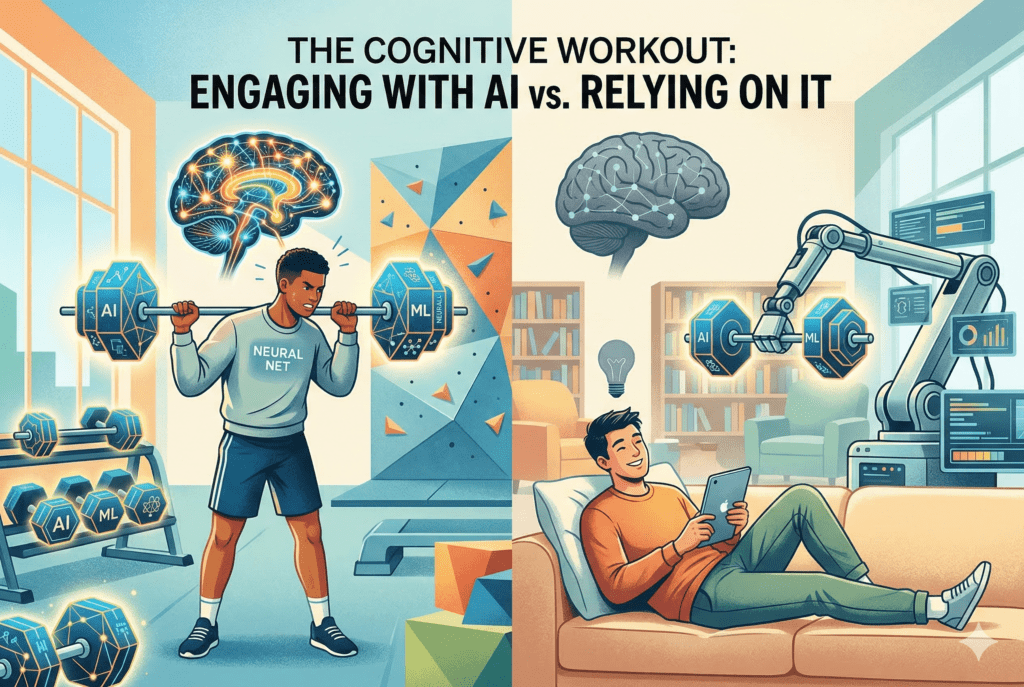
GenAI doesn’t automatically make people smarter or dumber. What the research keeps showing is simpler than that: AI helps learning when it supports thinking, and it hurts learning when it replaces thinking. That’s the whole argument. Everything else is just detail.
The Pattern That Keeps Showing Up
Across studies from MIT Media Lab, Anthropic, OpenAI, Google DeepMind, and Microsoft Research, the same thing happens consistently. When people use AI as a shortcut, they finish faster but learn less. When they use it more like a coach or sparring partner, learning improves.
So this isn’t really about whether AI is good or bad. It’s about whether the person using it is still doing enough of the actual thinking.
That framing matters because it puts the question back on behavior, not the tool.
What Happens When You Hand Your Brain a Shortcut
Researchers call it “cognitive offloading,” which just means delegating mental work to a tool. We already do this with calculators and GPS. GenAI extends that habit into higher-level tasks like writing, reasoning, and problem-solving.
If AI helps you get unstuck or explains something from a different angle, your brain still has to engage. The friction stays in the system. That’s fine.
But if AI does the actual thinking, your brain clocks out while the assignment still gets done. The output looks fine. The cognitive work that builds real understanding never happened.
The MIT Study
MIT Media Lab split people into three groups for an essay task: one used ChatGPT, one used search, one used only their own minds. They tracked it with EEG and followed up with memory tests.
The AI-assisted group showed lower neural connectivity, weaker recall afterward, and less sense of ownership over what they’d written. The researchers called it “cognitive debt.” You borrow convenience now and pay back understanding later.
The brain-only group showed the strongest engagement. The AI group showed the weakest. And when former AI users later had to work without it, their engagement still lagged. The habit had already set in.
The recall numbers were blunt: most people in the AI group couldn’t accurately quote from essays they had just finished writing. They produced the work. They didn’t absorb it.
Anthropic’s Coding Research
Anthropic looked at developers learning a new Python library with AI help. They finished a bit faster. Then came comprehension quizzes, where they scored about 17 percent lower than the group using traditional documentation. The gap was biggest in debugging, which is the skill that actually matters long-term.
But here’s the more useful finding: behavior within the AI group mattered a lot. People who asked AI to explain reasoning and walk through concepts learned more. People who just asked for answers learned less. The line between using AI as a helper versus a replacement showed up clearly, even within the same group using the same tool.
Performance Isn’t the Same as Learning
This is probably the most important thing in this whole debate, and it keeps getting glossed over.
GenAI often improves short-term output. People finish faster, the work looks polished, problems get solved in the session. But that’s not the same as having learned anything.
A student can submit a solid essay and still be unable to reconstruct the argument without the AI. A developer can ship working code and not understand why it works. The weakness only becomes visible when you take the tool away.
Most performance metrics only measure the output. They don’t catch the gap.
The Verification Problem
As tasks get harder, people lean on AI more, which is exactly when they’re least equipped to check if the answer is correct. The result is a gap between confidence and accuracy. People feel sure. They’re often wrong.
Fluent language isn’t the same as a correct answer. A well-structured paragraph can still be completely wrong. A lot of users haven’t built the habit of verifying AI output critically, which leaves them exposed in ways that aren’t obvious until something goes wrong.
Where It Actually Helps
When AI is designed to act like a tutor rather than an answer machine, results are better. Hints instead of solutions. Questions instead of conclusions. Feedback on drafts instead of rewrites. These approaches keep the learner mentally engaged with the material and consistently produce stronger outcomes.
OpenAI’s Study Mode is built around this. Early findings show students using it outperformed control groups. The gains came not from AI doing more, but from AI being designed to make the human do more.
Google DeepMind’s work through LearnLM and a collaboration with tutoring platform Eedi found similar things. AI-supported tutoring helped students solve novel problems more often than human-only support in some contexts, but the best outcomes came from human and AI working together. AI handled the logical scaffolding. Humans still mattered for tone, pacing, and knowing when someone was genuinely lost.
The Equity Issue
Microsoft Research flagged something that doesn’t get enough attention: the benefits of AI in learning aren’t evenly distributed. Students with stronger foundations in both the subject and in AI itself are better positioned to use it well. Students without those foundations are more likely to use it as a replacement, which compounds their disadvantage over time.
One student uses AI to ask sharper questions. Another uses it to skip the reading. Both look productive for a while. The gap shows up later.
So, Enhanced or Crashing?
Enhanced when AI supports reasoning. Crashing when it replaces it.
If AI gives feedback, asks questions, helps with structure, and keeps the person mentally engaged, it can genuinely improve understanding and retention. If it writes the essay and leaves the human as a light editor of machine output, learning weakens over time.
The tool isn’t deciding that. The workflow is.
Sources:
- https://pmc.ncbi.nlm.nih.gov — Your brain on ChatGPT – PMC
- https://bjgp.org — Your brain on ChatGPT | British Journal of General Practice
- https://brainonllm.com — Your Brain on ChatGPT: Accumulation of Cognitive Debt
- https://arxiv.org/abs/2506.08872 — Your Brain on ChatGPT (arXiv)
- https://arxiv.org/abs/2601.17055 — AI, Metacognition, and the Verification Bottleneck (arXiv)
- https://arxiv.org/abs/2601.00856 — Comment on: Your Brain on ChatGPT (arXiv)
- https://startalkmedia.com — Your Brain on ChatGPT with Nataliya Kosmyna – StarTalk
- https://anthropic.com — How AI assistance impacts the formation of coding skills
- https://medium.com — What Mental Health AI Can Learn from OpenAI’s Study Mode
- https://dspace.mit.edu — Socratic AI Tutoring in Primary School Mathematics
- https://media.mit.edu — Your Brain on ChatGPT – MIT Media Lab
- https://economics.mit.edu — AI, Human Cognition and Knowledge Collapse | MIT Economics
- https://openai.com — New tools for understanding AI and learning outcomes
- https://scale.stanford.edu — Beyond Automation: Socratic AI, Epistemic Agency – Stanford
- https://cloud.google.com — LearnLM | Google Cloud
- https://blog.google — Google AI for Learning Forum
- https://businesswire.com — Eedi and Google DeepMind: Human-in-the-Loop AI Tutoring
- https://learning-engineering-virtual-institute.org — Eedi: AI Tutoring Personalized Learning
- https://eedi.com — Eedi Labs
- https://microsoft.com — Learning outcomes with GenAI in the classroom
- https://brookings.edu — What the research shows about generative AI in tutoring
- https://tandfonline.com — AI vs. Human Feedback: A Meta-Analysis
- https://isrf.org — AI and the Future of Human Learning
- https://hungyichen.com — 2026 AI Cognitive Offloading Crisis
- https://startuphub.ai — OpenAI’s New AI Learning Measurement Tool
- https://ttms.com — ChatGPT’s New Study Mode: Revolutionizing Learning
- https://uq.pressbooks.pub — Three Paths to AI Integration in Business Education
- https://jriiejournal.com — AI-Driven Knowledge Building and Critical Thinking in Tanzania
- https://iosrjournals.org — Adaptive Scaffolding: AI Tutors in K-12 Coding Education
- https://edsurge.com — Teaching Machines to Spot Human Errors in Math Assignments
- https://mdpi.com — Higher Mathematics Education and AI Prompt Patterns / Critical Alliance of AI in Education
- https://preprints.org — ChatGPT-5 Study Mode: Python Programming Learning
- https://papers.academic-conferences.org — Socratic Conversational Agents for AI-Enhanced Learning