
Yes, You Should Absolutely Use AI to Make Cuts to Your Engineering Team
(Just kidding. Here’s what going agentic should look, and why the companies treating it as a headcount play are going to regret it.)
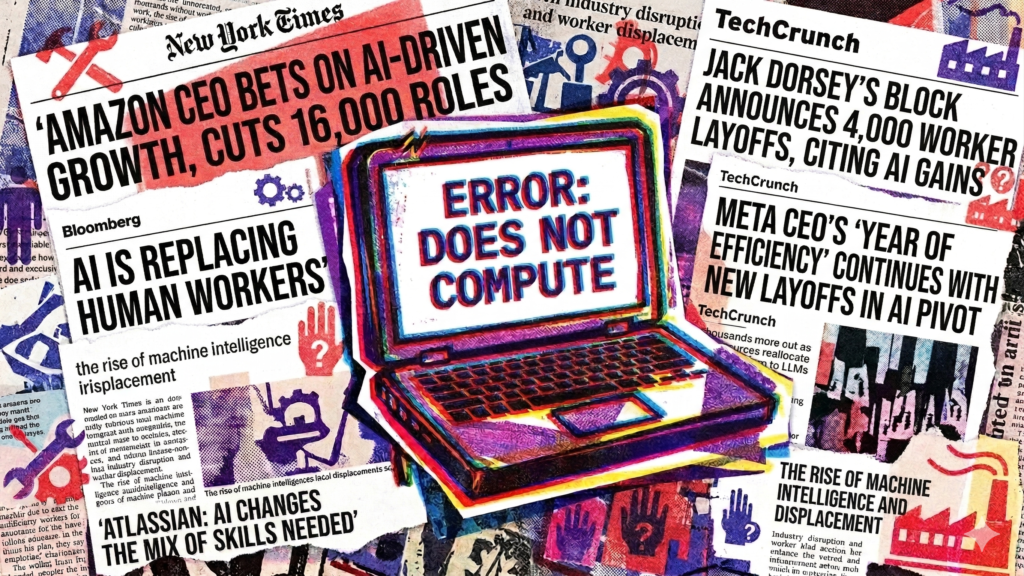
TL;DR FAQ: Should You Use AI to Cut Your Engineering Team in 2026?
▼ Q: Is AI a good reason to reduce your engineering headcount?
A: No. Companies that cut engineering talent to capture short-term AI savings are actively removing the human capability required to make AI useful. Senior engineers, architects, and experienced QA professionals are the steering layer of any effective agentic system — eliminating them leaves expensive tooling with no one qualified to run it.
▼ Q: What does an agentic engineering team actually look like?
A: Instead of traditional pod structures with human handoffs, agentic teams run on 2–3 person high-leverage squads supported by agent swarms. Work flows from business spec to agent execution to human verification. Velocity shifts from 2-week sprints to hours-to-production, and roles move up the value chain — junior devs manage RAG pipelines, senior devs design orchestration layers, and QA engineers build the evaluation datasets agents must pass before committing to production.
▼ Q: How do you keep agentic systems secure?
A: Security in an agentic environment is structural, not prompt-based. You build a swarm where a Coder Agent, Critic Agent, Security Agent, and Test Agent each play a distinct role with checks between them. Every agent runs in an isolated environment — such as a WASM container or ephemeral MicroVM — with no access to production data. Identity governance assigns each agent a specific Time-to-Live, purpose, and risk profile, and high-stakes actions require active human biometric approval.
▼ Q: What happens to observability and QA in an agentic world?
A: Observability becomes your primary QA layer. Because agentic output is non-deterministic, you can’t test every path. Unified storage that treats every signal as a wide structured event — retaining user, request, and system context — lets developers and agents trace issues without losing relational context. Teams need to be able to query things like which functions were written by a specific agent and never reviewed by a human. If you can’t answer that, your observability stack isn’t agentic-ready.
▼ Q: How do you manage the cost of running AI agents at scale?
A: Model tiering is the foundation. Frontier models like Claude, GPT-4o, or O1 handle architecture and complex refactors. Small local models like Llama or Haiku handle boilerplate and linting at near-zero marginal cost. The practical target is the 90/10 rule — 90% of tasks handled by smaller models at roughly 10% of the cost. Context engineering via RAG, feeding agents only the ~500 lines they actually need rather than entire codebases, can reduce token burn by up to 80%. Circuit breakers that freeze agents caught in repetitive failure loops prevent runaway token spend.
▼ Q: What is an agentic spec and why does it matter?
A: An agentic spec is a structured document — typically Markdown or YAML — that defines not just what an agent should build, but the security constraints, performance budgets, and testing requirements it must satisfy before opening a pull request. It replaces loose prompting with a governed workflow: business intent to agentic spec to multi-agent implementation to automated verification. Writing a good agentic spec requires deep knowledge of the codebase, business logic, and security requirements — it is senior engineering work, not a weekend prompt exercise.
▼ Q: What conditions should stop a company from deploying agents right now?
A: Three clear blockers: if a business process isn’t standardized, an agent can’t automate it reliably — fix the process first. If data quality is below retrieval thresholds, agent output will be garbage and will erode trust in the whole system. And if the cost of a single error exceeds the aggregate benefit of automation, a human needs to remain in the decision loop. As of 2026, Gartner estimates only about 2% of organizations have fully scaled agentic deployments, and fewer than 20% have mature AI governance in place — most teams are earlier in this transition than they realize.
▼ Q: Why do companies making the agentic shift need a recruiting partner like STEM Search Group?
A: The transition to agentic engineering isn’t a tooling upgrade — it’s a structural redesign of how engineering teams are built, hired for, and led. The roles look different now: Context Engineers, Agentic Architects, Evaluation Architects, Platform Orchestrators. Most hiring managers haven’t written a job description for these positions before, and most candidates don’t have a title that maps cleanly to what the work actually requires. STEM Search Group works at the intersection of technical depth and this specific moment in the industry. Beyond filling seats, they can consult on what these roles should look like in an agentic structure, which skills matter in 2026 versus two years ago, and how to build a team architected for where engineering is going — not where it’s been. For companies that want to do this transition right rather than fast and wrong, that kind of partnership is the difference between compounding capability and expensive regret.
Most teams, most companies are not ready for this. Not because the tools are hard to use, but because the shift isn’t about tools. It’s about how work gets structured, who does what, and honestly, what “writing software” even means in 2026.
Let’s walk through the real picture: where teams are today, where we think companies should be going, and what you actually need to think through to get there without burning it all down to the ground.
First, Let’s Talk About What Becoming an Agentic Team Is Not
AI is not a magic pill. It should not be used as a headcount reduction strategy. It is not something your CEO read about on a flight and can implement by Monday. It is not something that an influencer you’ve never spoken to, but magically found on X, should be your guiding voice about. And weekend vibe coding sessions are not how you build scalable application architecture. Full stop.
There is a version of this conversation happening in boardrooms right now that goes something like: “If AI can write code, why do we need as many engineers?” That question is being asked by people who do not always understand what engineers actually do, and acting on it will set companies back, not forward.
The real question is: do you want a short-term EBITDA bump that hollows out your technical capability, or do you want to lay a foundation that produces greater productivity, higher revenue, more innovation, and the kind of adaptability that keeps you relevant when the next shift comes? Because the innovation lifecycle is not a project with an end date. In an AI world, it is always on. The companies that treat this moment as a cost-cutting opportunity are the ones that will be playing catch-up in 18 months.
Trust your CTOs. If you don’t trust your CTOs, that’s a different problem, but the answer is not to override their judgment with a vendor pitch deck.
The Roles You Cannot Afford to Cut
Here is the part that gets missed in almost every executive-level AI conversation: the people who make agentic systems work are exactly the people some companies are tempted to cut.
You cannot run an effective agent swarm without people who understand proper application architecture. You cannot feed an AI agent useful context without people who understand what context it needs, how the codebase is structured, and what the business logic actually requires. You cannot govern autonomous systems without people who understand security, identity, and what “least privilege” means in practice.
AI agents do not generate good output from vague input. They generate good output from precise, well-structured, domain-accurate input. The people who can provide that are your senior engineers, your architects, and your experienced QA people. These are not roles you eliminate. These are the roles that become the steering layer of your entire agentic operation.
When a company cuts these people to “save money with AI,” what they are actually doing is removing the human capability required to make the AI useful. What is left is expensive tooling with no one who knows how to run it properly.
Traditional Team Structure
The current model is what you’d call a “pod” structure. You have developers, QA, a PM, maybe a DevOps person, and work moves through human handoffs. Somebody writes a Jira ticket. A dev picks it up. QA tests it. DevOps deploys it. The whole thing runs on synchronous handoffs and 2-week sprints.
It works. But it’s slow, it’s expensive per feature, and it scales by adding people.
That model is already being outpaced. Gergely Orosz describes a “Software Factory” model where the traditional team pod is collapsing into 2-3 person high-leverage squads supported by agents. That’s not a future prediction. Teams are doing it right now.
What the Agentic Structure Looks Like
Instead of human handoffs, the work flows like this: business spec to agent swarm to human review to deploy. The handoff isn’t dev to QA anymore. It’s human intent to agent execution to human verification. Velocity is no longer measured in 2-week sprints; it’s measured in hours to production.
Junior developers aren’t writing boilerplate and CRUD tasks. They’re training and prompting agents, doing manual verification, and managing the knowledge base the agents pull from. Senior devs aren’t grinding through complex feature implementation; they’re designing the orchestration layer and the specs that govern what agents do.
This isn’t a marginal change. The job description changes entirely, but the people doing those jobs need to understand software deeply to do them well. That understanding does not come from a two-day AI bootcamp.
The Security Question (Because You’re Already Thinking It)
Giving an agent write access to a production codebase sounds terrifying. The answer isn’t better prompts. It’s structural isolation, and it’s agents checking agents.
You build a swarm, not a single agent. The Coder Agent generates the feature code. The Critic Agent checks it against your team’s style guide and known architectural mistakes. The Security Agent scans for OWASP vulnerabilities and credential leaks before a PR is even opened. The Test Agent generates an integration suite based on the spec, not the code, specifically to avoid bias.
Every agent operates in a clean room, like a WASM container or ephemeral MicroVM, with no access to production data or long-term secrets. An independent, locally-hosted validator model scans the coder agent’s output for malicious intent or resource exhaustion before anything reaches a human.
On the identity side, every agent gets provisioned into a registry with a specific Time-to-Live, purpose, and risk profile. For anything high-stakes, the system requires the human to actively approve the action via a biometric challenge. Even when an agent is acting independently, it stays bound to verified human intent.
None of this gets configured correctly by someone who doesn’t understand identity governance, zero trust architecture, or what an attack surface actually looks like. These are your security engineers and your architects. Keep them.
Observability Is Now Your QA Layer
In an agentic world, you can’t test every path. It’s too non-deterministic. The old telemetry model, storing metrics, logs, and traces in separate databases, is a problem for agentic validation. It separates relational context at write-time, which means agents can’t do the reasoning they need to do.
In a unified storage model, every signal is treated as a wide structured event that retains the context of the user, the request, and the system state. This lets developers and agents zoom from high-level metrics down to individual traces without losing their place or copying IDs between tools.
Practically speaking, you need to be able to ask: “Show me all functions written by Agent-Refactor-Bot that haven’t been touched by a human in three months.” If you can’t answer that query, your observability isn’t ready for agentic deployment.
Charity Majors has been clear on this: as agents generate more code, humans shift from writing to verifying. High-cardinality observability is the only way to manage the unknown provenance of agent-produced code. You need people who understand what they’re looking at in those logs. That is a skill. It takes time to develop.
The Cost and Token Usage Questions
Right now, OpenAI, Anthropic, and Google are burning billions to win adoption. The models are being subsidized. That will not last. When the economics shift toward profitability, the teams that win are the ones who figured out model tiering before they were forced to.
The principle is straightforward: don’t use a frontier model for everything. Architectural planning and complex refactors go to frontier models like O1, GPT-4o, or Claude, because those tasks justify the cost. Boilerplate, unit tests, and linting go to small local models like Llama or Haiku, where the marginal cost is near zero. Security scanning goes to specialized fine-tuned models, used only during the check phase where precision matters.
The practical target is the 90/10 rule: high-leverage teams use small language models for 90% of tasks at roughly 10% of the cost.
Context engineering is where the real efficiency gains are. Instead of feeding an agent 100,000 lines of code, you use RAG to provide the 500 lines it actually needs. This can reduce token burn by up to 80%. Andrej Karpathy’s framing is useful here: the LLM is the CPU and the context window is RAM. If you load the whole repo into RAM, everything gets sluggish and expensive. The agentic framework’s job is to intelligently swap pages in and out.
There’s also a real cost to the infinite loop problem. An agent that keeps trying the same failing fix will burn $50 in tokens on a $0.50 problem. The fix is a circuit breaker: if an agent modifies the same file more than three times without a passing test, freeze it, summarize the failure, and ping a human.
Who sets those circuit breakers? Who monitors the token spend? Someone with enough technical context to make those calls. Not a spreadsheet.
Re-Engineering the Roles, Not Eliminating Them
The better conversation is not “how many engineers can we replace.” It is “how do we move our engineering team up the value chain.”
Your junior developers become Context Engineers, managing the RAG pipelines and documentation that feed agents. Your senior developers become Agentic Architects, designing orchestration flows and writing the agentic specs that govern what agents build. Your QA engineers become Evaluation Architects, building the golden datasets that agents must pass before committing to production. Your DevOps people become Platform Orchestrators, routing tasks between local and cloud models to optimize cost and latency.
The work isn’t gone. It moved up the stack. Tasks that required a developer’s full attention now get handled by an agent. That developer’s attention is now free for the work that actually requires human judgment: architecture decisions, security boundaries, spec design, and verifying that what the agent built is actually what the business needed.
You are not cutting the team. You are amplifying what the team can do.
Agentic Specs: The New SDLC Document
One of the most underrated structural changes is moving away from loose prompts toward agentic specs. These are structured documents, usually Markdown or YAML, that define the invariants of a feature. They tell the agent not just what to build, but the security constraints, the performance budgets, and the testing requirements it must satisfy before it can submit a PR.
The workflow shifts from prompt to code, to something more like: business intent to agentic spec to multi-agent implementation to automated verification.
The engineer’s job in this model is spec architect. They’re making sure the context is accurate enough that the agent doesn’t hallucinate into a costly loop. Writing a good agentic spec requires understanding the codebase, the business logic, the security requirements, and the performance constraints. That is senior engineering work. It is not something you hand to someone who learned to prompt over a weekend.
Then You Get to the Innovation Lab
Once you’ve clawed back 40-50% of the team’s capacity through agentic efficiency, you have a decision to make. The short-term thinking is to cut headcount and pocket the savings. The compounding thinking is to redeploy that capacity toward things that were always “too expensive to justify.”
The structure that works is an “If Only” pipeline. Business units, sales, marketing, ops, whoever, can post problems in the format: “If only we could automate X” or “If only we had a tool that did Y.” Engineering treats these as bounties. A developer plus an agent swarm takes a ticket and attempts a zero-to-one build in 48 hours.
This is how engineering shifts from a cost center fixing bugs to a value engine creating bespoke internal software that gives the company a competitive edge. The companies that invest in this pipeline will keep finding new ways to differentiate. The ones that cut to EBITDA will spend those same 18 months trying to rebuild capability they let walk out the door.
What You Need in Place Before You Scale
Most enterprise AI transitions follow a 90-day cycle. Weeks 1-4 are about strategic alignment: agreeing on what problems AI should actually solve, tied to specific KPIs, and defining autonomy bands, meaning which tasks an agent can monitor versus which it can execute. Weeks 5-8 shift to data readiness and infrastructure. Weeks 9-12 move to testing in shadow mode using digital twins, followed by limited production deployment with continuous drift monitoring.
There are also clear conditions where you should not deploy an agent yet. If a business process isn’t standardized, an agent can’t automate it reliably, so fix the process first. If your data quality is below the threshold for reliable retrieval, the outputs will be garbage, and agentic slop undermines the whole system’s credibility. If the cost of a single error exceeds the aggregate benefit of automation, you need a human in the loop at the decision point, not full autonomy.
The enterprise readiness picture as of 2026 is uneven. Gartner estimates that while 40% of enterprise applications will embed task-specific agents by end of year, only about 2% of organizations have fully scaled those deployments. Less than 20% have mature AI governance in place. Most teams are earlier in this than they think, which means there is still time to do it right.
The Companies That Get Left Behind
They will share a few common traits. They cut engineering talent in 2026 and 2027 to capture short-term savings. They deployed agents without governance frameworks because it seemed faster. They treated AI adoption as a cost story rather than a capability story. They ignored the advice of their technical leadership because a vendor promised them a simpler answer.
The companies that future-proof themselves do the opposite. They keep the people who understand architecture, security, and context. They build the governance layer before they scale the autonomy. They use the efficiency gains to fund bespoke innovation rather than extract margin. They understand that the innovation lifecycle doesn’t have a finish line, and they staff accordingly.
The question for any leadership team right now is simple: which company do you want to be?
You Don’t Have to Figure This Out Alone
Forward-thinking companies that embrace both agentic engineering and the craft that is software development need people who take both seriously. The technical depth required to make this transition well is real, and so is the organizational weight of it. This is not a tooling upgrade. It is a fundamental shift in how engineering teams are structured, hired for, and led.
A lot of companies right now are stuck in analysis paralysis. They know something has to change. They just don’t know where to start, who to talk to, or how other companies are actually tackling it in practice. Sometimes you need another voice in the room, someone who can speak to what this looks like on the ground, not just in a whitepaper.
That is where a recruiting partner who understands this space at a deeper level becomes something more than a recruiting partner. Finding talent is the minimum. The right partner can consult on what these roles actually look like in an agentic structure, what skills matter now versus what mattered two years ago, and how to build a team that is ready for where engineering is going, not where it has been.
That is what we do at STEM Search Group. We are not just filling seats. We understand what being agentic means, what the corresponding roles look like, and what kind of people thrive in this new structure. If you are trying to figure out your next move, or you just want to know how other companies are approaching this, we are worth a conversation.
Sources:
- Gergely Orosz (The Pragmatic Engineer): https://blog.pragmaticengineer.com/author/gergely/
- Charity Majors (Observability / charity.wtf): https://charity.wtf/
- Andrew Ng (DeepLearning.AI): https://www.deeplearning.ai/
- Andrej Karpathy (LLM OS framing): https://karpathy.ai/
- Simon Willison (AI-Augmented Development): https://simonwillison.net/
- James Governor / RedMonk (Agentic DevOps): https://redmonk.com/jgovernor/
- Strata.io: New Identity Playbook for AI Agents: https://www.strata.io/blog/agentic-identity/new-identity-playbook-ai-agents-notnhi-8b/
- Neontri: Enterprise AI Agents Architecture and ROI: https://neontri.com/blog/enterprise-ai-agents/
- RTS Labs: Enterprise AI Roadmap 2026: https://rtslabs.com/enterprise-ai-roadmap/
- Improving.com: AI Strategy and Roadmap Assessment: https://www.improving.com/thoughts/ai-strategy-and-roadmap-assessment/
- Veza: State of Identity and Access 2026: https://veza.com/resources/the-state-of-identity-access-2026/