
The End of the Social Contract: When Silicon Valley Became Liable
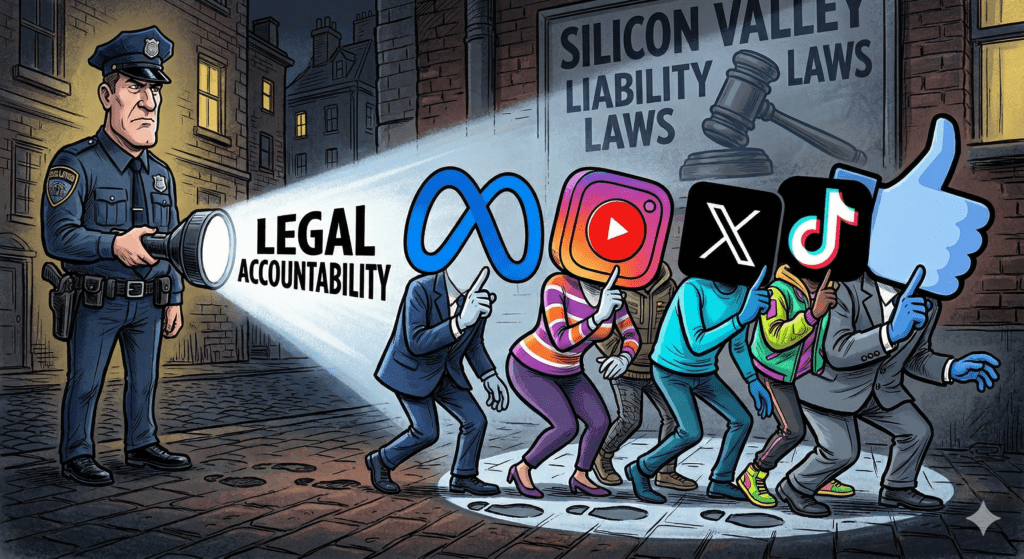
TL;DR FAQ: Is social media becoming legally accountable for its design?
▼ Q: What is changing in how social media platforms are regulated?
A: Social media regulation is shifting from focusing on user-generated content to scrutinizing platform design. Courts and governments are increasingly treating features like algorithms, infinite scroll, and autoplay as intentional product decisions that can create harm and therefore carry legal risk.
▼ Q: Why are tech companies being sued for “addictive design”?
A: Lawsuits argue that platforms deliberately engineered features to maximize user engagement by exploiting human psychology. Courts are beginning to treat these features as product liability issues, similar to how tobacco companies were held responsible for addictive products.
▼ Q: How are courts getting around Section 230 protections?
A: Instead of targeting content, plaintiffs are focusing on conduct, specifically platform design. Since design decisions are considered intentional actions by companies, they fall outside traditional Section 230 protections, opening the door to liability.
▼ Q: What legal precedents are driving this shift?
A: Recent cases in the U.S., including major verdicts against Meta and rulings on “addictive design,” have established that platforms can be held liable for harm caused by their product features, not just the content users post.
▼ Q: Are governments regulating social media more aggressively?
A: Yes. Countries like Australia, France, and Brazil are implementing age restrictions, banning certain features, and requiring stronger safeguards for minors. Regulators are also targeting “dark patterns” and manipulative interface designs.
▼ Q: What does this mean for social media business models?
A: The traditional model based on maximizing engagement is under pressure. Companies may need to shift toward “safety-by-design,” where reducing harm and proving user well-being becomes as important as growth metrics.
▼ Q: How will this impact the future of digital platforms?
A: Platforms are likely to operate more like regulated utilities, with stricter oversight and region-specific rules. This could lead to a more fragmented global internet and force companies to redesign products to meet legal and compliance standards.
For most of the internet era, social media operated on an unwritten deal.
Platforms would connect the world, users would supply the content, and governments would mostly stay out of the way. The understanding was simple: these companies were neutral pipes, not responsible actors.
That deal is now over. Whether you agree with that shift or not, the operating environment has clearly changed.
Between 2024 and 2026, the global regulatory and legal environment didn’t just tighten, it fundamentally redefined what social media companies are. What used to be a social contract is quickly becoming a legal one.
The Shift: From Content to Conduct
For years, tech companies hid behind a powerful legal shield: they weren’t liable for user-generated content. If something harmful happened, the blame rested with the user, not the platform.
Courts have started to dismantle that logic, not by attacking content, but by focusing on design.
That distinction matters.
Design is intentional. Design is engineered. And design is now being treated as conduct.
In early 2026, juries in the United States delivered a clear message. In New Mexico, Meta was hit with a $375 million judgment tied to how its platform design exposed minors to harm. In California, another case found Meta and YouTube liable for “addictive design” features like infinite scroll and autoplay.
The takeaway is straightforward: if your product is designed to keep people hooked, you own the consequences.
The New Legal Theory: Addiction as Product Liability
What’s happening now looks a lot like the tobacco lawsuits of the 1990s.
Back then, the argument wasn’t just that smoking was harmful. It was that companies engineered products to maximize addiction while downplaying the risks.
Today, social media is being framed the same way.
Not as a communication tool, but as a delivery system for dopamine.
Courts and regulators are increasingly treating features like:
- Infinite scroll
- Autoplay
- Algorithmic amplification
as deliberate mechanisms that exploit human psychology.
That’s a very different conversation than “content moderation.” It’s product liability.
And product liability doesn’t care about your mission statement.
Governments Are Acting More Directly
While U.S. courts are pushing from one direction, governments globally are coming in from another.
Australia has already implemented a nationwide ban on social media for users under 16. Europe is rolling out similar restrictions, and countries like Brazil are directly regulating “addictive design” features.
Even more telling, regulators are no longer just targeting what users see. They’re targeting how platforms are built.
Pop-ups, dark patterns, and subscription traps are all under scrutiny. The emerging pattern is consistent: interface decisions that shape user behavior are increasingly being treated as compliance and risk considerations, not just UX choices.
The Collapse of the Old Internet Model
For two decades, the internet ran on a simple formula:
Engagement = growth = revenue.
The more time users spent on a platform, the more valuable it became.
That model is now under direct attack.
When increased engagement can be interpreted as evidence of harm, the entire incentive structure flips. What used to be a KPI is now potential liability.
This is why you’re starting to see a deeper shift across the industry. Not just policy changes, but existential ones.
Platforms are being forced to move from:
- Engagement-at-all-costs
to:
- Safety-by-design
That’s not a minor adjustment. It represents a meaningful shift in how these businesses may need to operate.
The “Splinternet” Is Real Now
There was a time when the internet felt global and uniform.
That’s gone too.
Different countries are now enforcing entirely different rules around age limits, content exposure, and platform design. The result is a fragmented digital landscape where companies have to operate as if they’re running separate products in each region.
In practical terms, social media is starting to look less like a global network and more like a regulated utility.
And regulated environments tend to limit how freely companies can experiment.
So What Replaces the Social Contract?
The original deal between platforms and society was built on trust and convenience.
That’s been replaced with something much stricter: accountability.
If a platform’s design causes harm, even indirectly, it can now face lawsuits, fines, or outright bans. The burden has shifted from “we didn’t create the content” to “you built the system.”
That represents a materially higher level of responsibility.
And it’s not going away.
What This Likely Means Going Forward
For operators, founders, and investors, the implications are clear.
The next generation of platforms may be judged not only on growth, but on their ability to demonstrate they are not causing harm.
That means:
- Designing for restraint, not addiction
- Building transparent algorithms
- Treating user well-being as a measurable outcome, not a PR statement
In other words, acting less like a growth machine and more like a product company with real-world consequences.
This may not be as exciting from a growth perspective.
But it’s a lot more durable.
And in this new era, durability is what keeps you in the game.
If the last 20 years of social media were about moving fast and breaking things, the next 20 will be about something much less glamorous.
Owning what you built, within a more clearly defined legal and regulatory framework.
Sources:
- https://www.cjr.org/tow_center/get-ready-more-big-tech-lawsuits-design-not-content-first-amendment-section-230.php
- https://www.techpolicy.press/what-does-the-first-us-social-media-addiction-trial-mean-for-the-tech-industry/
- https://www.multistate.us/insider/2026/2/4/social-media-liability-litigation-seeks-foothold-in-tort-law-court-report
- https://mashable.com/article/new-mexico-meta-court-case-meta-loses
- https://www.siliconrepublic.com/business/meta-child-safety-legal-us-new-mexico-social-media
- https://www.cp24.com/news/world/2026/03/24/jury-finds-meta-liable-in-case-over-child-sexual-exploitation-on-its-platforms/
- https://www.theguardian.com/technology/2025/dec/05/elon-musk-x-fined-eu-first-clash-under-new-digital-laws
- https://mashable.com/article/eu-fines-x-120m-blue-checks-elon-musk
- https://www.worldhappiness.report/ed/2026/
- https://www.disinfo.eu/disinfo-update-17-03-2026/
- https://www.mdpi.com/2076-328X/15/11/1450
- https://www.researchgate.net/publication/400749181_The_Impact_of_Social_Media_Use_on_Adolescent_Mental_Health_A_Systematic_Analysis_of_Digital_Engagement_Social_Comparison_and_Psychological_Well-being
- https://webprofessionalsglobal.org/december-2025-global-legislative-and-policy-updates-affecting-web-professionals/