
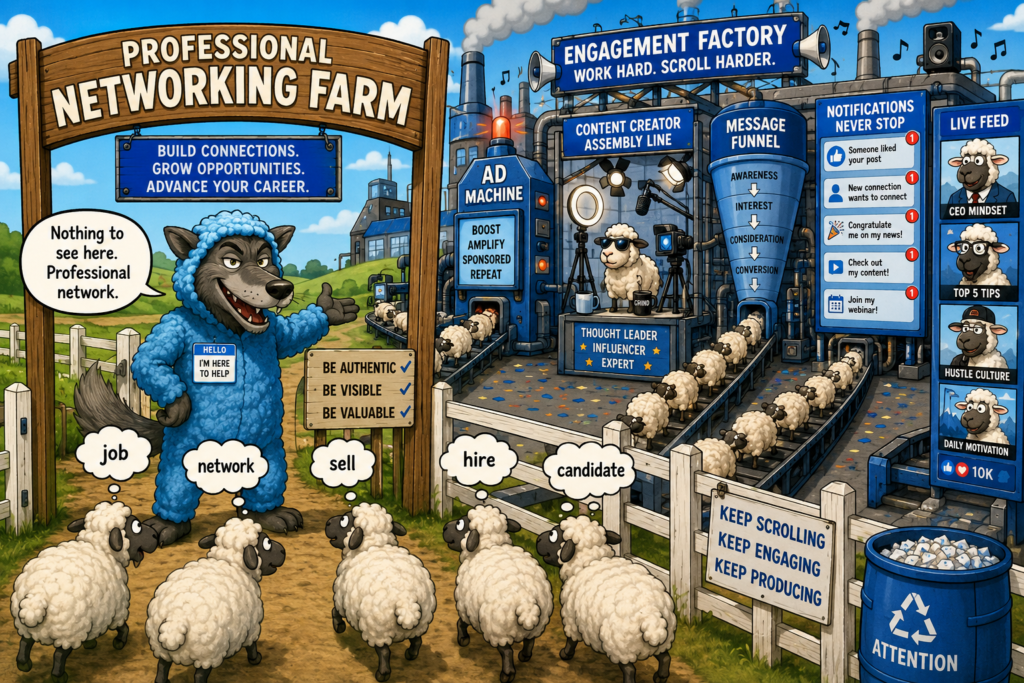
LinkedIn is a social network that sometimes talks about work
TL;DR FAQ: Is LinkedIn still a professional network?
▼ Q: Is LinkedIn still a professional network?
A: LinkedIn still has the professional graph: work history, job titles, company pages, hiring signals, recruiter tools, and connections. But the user experience now works more like a social network. The feed rewards attention, creator-style posting, paid amplification, and content from strangers. LinkedIn is still useful for work, but it no longer feels like a protected professional space.
▼ Q: Why does LinkedIn feel more like TikTok, YouTube, or Instagram now?
A: LinkedIn has adopted the same basic platform model used across the internet. TikTok pushed interest-based feeds. YouTube built the creator economy. Instagram normalized personal-brand content. Meta and Google trained advertisers to optimize attention through automated ad systems. LinkedIn added those habits to its own work identity data, which is why the platform now feels like a social feed that happens to contain resumes.
▼ Q: Why is organic reach down on LinkedIn?
A: Organic reach is harder because the feed is more crowded, more algorithmic, and more tied to paid distribution. Richard van der Blom’s 2025 Algorithm InSights report found major drops in LinkedIn organic performance, including lower views, engagement, and follower growth. LinkedIn is still growing as a business, but many users have a harder time reaching their own network without posting more often, creating more reactive content, or paying for distribution.
▼ Q: Why is LinkedIn full of personal stories, humblebrags, and AI-written posts?
A: LinkedIn rewards content that gets attention. Personal stories, emotional hooks, simple lessons, and polished AI-written posts are easy to react to, so they travel well. Real professional work is often specific, technical, and harder to explain quickly. That creates pressure for people to package work as content, even when the content is thin.
▼ Q: Is the LinkedIn inbox still useful for recruiting and sales?
A: The LinkedIn inbox can still work, but it is full of noise. Recruiters, salespeople, agencies, founders, event marketers, and automation tools have all used it heavily. InMail and direct messages now compete with canned pitches, fake personalization, SDR sequences, and recruiter blasts. The messages that still work are usually specific, relevant, short, and clearly written by someone who did real research.
▼ Q: If the feed and inbox are worse, why does LinkedIn still matter?
A: LinkedIn still matters because the graph is the product. LinkedIn knows where people work, where they used to work, who they know, who is hiring, who is open to work, who buys, who sells, and who manages teams. That work identity data is hard to recreate. People complain about LinkedIn, but recruiters, candidates, salespeople, founders, and companies keep using it because the professional graph is still there.
▼ Q: How should recruiters use LinkedIn now?
A: Recruiters should treat LinkedIn as one layer in the sourcing stack, not the whole strategy. Use LinkedIn for work history, title patterns, company mapping, career progression, mutual connections, and timing signals. Build candidate lists from other sources too: conference speaker lists, trade associations, licensing boards, patents, PubMed, GitHub, alumni networks, niche communities, referrals, ATS rediscovery, and Google. Then use LinkedIn to verify and contact people with real context.
There used to be a deal on the internet.
Twitter was for chaos. Instagram was for envy. Facebook was for your uncle’s political opinions and photos of lasagna. TikTok was for the algorithm to figure you out faster than your family ever did. YouTube was for creators, rabbit holes, tutorials, product reviews, podcasts, and long videos about topics you barely meant to care about.
LinkedIn had a different job.
LinkedIn was where work lived. Job history. Promotions. Hiring updates. Company announcements. Recruiter messages. Sales outreach. Industry commentary. The occasional humblebrag in a quarter-zip.
It was awkward. It was stiff. It had plenty of people congratulating themselves for basic workplace behavior.
But it was useful.
That was the point. LinkedIn had a function. People used it because work required it. It had something more valuable than entertainment: the professional graph.
Who works where. Who used to work where. Who knows whom. Who is hiring. Who is looking. Who sells. Who buys. Who manages. Who influences. Who might answer the message.
That was the wall.
LinkedIn had a boundary around it. You went there because of work. You did not go there because you wanted another feed.
That wall is gone.
LinkedIn is now a social network that sometimes talks about work.
A professional network helps you understand someone in the labor market. Where they have worked, what they have done, who knows them, what they are qualified for, and whether they might be worth hiring, selling to, partnering with, or learning from.
A social network rewards attention. It pushes content from strangers. It trains people to perform. It turns personality into reach. It turns credibility into ad creative. It turns expertise into inventory.
LinkedIn made that shift one product decision at a time.
The internet became one big feed
The easy take is that LinkedIn got worse because Twitter got worse.
There is some truth there. After Twitter became X, people cross-posted more. Founders, investors, recruiters, consultants, journalists, and political commentators brought habits from one platform to another.
That explanation is too small.
LinkedIn changed because every major platform started moving toward the same model.
TikTok taught the internet that the follower graph was optional. You did not need to follow the right people. You did not need to build a network. You did not even need to know what you wanted.
The platform watched what made you pause, scroll, like, comment, share, rewatch, or come back. Then it gave you more of that.
YouTube built the creator economy at scale. It turned individual people into media businesses. Product reviewers, educators, entertainers, analysts, podcasters, niche experts, and hobbyists became distribution channels.
That changed how brands thought. People trusted people more than logos. A creator with a loyal audience could do what a corporate ad often could not.
Instagram trained everyone to treat identity as content. Your taste became content. Your meals became content. Your office became content. Your routine became content. Your supposedly candid reflection became content.
Meta and Google trained advertisers to think in systems. Give the platform a goal, a budget, creative assets, and conversion data. Let the machine find the audience.
LinkedIn absorbed all of it.
It took stranger-driven content discovery from TikTok. It took the creator economy from YouTube. It took personal-brand performance from Instagram. It took automated ad logic from Meta and Google.
Then it added its unfair advantage: work identity.
That is why LinkedIn feels so strange now. It has the emotional habits of social media, the ad logic of performance marketing, the creator incentives of YouTube, the feed structure of TikTok, and the professional data of a resume database.
That is a good business. It is a worse professional space.
The numbers tell the story
LinkedIn is bigger than ever.
Microsoft has said LinkedIn passed the billion-member mark. LinkedIn revenue keeps growing. It is still tied deeply to recruiting, sales, job search, employer branding, and B2B marketing.
LinkedIn is doing fine.
The people using LinkedIn are having a different experience.
Richard van der Blom’s 2025 Algorithm InSights report, based on roughly 1.8 million LinkedIn posts, found major drops in organic performance. Public summaries of the report cite organic views down 50%, engagement down 25%, and follower growth down 59%.
The exact number will vary by person and category. The direction is clear enough.
LinkedIn is growing. Revenue is growing. Ad products are growing. Creator tools are growing.
At the same time, the average professional has a harder time reaching their own network.
That is the trade.
The platform is worth more to Microsoft while becoming less useful to many of the people who made it valuable.
The feed changed
Most people complain about the symptoms.
The fake vulnerability. The humblebrags. The recycled leadership lessons. The engagement bait. The AI-written posts. The fake gurus. The carousels. The posts about what someone’s toddler taught them about enterprise sales.
All annoying.
But the feed is the real story.
The old LinkedIn leaned on the professional graph. Your feed was shaped by people you knew, companies you followed, industries you worked in, and connections that had some tie to your actual work life.
The new LinkedIn leans harder on interest.
It shows you content because the system thinks you might react to it. The person posting may have no real connection to your work. They may just be good at getting attention.
That is the TikTok move.
TikTok showed every platform that strangers scale better than networks. Your actual network has limits. Your coworkers are busy. Your best contacts may never post. The most capable people in your field may be doing the work instead of narrating it.
An interest feed never runs out.
There is always another post, another take, another story, another video, another stranger with a lesson about leadership, layoffs, hiring, burnout, sales, parenting, failure, resilience, or crying in an airport.
This is why LinkedIn started to feel like every other feed with a job title slapped on top.
LinkedIn also has the AI infrastructure to push this further. Its researchers introduced 360Brew, a 150-billion-parameter model built for ranking and recommendations across LinkedIn.
In theory, that can improve the feed. It can make keyword stuffing less effective. It can reduce some crude gaming. It can help match people with content they might care about.
It also gives LinkedIn more control over what professional content you see.
That is the shift.
LinkedIn used to help you navigate your professional network. Now it increasingly decides what work-flavored content deserves your attention.
The creator economy came for the office
YouTube proved that individual people could become media businesses.
That idea changed the internet.
Creators became distribution channels. They built trust with audiences. They reviewed products, explained industries, taught skills, built communities, sold courses, sold ads, sold sponsorships, and shaped buying decisions.
Brands noticed.
People trust people more than brands.
LinkedIn noticed too.
In 2023, LinkedIn introduced Thought Leader Ads. The idea is simple: a company can sponsor a post from a person, not just a company page.
That person might be an executive, founder, employee, customer, expert, or creator. The post looks like a normal personal post, with a promoted label.
From a marketing view, it makes sense.
A real operator explaining a real problem usually beats a generic company graphic with a stock photo and a line about innovation.
From LinkedIn’s view, it is even better. The platform can sell ad inventory with a human wrapper.
But it changes the culture.
Once a personal post can become a corporate ad, posting changes. Your post can become paid media. Your voice can become distribution. Your reputation can become campaign material.
Then LinkedIn went further.
In 2026, LinkedIn launched Creator Marketplace, a tool for brands to find and work with B2B creators. Advertisers can search creators by topic, audience, and expertise. They can find organic posts that mention their brand. They can use creator content in paid campaigns.
That is creator-economy infrastructure.
LinkedIn is now building a market where the product is professional credibility.
Your expertise. Your audience. Your niche. Your trust. Your personal voice.
That is the business now.
The professional network became a media network because media networks make more money.
The vulnerability machine
You know the posts.
“I never thought I would share something this personal on LinkedIn, but…”
“What a flight delay taught me about leadership.”
“We had to let two people go today. I am struggling.”
“My daughter asked me why I work so hard. Here is what I learned.”
This stuff is easy to mock because a lot of it deserves mocking.
There is a reason people screenshot LinkedIn posts and pass them around like evidence from a workplace crime scene.
But the cringe is only the surface.
Performative vulnerability is a rational response to the system.
Real work is often boring to explain. It is specific, technical, slow, repetitive, and tied to context. A useful post about manufacturing yield, candidate sourcing, clinical operations, quality systems, software implementation, maintenance reliability, or regulatory hiring may matter a lot to 300 people.
It may also go nowhere.
Emotional content travels.
Conflict travels. Pain travels. Redemption travels. Public humility travels. Personal stories with clean business lessons travel.
So people adapt.
Layoffs become leadership lessons. Burnout becomes brand positioning. A hard conversation becomes a carousel. A family moment becomes a sales metaphor. A private struggle becomes proof of resilience.
Some of these posts are sincere. Work is human. People have real stories. A lot of professional life is emotional, stressful, and personal.
The problem is the packaging.
Once vulnerability becomes a growth tactic, the platform trains people to turn private life into professional content.
That is how you get the crying CEO genre. A leader lays people off, posts a tearful selfie, and somehow the story becomes about his pain.
The first time, it feels grotesque.
After a while, it becomes a format.
The feed does not care about dignity. It cares whether people stop scrolling.
The AI flood
The human cringe era almost looks quaint now because AI made the problem bigger.
Originality.AI analyzed 3,368 long-form LinkedIn posts from 99 influential profiles across 11 industries and found that 53.7% were likely AI-generated.
AI detection is imperfect, so treat that number with some caution. The broader point is hard to miss if you use LinkedIn.
The feed is full of writing that sounds like it was approved by a committee that fears adjectives and lawsuits.
You can spot it fast.
“In today’s fast-paced business environment…”
“Here are five lessons I learned…”
“The future belongs to leaders who…”
“Let’s unpack this…”
“Agree?”
AI did not invent bland professional writing. LinkedIn already had plenty.
AI made it cheap and endless.
That matters because LinkedIn depends on trust.
A resume is a trust document. A recommendation is a trust document. A job history is a trust document. A professional network only works if the people and claims inside it are mostly real.
AI content weakens that signal.
A recruiter posting market analysis may have learned it from hundreds of candidate calls. Or they may have asked ChatGPT for trends in biotech hiring.
A founder posting about management may be sharing hard-earned experience. Or outsourcing wisdom.
A consultant may have a real point of view. Or a content calendar and a prompt template.
AI can help people write. That part is fine. It can help busy people express ideas more clearly. It can help people who know their field but struggle to write. It can help non-native English speakers sound more confident.
The issue is volume.
When everyone can publish polished posts at almost no cost, polish stops meaning much.
The language gets cleaner. The substance gets thinner. The feed fills with plausible content that says very little.
LinkedIn starts to sound like a machine congratulating itself for being insightful.
The inbox got burned too
Some people act like the feed is just noise and the real LinkedIn still lives in direct messages.
That sounds neat.
It does not match reality.
The inbox got commercialized years ago.
Recruiters use it. Salespeople use it. Agencies use it. Founders use it. Event marketers use it. Software vendors use it. People selling lead generation use it to sell lead generation, which feels a little too on the nose.
The average LinkedIn user is not opening a clean set of thoughtful one-to-one professional conversations.
They are opening recruiter blasts, SDR sequences, agency pitches, canned founder messages, event invites, fake personalization, connection requests with immediate sales follow-ups, and notes that clearly went to 500 other people.
The feed became noisy because attention got monetized.
The inbox became noisy because access got monetized.
InMail was supposed to be the higher-quality version because it costs credits and sits inside LinkedIn’s paid products. It can still work. A well-researched InMail to the right person with a clear reason can get a response.
But bad InMail is everywhere.
Public benchmarks vary, but many estimates put average InMail response rates somewhere between 10% and 25%, with weak campaigns falling below 10%. Some recruiting campaigns are worse. And even a “response” does not mean interest. A no is still a response.
LinkedIn has known this for years. Recruiter users have historically been warned or restricted when they send too many InMails with poor response rates. One commonly cited threshold is a response rate below 13% after sending 100 or more InMails in a 14-day period.
That is not a small policy detail.
That is LinkedIn admitting the channel needed guardrails because people were burning it down.
The inbox is not where the old LinkedIn survived.
The inbox is another paid channel with its own spam problem.
Fake accounts make the trust problem worse
AI content and canned outreach sit on top of another trust problem: fake accounts, spam, scams, and synthetic engagement.
LinkedIn removes large numbers of fake accounts. It deserves some credit for catching many of them before users ever see them.
But the scale should make people uncomfortable.
In its July to December 2024 transparency reporting, LinkedIn said it removed 80.6 million fake accounts at registration, according to Rest of World. That was up from 70.1 million in the prior six months.
Those are big numbers.
A professional network depends on real people. Real names. Real companies. Real work histories. Real roles. Real messages.
When fake recruiters, bot comments, fake executives, spam accounts, and automated sales profiles become common enough to notice, the platform’s basic promise starts to crack.
Every large platform fights spam and automation.
LinkedIn has higher stakes.
A fake Instagram account might sell you a bad hoodie. A fake LinkedIn account can impersonate a recruiter, ask for sensitive information, scrape company details, run an employment scam, or build credibility for social engineering.
When trust is the product, fake activity is corrosion.
The graph is the product
Here is the strange part.
The feed is worse.
The inbox is worse.
LinkedIn is still winning.
That is because neither the feed nor the inbox is the real product.
The product is the graph.
LinkedIn knows where people work. Where they used to work. What they claim to know. Who they know. Who is hiring. Who is open to work. Who changed jobs. Who manages teams. Who buys software. Who influences budgets. Who might answer a message.
That is the moat.
A competitor cannot just build a nicer LinkedIn.
It would need years of job histories, company pages, recruiter workflows, job listings, mutual connections, candidate behavior, sales habits, content libraries, and professional identity data.
That is a brutal starting point.
People stay because their network is there. Recruiters stay because the candidates are there. Candidates stay because the recruiters are there. Salespeople stay because buyers are there. Founders stay because customers, investors, and hires are there. Companies stay because everyone else stayed.
LinkedIn does not need to be loved.
It needs to be necessary.
That is a stronger position.
It explains why complaints do not change much. When exit costs are high, a platform can make the experience worse and still keep the market.
The trap
LinkedIn is still useful.
People using it are not all fake. Companies using it are not all cynical. Recruiters posting there are not all playing some empty game.
The problem is the incentive structure.
LinkedIn pushes rational people to make LinkedIn worse.
Say you post something thoughtful about supply chain staffing. It gets 12 likes.
Someone else posts about what their dog taught them about customer success. It gets 4,000.
Your post may be more useful.
Their post is easier to react to.
That matters.
Recruiters need candidates and clients. Founders need customers, hires, and investors. Consultants need pipeline. Job seekers need visibility. Executives need influence. Companies need demand.
People go where the attention is.
If the platform rewards personal stories, people make things personal. If it rewards frequency, people post more. If it rewards video, people record video. If it rewards emotional hooks, people write emotional hooks. If it rewards AI-polished posts, people use AI.
Companies face the same pressure.
If a competitor uses Thought Leader Ads to put an executive’s personal-looking post in front of the buyers you want, you can complain or compete.
Most companies compete.
That is how the line moves.
LinkedIn has its own version of the same trap. It can try to improve quality. It can suppress spam. It can punish engagement pods. It can use AI to rank better content. It can say it wants better professional conversations.
Some of that work is real.
But LinkedIn also needs activity. More posts. More comments. More creators. More ads. More time on platform. More reasons for marketers to spend.
A protected professional space needs restraint.
An attention market needs volume.
LinkedIn chose volume.
What this means for hiring
For recruiting and hiring, this shift matters.
LinkedIn used to be valuable because it surfaced work history. Recruiters could find people based on title, industry, geography, skills, experience, and connections. Candidates could keep a professional presence without becoming creators.
It was flawed. It was still useful.
Now visibility and performance are mixed together.
That creates risk.
The best candidate may have no audience.
The strongest engineering manager may never write a leadership post. The best quality director in a manufacturing plant may have no interest in posting about resilience. The most capable scientist may not be building a personal brand. The nurse, machinist, plant manager, project engineer, superintendent, regulatory lead, or clinical operations director who can actually do the job may be almost invisible in the feed.
Meanwhile, someone with decent experience and strong content instincts can look much bigger than they are.
Content can still be a useful signal. Good posts can show judgment, communication, taste, consistency, and domain knowledge.
But content is one signal.
Hiring teams that confuse LinkedIn visibility with professional quality will miss people. Recruiters who rely too much on the feed will overlook quiet operators. Candidates who feel forced to perform may spend too much energy managing perception.
The old rules still matter.
References matter. Tenure matters. Specific accomplishments matter. Work samples matter. Technical depth matters. Manager reputation matters. Consistency matters. The ability to explain tradeoffs matters.
What someone has actually done still matters more than how well they post.
The noisier LinkedIn gets, the more valuable verification becomes.
What recruiters should do now
The old recruiting playbook treated LinkedIn as both the map and the communication channel.
Find people on LinkedIn. Message people on LinkedIn. Track people on LinkedIn. Build relationships on LinkedIn.
That playbook is weaker now.
LinkedIn should be one layer in the stack.
Use LinkedIn for what it still does well: work history, company mapping, title patterns, career progression, mutual connections, hiring signals, and timing.
But stop treating LinkedIn as the full sourcing strategy.
Build candidate universes outside LinkedIn too.
Use conference speaker lists. Trade association directories. State licensing boards. Patent databases. PubMed. GitHub. Alumni networks. Industry newsletters. Local business journals. Niche Slack groups. Technical forums. Certification databases. ATS rediscovery. Referral calls. Plain old Google.
Then use LinkedIn to verify.
Does the career path make sense? Did the person actually work in the environment you need? Is the title inflated? Is the scope real? Is the company relevant? Did they move from hands-on work into management? Did they stay long enough to have seen problems through?
The irony is that recruiting is slowly returning to the thing LinkedIn originally tried to make easier.
Actual research.
Outreach has to change too.
More volume will not fix a trust problem.
Better targeting will.
A good recruiting message should make it obvious why that person is being contacted. “I came across your profile and thought you might be a fit” is not enough.
That is barely a sentence.
A better message sounds like a person did the work.
“I saw you spent four years in supplier quality at a Class II medical device manufacturer, then moved into a plant-facing quality role. I am working with a company that needs someone who has dealt with that exact handoff between supplier issues, production pressure, and corrective action.”
That is harder to automate.
Good.
That is the point.
Automation made the inbox worse. The workaround is not better fake personalization. It is actual relevance.
What this means for companies
Companies still have to use LinkedIn.
Employer branding matters. Executive visibility matters. Recruiter content matters. Candidate-facing communication matters. Companies that explain themselves clearly have an advantage.
But clarity and theater are different things.
Good employer branding answers real questions.
What does the company do? Why does the work matter? Who succeeds there? Who struggles? What is stable? What is changing? What is hard about the role? What does leadership value when tradeoffs show up?
Bad employer branding turns every office lunch into a moral fable.
Candidates can tell the difference.
They know when a post is really a recruiting ad in a hoodie. They know when “we are a family” means weak boundaries. They know when “fast-paced environment” means the process is broken. They know when “mission-driven” is doing a suspicious amount of work in the sentence.
LinkedIn may reward performance.
Hiring still depends on trust.
The companies that understand that will have an advantage.
What probably happens next
LinkedIn will keep growing.
It may get better at suppressing junk. It may reduce crude engagement bait. It may improve feed controls. It may punish spam and fake accounts more effectively. It may even reward useful professional content more often.
But the old LinkedIn is gone.
The old version made less money.
The future is probably clear enough.
Organic reach stays harder. Thought Leader Ads become normal. Creator Marketplace grows. AI-written content becomes background noise. Verification becomes more important. Recruiters, founders, executives, job seekers, and companies keep using LinkedIn while complaining about it.
LinkedIn becomes worse as a place and stronger as infrastructure.
Like an airport.
Nobody loves being there. Good luck opting out.
The honest point
LinkedIn sold the wall.
The protected professional network was useful, but it had limits. The attention market that replaced it makes more money.
It creates more content, more impressions, more ad products, more creator inventory, more behavior data, and more reasons for marketers to spend.
Professionals who remember the old LinkedIn are remembering something real.
There was a version where work history mattered more than content performance. Where expertise had a better chance of reaching the right people. Where the feed did not feel like a sales conference, therapy session, AI writing demo, and airport lounge trapped inside one browser tab.
That version was useful.
It is gone.
LinkedIn knows what it traded.
It knows what it got.
The wall was sold.
The buyers are keeping it.
Sources
- Microsoft FY2025 LinkedIn revenue reporting:
https://www.microsoft.com/en-us/Investor/earnings/FY-2025-Q4/productivity-and-business-processes-performance - LinkedIn 360Brew foundation model paper:
https://arxiv.org/abs/2501.16450 - Business Insider coverage of LinkedIn Creator Marketplace:
https://www.businessinsider.com/linkedin-launching-creator-marketplace-details-2026-6 - TikTok explanation of the For You recommendation system: https://newsroom.tiktok.com/how-tiktok-recommends-videos-for-you?lang=en
- YouTube Partner Program and Shorts monetization documentation: https://support.google.com/youtube/answer/12504220?hl=en
- Originality.AI study on likely AI-generated LinkedIn content: https://originality.ai/blog/linkedin-ai-study-engagement
- Rest of World reporting on LinkedIn job scams and fake-account removals: https://restofworld.org/2025/linkedin-job-scams/
- LinkedIn transparency center: https://about.linkedin.com/transparency
- Salesflow summary of LinkedIn InMail response-rate guardrails for Recruiter users: https://salesflow.io/blog/linkedin-inmail-best-practices-improve-response-rates
- LinkedIn help center for Recruiter: https://www.linkedin.com/help/recruiter
- LinkedIn help center for Thought Leader Ads: https://www.linkedin.com/help/lms/answer/a1443493
- LinkedIn Marketing Solutions: https://business.linkedin.com/marketing-solutions
- Algorithm InSights by Richard van der Blom: https://www.algorithm-insights.com