
a16z is right about behavioral health. They are looking at the last layer of the problem.
TL;DR
Is behavioral health limited by patient demand or by infrastructure?
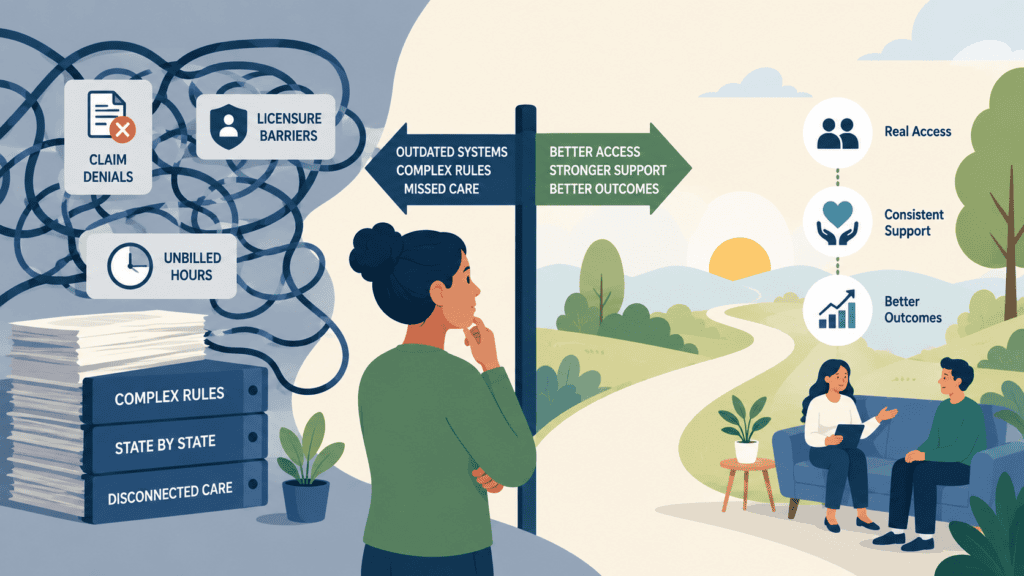
It is limited by infrastructure: payer reimbursement rules, state-by-state licensure, and a lack of support for patients between sessions.
Why do behavioral health claims get denied so much more than medical claims?
Behavioral health claims get denied 19 to 30 percent of the time in network, versus 8 to 12 percent for general medical claims, and 60 to 81.7 percent of those denials get overturned on appeal.
What is the non-reimbursable charting trap in therapy billing?
Standard psychotherapy billing codes only pay for face-to-face time, so therapists absorb 15 to 20 minutes of unpaid documentation work for every billable hour.
Why is a therapist shortage not the full explanation for access problems?
Licensure is state by state, and payers often restrict or lower pay for associate-level clinicians (LMSW, LPC Associate, AMFT) compared to fully licensed ones (LCSW, LPC, LMFT).
What is the 167-hour problem in behavioral health?
It is the 167 hours a week outside the therapy session that go largely unmanaged, driving missed appointments and early dropout.
Which business models are winning in behavioral health right now?
Reimbursed network infrastructure, high-acuity specialty care, and hybrid continuous care are attracting the most capital, while generic cash-pay platforms are losing ground.
Where is AI actually being used in behavioral health today?
Mostly in documentation, intake, and claims support, not in delivering therapy itself.
In the post The Hidden Math of Behavioral Health, a16z shared how behavioral health is limited by infrastructure, not patient demand. People want care. The bottleneck is getting them connected to it, credentialed, billed, and kept in treatment.
That is a fair read. But “infrastructure” is doing a lot of work in that sentence. Most people hear it and picture outdated scheduling software. Old EHRs. Clunky booking pages.
The real infrastructure problem sits one layer down. It is in how payers get paid to say no. It is in how licensure law splits one clinician into a dozen separate legal identities depending on the state. It is in a court system that just made it harder to hold anyone accountable for either of those.
None of that gets solved with a better app.
The demand story is not new
Nobody is arguing behavioral health demand has kept pace with supply. That part of the a16z piece is well known, and it is correct.
What gets skipped over is why the infrastructure keeps buckling even with billions of venture dollars thrown at fixing it. A lot of the friction is the system working exactly as designed, for the side that benefits from it.
Three things explain most of the gap:
- How payers are set up to deny claims first and pay later
- How licensure law fragments supply well beyond a simple shortage
- How patient engagement falls apart in the 167 hours a week nobody bills for
a16z touches on all three. Anyone running a behavioral health practice lives inside them daily.
Payers are built to deny claims
In general medicine, one exam or diagnostic test often covers an entire episode of care. Behavioral health does not get that. Payers require medical necessity justification session by session. A clinically sound note can still get denied because it is missing specific phrasing from a payer’s own internal criteria, criteria the payer does not have to disclose in full.
Then there is the billing structure itself. Individual therapy gets billed under time-based codes: 16 to 37 minutes, 38 to 52 minutes, 53 plus minutes. Payers audit the long code aggressively. Bill it for more than 80 to 90 percent of your sessions and you become a target. Sometimes that means a clawback over one missing timestamp, even when the session happened exactly as billed.
There is also a coding quirk most people outside billing have never heard of. Standard therapy codes only pay for time spent face to face with the patient. Every minute writing the note afterward, reviewing the chart before, updating a treatment plan, coordinating with a school or a psychiatrist: none of that is billable. Medical doctors get to bill “total time,” which folds in prep and documentation. Therapists do not get that option.
So every billable clinical hour comes with 15 to 20 minutes of unpaid work attached. Do the math across a week and a full-time therapist tops out around 25 to 30 billable hours, no matter how fast they write notes.
The denial numbers back this up:
- General medical claims get denied 8 to 12 percent of the time
- Behavioral health claims get denied 19 to 30 percent of the time in network
- Out-of-network behavioral health denials on ACA marketplace plans run above 37 percent
That gap would matter less if the denials held up on review. They do not. Independent appeals overturn behavioral health denials 60 to 81.7 percent of the time. In New York, independent reviewers overturned roughly 60 to 61 percent of the behavioral health denials they looked at.
That overturn rate is the tell. The initial denial is a financial decision wearing a clinical label.
Reworking one denied claim costs a practice somewhere between $25 and $181 in staff time. For a solo clinician, that can eat the entire margin on the session in question, or more. So somewhere between half and two-thirds of denied behavioral health claims never get resubmitted. The payer keeps the money. Not because the care was unwarranted, but because fighting the denial costs almost as much as delivering the care did.
The legal backdrop makes this stick around. Wit v. United Behavioral Health found in 2019 that UBH built its utilization guidelines to favor its own bottom line over accepted clinical standards. A real fiduciary breach, with a court order to reprocess tens of thousands of denied claims. Then, in 2022 and 2023, the Ninth Circuit overturned that remedy. The ruling gave plan administrators wide discretion to interpret their own plan language, and said it was not unreasonable for a payer to skip generally accepted clinical standards unless the contract explicitly required them. Add a 2025 pause on enforcing the newest federal parity rule, and denying first and paying later is not just tolerated. It is protected.
Licensure is bigger than a shortage
The supply story usually gets told as simple math: not enough therapists. True, but incomplete. A lot of usable supply disappears to fragmentation that has nothing to do with headcount.
A clinician has to be licensed in the state where the patient is physically sitting. Not where the clinician lives, not where the platform is based. Licensure is a state power, not a federal one, so scaling telehealth across state lines means tracking separate fees, separate continuing education rules, and board approval timelines that can run 3 to 9 months per state.
Interstate compacts have helped. PSYPACT for psychologists, the Counseling Compact for LPCs, and the Social Work Compact for clinical social workers each now cover 30 to 40-plus states. But a compact only grants legal permission to practice across a state line. It does not grant insurance credentialing in that state. That is a separate process a platform still has to run, state by state, payer by payer.
There is a second layer here that gets almost no attention: licensure tier. A network advertising 30,000 clinicians can be much smaller in practice than it looks on paper. Payers often draw a hard line between fully licensed clinicians (LCSW, LPC, LMFT) and associate or provisional level clinicians working under supervision (LMSW, LPC Associate, AMFT; the exact letters change by state). Some payers will not credential associate-level clinicians at all. Others will, but at a lower rate, or only with extra supervision paperwork attached.
Because the acronyms and the rules shift market to market, this gets missed constantly, by platforms and by patients. It shrinks the real, usable network well below whatever number is on the homepage.
A true count of network capacity has to check five things at once: state, specialty, payer, availability, and licensure tier. Miss one, and the therapist who is technically “in network” is not actually reachable by the person who needs them.
The 167 hour problem
Even when a session gets booked, billed, and paid cleanly, virtual care has mostly solved for the 45 to 60 minutes in the room. It has not solved for the other 167 hours of the patient’s week, the hours where symptoms actually spike, medication gets skipped, and homework goes undone.
Disengagement between sessions drives a lot of the missed appointments and early dropout in this space. Self-guided digital mental health programs show the same pattern over and over: a small slice of users stay engaged, and the rest fall off fast.
This is also where the fully autonomous “AI therapist” bet has mostly failed. A few products built around unsupervised AI delivered therapy have shut down or scaled back. Part of that is reimbursement. There is no clean payment pathway for it. Part of it is risk. An ungated language model can reinforce a delusion or respond badly in a crisis moment, and those are exactly the moments where it matters most.
The AI actually gaining ground here is doing something narrower:
- Ambient documentation that cuts down charting time after a session
- Pre-visit intake and triage before the first appointment
- Automated claim scrubbing that checks for the timestamp and medical necessity language payers demand before a claim goes out
- Ongoing risk monitoring that flags a patient who is slipping, so a human can step in
The models that win, not the companies
It is tempting to point at a few company names and call them the winners. That ages badly. Funding rounds change, and logos come and go. What holds up is the pattern behind each one: the structural bet each model is making about which layer above it is actually solving.
Reimbursed network infrastructure. These are the credentialing, billing, and distribution platforms sitting between independent clinicians and payers. They take a transaction fee or a margin spread instead of employing thousands of clinicians outright. This model is a direct bet against the payer layer and the licensure layer, built to absorb the credentialing and billing work that would otherwise eat a solo clinician’s week. The risk is commoditization. If switching platforms is easy for a clinician, the platform has no real moat left besides distribution.
High acuity specialty pathways. Instead of a general therapist directory, these models build one clinical protocol around one costly, well-defined condition: eating disorders, OCD, opioid use, adolescent crisis care. Payers give better in-network terms here because the untreated version of these conditions is expensive in ER visits and hospital stays. That gives the model real leverage a generalist platform does not have.
Hybrid continuous care. These pair a clinical visit with a daily digital touchpoint: check-ins, mood tracking, FDA-cleared prescription digital therapeutics. The goal is closing the 167-hour gap. Newer CMS billing codes for digital therapeutic interventions have started making this reimbursable instead of just a nice add-on. That is the difference between this model and the wellness app wave before it.
The platforms visibly struggling share one thing in common: generic, cash pay, high cost per acquisition, no clinical specialty, no path to in-network reimbursement. When the underlying economics do not touch any of the three layers above, ad spend and brand awareness do not hold up retention or margin for long.
What the market is already doing
Capital has already moved in the direction the three models above describe.
Funding bounced back in 2026 after several thin years, but unevenly. A small number of large rounds account for most of the money raised, and that money is going to companies solving reimbursement, credentialing, or a single high acuity condition. Generic, cash-pay platforms are losing ground.
Exits look different this year too. Instead of IPOs, bigger platforms are buying smaller ones outright, and the acquisition targets tend to be the reimbursement infrastructure and specialty care companies described above.
AI investment inside the sector follows the same pattern. The dollars are going into documentation, intake, and claims work: the narrow productivity layer, not autonomous therapy delivery. Smaller, undifferentiated players are the ones shutting down or getting quietly absorbed.
Sources
- a16z: The Hidden Math of Behavioral Health
- The Hemingway Report: A Guide to Unit Economics in Mental Health
- blueBriX Health: The Top 10 Reasons Behavioral Health Claims Get Denied in 2026
- KFF: Claims Denials and Appeals in ACA Marketplace Plans in 2024
- MHANYS: Huge Rates of Insurance Denials Get Overturned by Independent Review Experts
- AHA: Payer Denial Tactics, How to Confront a $20 Billion Problem
- Becker’s Payer Issues: Payers’ Prior Authorization Denial Rates Go Public
- PubMed: A Verdict Overturned, Analysis of the Ninth Circuit Wit v. UBH Decision
- Maynard Nexsen: MHPAEA Update, Enforcement of the 2024 Mental Health Parity Final Rule Halted
- Dickinson Wright: Updates to Wit v. United Behavioral Health
- NGA: Understanding Behavioral Health Licensure Compacts
- Wellness Collaborative: Interstate Compacts for Therapists, PSYPACT, Counseling and Social Work
- Swing Care
- Prosperity Behavioral Health: CPT Code 90837 Billing, Documentation, and Audit Guidelines
- PMC: Digital Therapeutics for Mental Health, Is Attrition the Achilles Heel
- Behavioral Health Business: After Years of Stalled Investment, Behavioral Health Startups Are Experiencing a Funding Renaissance
- Behavioral Health Business: Inside the Consolidation Renaissance Across Digital Behavioral Health
- Mertz Taggart: Q1 2026 Behavioral Health M&A Report
- Galen Growth: The American Powerplay, U.S. Digital Health Funding in Q1 2026
- New Market Pitch: Mental Health Startup Funding 2025-2026
- ValueAdd VC: Mental Health Tech in 2026, Where the $5B Market Is Consolidating
- Becker’s Behavioral Health: 15 Behavioral Health Services and Facility Closures in 2026