
The US surveillance state: what’s actually watching you (not another Flock Safety piece)
TL;DR
Is the United States a surveillance state?
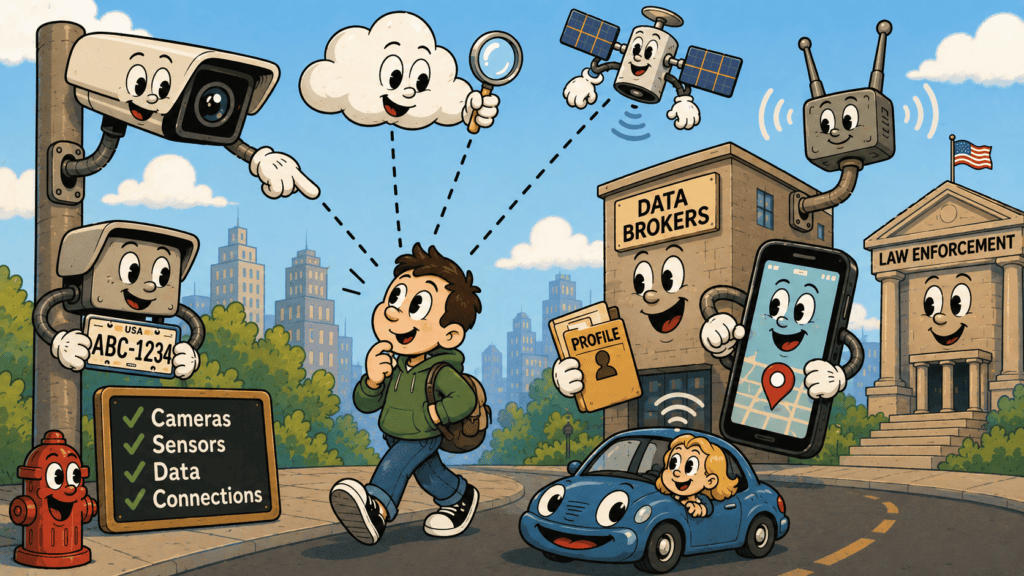
Not in the sense of a single government agency watching everyone, but private cameras, connected cars, and data brokers now feed into networks that police and companies can both query.
How many license plate cameras are there in the US?
Flock Safety, Axon, Motorola Solutions, and Rekor Systems together run more than 100,000 fixed and mobile plate readers across thousands of jurisdictions.
Can police get my Ring or Nest footage without a warrant?
Usually they need a warrant or subpoena, but vendors can hand footage over without one during a genuine emergency involving risk of death or serious injury.
Is my car company selling my driving data?
General Motors was doing this through OnStar until the FTC banned it from selling telematics to consumer reporting agencies for five years, starting in 2026.
What is a Real-Time Crime Center?
It is a control room where police combine live video, license plate reads, gunshot sensors, and drone footage into a single dashboard.
Is my phone secretly listening to my conversations for ads?
No. Advertisers get the same targeting result from location pings, Wi-Fi and Bluetooth proximity, and purchase history, and that approach is cheaper than recording audio.
What did the Chatrie Supreme Court ruling actually change?
It said police need a warrant to pull broad, continuous location history from tech companies, and that is starting to raise questions about how much license plate tracking crosses the same line.
Rockwell asked the question in 1984, in “Somebody’s Watching Me,” with Michael Jackson quietly singing the hook. It’s a paranoid, jittery synth-pop track about feeling watched during the most ordinary parts of the day: taking a shower, watching TV, opening the front door. Forty years later, the paranoia has a real infrastructure behind it. It’s a network of cameras, sensors, and data brokers most people never think about until a plate reader flags their car or a Ring account gets subpoenaed. Real, hyped, or tin foil? Probably some of each, depending on which piece you’re looking at.
Flock Safety gets most of the headlines, and there’s a reason for that. The company built its product around a real problem: a founder’s Atlanta neighborhood went through a string of break-ins, and he wanted a way to help. That origin story is genuine. It’s also a small piece of a much older and much bigger picture. Motorola Solutions has been building surveillance and communications technology since long before 2017. LexisNexis Risk Solutions has been in the data brokering business for decades. GM’s OnStar has logged driver behavior since 1996. Ring and Google’s Nest turned front porches into a camera grid. A longer list of smaller, lesser-known operators- SoundThinking, Kochava, InMarket, Outlogic– quietly move location and behavioral data in the background.
If there’s data tied to you, somebody wants it. The federal government wants it. Companies want it. Good actors want it, and so do bad ones. Is it safe? Is it always used for good? Does it protect you, or does it violate the trust you placed in the product on your porch or the app on your phone? Those are fair questions, and we’re not here to push you toward an answer.
What’s worth understanding is how far this actually reaches, past the startup out of Atlanta that began with a good intention and a real experience. Information is king. What happens to it next depends on who’s holding it.
The plate reader network you’re driving through
Flock Safety is the name most people recognize, but Axon and Motorola Solutions run competing networks of their own. Combined, these companies operate over 100,000 cameras across the country, and they do more than photograph a plate number. The cameras log vehicle color, make, model, direction of travel, and even distinguishing features like a cracked bumper or a roof rack.
Here’s the pipeline once a car passes a camera:
- The camera captures the plate and physical details, tagged with time and location.
- That record lands in a local database, usually held for 21 to 30 days depending on the city’s policy.
- Local databases connect into regional and national search networks, so an agency in one state can query vehicle movement in another.
- Historically, loose administrative settings let out-of-state and federal agencies pull from these local databases without much friction.
That last point is where the lawsuits start. In California, investigations found that police departments running Flock systems were sharing plate data with Immigration and Customs Enforcement and Customs and Border Protection, despite a state law, SB 34, that specifically bars that kind of sharing. Class-action suits followed.
The courts haven’t settled on one answer for how much of this is constitutional. In Schmidt v. City of Norfolk, a federal judge upheld Norfolk’s network of 175 cameras and its 21-day retention window, reasoning that scattered snapshots of a car passing by don’t add up to a full picture of someone’s life. The same ruling included a warning, though: pack in enough cameras, and that reasoning stops holding up.
Separately, the Supreme Court’s Chatrie v. United States decision ruled that broad “geofence” warrants for historical cell phone location data go too far without a warrant. Chatrie was about phones, not plates. But legal scholars expect that as camera density climbs and AI search tools get better at stitching sightings into full travel histories, the two issues collide.
Your doorbell is part of the network too
Ring, Nest, Arlo, Eufy, Blink, and Wyze cameras cover a huge share of American front doors at this point. Nobody installed one to help police build a surveillance grid. People bought them to see who’s on the porch. But add them up across a neighborhood, and you get continuous coverage of sidewalks, driveways, and streets that no single homeowner intended to create.
Law enforcement has three real paths into that footage:
- A warrant or subpoena. This is the standard route, and it usually requires notifying the account holder.
- The exigent emergency exception. Under the Stored Communications Act, a vendor can release footage without a warrant or the owner’s consent if there’s an immediate risk to life.
- Voluntary geofenced requests. Apps like Neighbors let police post a case number and ask everyone within a radius to upload relevant clips. Once someone uploads, that footage sits in a police evidence system indefinitely.
Ring used to run a portal that let police email thousands of camera owners directly within a chosen radius. Public backlash and a wave of scrutiny over the company’s internal data practices ended that setup. What’s left is narrower, but the underlying dynamic hasn’t gone away: private cameras, purchased for personal use, feeding public safety systems through hardware adapters that link residential footage straight into police command platforms.
Your car has been logging every trip you take
Modern cars are rolling sensor arrays. GM’s OnStar and similar systems from other manufacturers record speed, precise GPS position, seatbelt status, hard braking, and acceleration as often as every three seconds.
That data doesn’t stay in the car. It flows to the manufacturer’s cloud, then often gets sold to data brokers like LexisNexis Risk Solutions and Verisk Analytics. Those brokers build “Driving Scores,” algorithmic risk ratings based on speed, braking patterns, and late-night driving. Insurance companies buy those scores and use them to adjust premiums, and drivers frequently never knew the data left their car in the first place.
Regulators noticed:
- The FTC finalized a consent order against GM, citing deceptive enrollment practices that pushed drivers into data collection under the threat of losing vehicle features. GM is now barred from selling geolocation and telematics data to consumer reporting agencies for five years, and must get explicit opt-in consent for 20 years going forward.
- California’s Attorney General and Privacy Protection Agency fined GM $12.75 million, the largest CCPA penalty issued to date, and required deletion of historically retained driving records.
- Texas sued over unlawful collection and sale of driving data belonging to 1.8 million residents; that case is still working through the courts.
- Verisk shut down its driver-scoring product entirely after the backlash.
Cars still collect this data for legitimate reasons: crash detection, emergency services, product diagnostics. The part that’s changed is who else got to buy it.
Real-time crime centers tie it all together
A Real-Time Crime Center is the room where all of this converges. Axon, through its acquisition of a company called Fusus, has built a platform that pulls public traffic cameras, private security footage, license plate reads, acoustic gunshot sensors, and drone feeds into one interface.
Here’s what that looks like in practice. SoundThinking’s ShotSpotter picks up an acoustic signature that matches gunfire and pinpoints the location. That location gets sent automatically to the crime center software, which slews nearby cameras toward the spot, checks license plate readers in the area for vehicles leaving the scene, and can launch a drone to stream live video before officers arrive.
Cities including Chula Vista, Milwaukee, Brookhaven, and Atlanta are running these systems now, and adoption is climbing fast. Response times drop. But civil liberties groups point out something simple: this whole apparatus operates with almost no standard statutory oversight, and by pulling private business and home cameras into the loop through hardware adapters, it erases the line between investigating a specific crime and watching everyone all the time.
No, your phone isn’t listening to your conversations
This one keeps coming up, and it’s worth addressing directly. People notice an ad for something they only just talked about out loud and assume their phone recorded them. It’s a reasonable-sounding theory. It’s also not what’s happening, and the real explanation is arguably more unsettling.
Voice assistants process audio locally, on dedicated low-power chips, continuously overwriting a short buffer until they detect a wake word. Streaming raw audio to ad servers around the clock would show up as obvious battery drain and network traffic, and that signature doesn’t exist on normal phones.
What advertisers actually use is simpler and cheaper:
- Devices broadcast identifiers over Wi-Fi and Bluetooth, so when two people are near each other, their devices register that proximity, and ad systems can infer shared interests without hearing a word.
- Brokers like Kochava, InMarket, and Outlogic combine device identifiers, email hashes, browser fingerprints, and store transaction records to build cross-device profiles that can predict a purchase before you’ve searched for it.
- Location history, app usage, and accelerometer data alone are enough to model behavior with startling accuracy.
Skip the microphone story. The profiling works fine without it.
Where the law actually stands right now
The legal picture is split, and it’s staying split for a while. Courts have generally held that driving on a public road carries no expectation of privacy, which is the reasoning behind rulings like Schmidt. At the same time, Chatrie drew a hard line against warrantless access to continuous digital location history. Washington’s SB 6002 adds statutory audit requirements and retention caps specifically for plate reader data, and other states are watching to see how it holds up.
None of this is settled. As camera density increases and AI tools get better at cross-referencing sightings, the gap between “a discrete public observation” and “a continuous tracking dragnet” keeps shrinking, and courts will have to decide which side of that line the newer systems actually fall on.
The pattern across every domain here is the same. Consumer devices and connected cars generate the raw data. Brokers package and sell it. Public safety platforms pull it into real-time systems. Then courts and legislators try to catch up after the fact. None of the individual pieces required a conspiracy. They just needed a market.
What this means for hiring
We’re not trying to answer questions about who is in the right or wrong here. Instead, our team at STEM Search Group looked at this through the lens where our expertise shines: how does this relate to hiring? This industry keeps generating new hiring problems with limited solutions. A plate recognition vendor needs privacy engineers who understand retention law state by state. An insurer building driving-score models needs data scientists who can defend their methodology to a regulator. A city standing up a real-time crime center needs security and compliance talent who understand both the technology and the statute. Companies across surveillance technology, data privacy, insurtech, and public safety tech are looking to fill exactly these kinds of specialized roles. Even with compounding litigation, this is an industry signaling it will only keep growing.
If you’re a company in that space hiring, and you get the feeling your current recruiting partner hasn’t taken the time to understand what a law like CCPA or the SCA actually means for your business, we’d be happy to talk. We’ll see if we’re the right fit to represent your company to the people capable of filling those unique, hard-to-find/hard-to-fill roles on your team.
And for those looking for a little nostalgia (or others trying to figure out what’s up with the Rockwell 80s reference)…
Sources
- Truthout: SCOTUS ruling could be bad news for Flock, but won’t stop mass surveillance
- MRSC: What to know about the new restrictions on Flock and similar camera systems
- The Record: License plate cameras may be next target after Supreme Court reins in location tracking
- WHRO: A federal judge ruled Norfolk’s Flock surveillance cameras don’t invade people’s privacy, yet
- Flock Safety: Federal court confirms license plate readers are constitutional
- Gibbs Mura Law Group: Flock Safety license plate reader cameras lawsuit
- Flock Safety: What the Supreme Court’s Chatrie decision means for ALPR technology
- Biometric Update: Ring’s partnership with Flock raises privacy alarms
- Ifrah Law: Ding dong, the police want access to your doorbell footage, can they get it?
- EFF: Victory, Ring announces it will no longer facilitate police requests for footage from users
- Ring: Learn about Ring law enforcement guidelines
- CNET: Ring, Google and the police, what to know about emergency requests for video footage
- Police1: Axon rolls out new ALPR cameras, Ring integration to boost real-time policing
- Reddit r/tampa: Drop Ring doorbells and cameras immediately
- WardsAuto: FTC announces proposed settlement with GM for selling connected vehicle data
- CodaMail: Vehicle and driving data brokers
- CarBuzz: GM’s data privacy scandal shows why your driving data became so valuable
- FTC: General Motors LLC, final complaint
- Michigan Public: General Motors agrees to not sell driver behavior data for five years in settlement with FTC
- IAPP: California authorities announce largest CCPA fine to date
- ACLU of Wisconsin: Comments to the Public Safety and Health Committee
- GACP: Five major developments in US law enforcement to watch
- StateScoop: Police real-time crime centers are becoming data powerhouses
- Maryville Residents for Privacy: Who is Axon, and why public oversight matters
- Axon: How Cobb County PD tracked the Midtown shooter
- SoundThinking: Company overview
- PR Newswire: Axon reports Q2 2026 revenue of $904 million, up 35% year over year
- Chula Vista: Approve a Master Services and Purchasing Agreement with Axon Enterprise for Fusus
- SoundThinking: Evaluating gunshot detection technology impact requires the right measures
- Axon Investor Relations: Axon reports Q2 2026 revenue of $904 million, up 35% year over year
- Attorney Michael Benavides: The litigation landscape, what has been filed, what has won, and what has failed