
It’s not 2008, fellow Gen X, Xennials, and Millennials, but Myspace wants to have its own Cobra Kai moment
TL;DR
What was Myspace?
Myspace was the social network that launched in 2003, let users trash their own profile with homemade HTML and autoplaying music, and became the biggest site in America before Facebook showed up.
When did Facebook pass Myspace?
Facebook passed Myspace in worldwide visitors in April 2008, then in the US a year later, and never looked back.
Why did Facebook beat Myspace?
Facebook was clean, stable, and built around real names and real friend groups. Myspace was a glitter bomb held together with duct tape and ad revenue targets.
Why did Myspace disappear?
A 2019 server migration wiped out over a decade of uploaded photos and songs, and by 2024 the site was a ghost town you could still technically visit.
What happened to Tom Anderson?
Tom, everyone’s automatic first friend, took his News Corp payout, quit tech entirely, and became a full-time photographer.
What happened to the other Myspace founders?
Most stayed in tech and started new companies; Chris DeWolfe went into mobile gaming, Josh Berman into e-commerce and venture capital, Aber Whitcomb into AI, and a couple of them all but vanished from public life entirely.
Who actually owns Myspace now?
Brothers Tim and Chris Vanderhook, ad tech guys who bought it for pocket change in 2011 and have refused to let go of it through four separate corporate ownership changes.
Is Myspace actually coming back?
The Vanderhooks say yes, pitched as the anti-algorithm cure for TikTok fatigue, though their last comeback attempt cost them over 150 million dollars.
Once upon a time, your Top 8 was a public referendum on your friendships
Myspace launched in August 2003. Chris DeWolfe, Tom Anderson, Josh Berman, CTO Aber Whitcomb, technical architect Toan Nguyen, and corporate development lead Colin Digiaro built it inside eUniverse, a marketing company run by a guy named Brad Greenspan. A seventh name, Jon Hart, is also credited as a co-founder on Myspace’s own Wikipedia page. They wrote the entire first version in ColdFusion in about ten days flat, which tells you everything about the priorities. Ship it now, deal with the consequences later.
The consequences showed up eventually, but first, the glow up. eUniverse had 20 million email addresses sitting around, so Myspace hit a million monthly visitors by mid 2004 and 20 million registered users a year after that. Profiles were a free-for-all: anyone could paste in raw HTML and CSS, which is how we ended up with a decade of blinking text, cursor trails, backgrounds that looked like a screensaver had a mental breakdown, and songs that started playing before the page even finished loading.
Bands were obsessed with it. No label, no gatekeepers, just a Myspace page and a fan base that would find you.
In 2005, Rupert Murdoch’s News Corp bought Myspace’s parent company for 580 million dollars, which at the time seemed like either genius or lunacy depending on who you asked. By June 2006, Myspace had passed Google Search and Yahoo Mail to become the most visited site in the country. Google backed up a truck full of money in the form of a 900 million dollar ad deal that August. By the end of 2008, Myspace had 115 million monthly visitors and 800 million dollars a year in revenue. Yahoo merger talks in 2007 had already floated a 12 billion dollar valuation.
- Founded: August 2003
- Peak traffic: 115 million monthly visitors (2008)
- Peak valuation: 12 billion dollars (2007 Yahoo talks)
For a hot minute, Myspace basically was the internet.
And it actually did some good, before it all fell apart
Before we get to the part where everything goes wrong, it is worth remembering Myspace was not just a glitter covered ghost town. It genuinely changed how people found music, and for a few years it did it better than the actual music industry.
In September 2004, R.E.M. streamed their new album in full on Myspace, weeks before it hit stores. Fans could log in and listen for free before anyone else on earth had access to it. That single move helped convince people Myspace was a serious music platform and not just a Friendster clone with better wallpaper.
Arctic Monkeys got signed after fans, not the band, uploaded their demos to Myspace, and the buzz reached Domino Recording Company, who signed them in 2005. Calvin Harris got discovered the same way: a demo made the rounds on the site, his future manager heard it, and that was that. Panic! At the Disco built a cult following on Myspace before their debut album even came out.
Myspace even started its own record label. MySpace Records, a joint venture with Interscope, put out compilations and signed acts like Hollywood Undead, Pennywise, and Christina Milian. It was part legitimate talent pipeline, part victory lap for a website proving it belonged on the same shelf as a real label.
None of that saved it later. But for a few years, an unsigned band with a Myspace page and a decent song had a real shot at getting heard, which is more than most platforms before or since can say.
Then Facebook showed up
Facebook passed Myspace in worldwide unique visitors in April 2008, then took the US market a year after that. It was not one single mistake. It was a pile of them.
Start with the code. Myspace got built fast in ColdFusion, patched later with a Microsoft .NET transplant, and shipped straight to production with no staging environment, basically performing surgery on a patient who was still awake and walking around. Facebook built its own scaling tools and actually reviewed code before it went live, a wild concept apparently.
Then there is the vibe. Myspace let every single user turn their profile into a chaotic mess of auto playing music and eye searing color combinations. Facebook forced everyone into the same plain blue and white box: no CSS, no customization, a feed that loaded fast and looked identical no matter whose page you were on. Boring wins. Boring always wins.
Identity sealed the deal. Myspace ran on usernames, fan pages, and loose ties built around bands and shared interests. Facebook demanded real names and started with .edu emails only, which meant it mirrored the actual friend groups people already had. That is a much stickier product than “people who also like this one band.”
News Corp piled on by chasing ad dollars over product fixes. Engineers pitched redesigns, leadership killed them to protect short term ad numbers, and the site kept getting worse while Facebook quietly kept growing.
Why Myspace basically vanished
News Corp finally cut its losses and sold Myspace to Specific Media and Justin Timberlake for 35 million dollars in 2011, a brutal write down from the 580 million they paid six years earlier. The new owners tried repositioning it as a music discovery hub, then watched it get passed around like a hot potato through Time Inc and Meredith Corporation.
The real death blow came in March 2019. A server migration error permanently destroyed everything users had uploaded between 2003 and 2015: an estimated 50 million songs from 14 million artists, plus every photo, blog post, and glitter covered layout anyone had ever made. By January 2024, the site had shrunk to a static, read only archive. No posting, no messaging, no way to relive your Top 8 drama even if you wanted to.
Whatever happened to Tom, everyone’s first friend
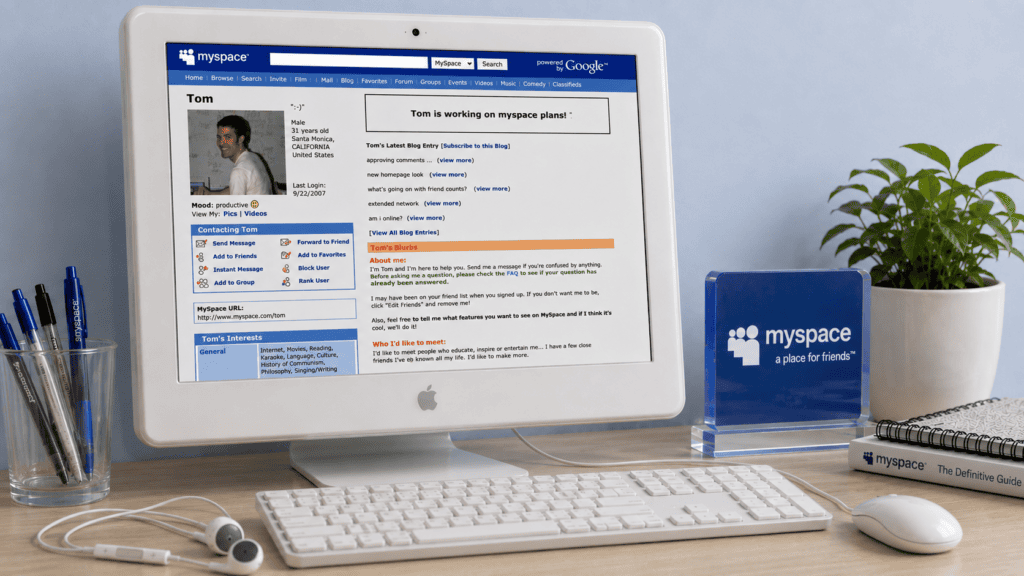
Every single person who signed up for Myspace got Tom Anderson slapped onto their friends list automatically, no consent required. His grinning profile photo, taken in front of a whiteboard in 2003, ended up as one of the most viewed images in early internet history purely by default setting.
Tom was President alongside CEO Chris DeWolfe until 2009. When News Corp bought the company in 2005, he reportedly walked away with about 50 million dollars. Then, once he left in 2009, he did something almost nobody in tech does. He actually left.
No board seats. No venture fund. No think pieces. He bought property in Hawaii and California and became a landscape and architectural photographer, and he has spent the last decade and a half just traveling and taking pictures. It is the cleanest exit in tech history, and it kept him far away from every controversy that later swallowed up the rest of the social media founder class.
The rest of the founding crew, and where they landed
Tom gets all the attention because of the automatic friendship, but Myspace had a whole roster of people behind it. Here is the group photo nobody kept.
- Chris DeWolfe, the CEO who ran product alongside Tom, stepped down in 2009 and stayed in tech. He went on to co-found mobile gaming giant Jam City, and in 2023 launched Plai Labs, a metaverse gaming company. He also showed up in the 2026 Myspace documentary, still talking about user experience like a man who never stopped thinking about it.
- Josh Berman, Myspace’s original chief operating officer, kept founding things. He co-founded e-commerce company BeachMint, which later merged into Condé Nast’s Lucky Group, then moved into venture capital as a general partner at Troy Capital, and co-founded fintech company Quid on the side. The most active serial founder of the bunch, by a wide margin.
- Aber Whitcomb, the original CTO, has had maybe the wildest second act of anyone on this list. He went on to co-found mobile game studio Jam City, then blockchain and AI infrastructure company Core Scientific, and is currently CEO of an AI startup called Salt AI. He also personally owns Victoria, the world’s second most complete Tyrannosaurus rex skeleton, which is a sentence we did not expect to type while writing about a website with auto playing music.
- Toan Nguyen, the technical architect who got Myspace’s backend to actually hold up under 20 million users, has kept the lowest profile of the group. He does not appear to be doing regular interviews or building headline grabbing startups, and honestly, good for him.
- Brad Greenspan, the eUniverse founder who bankrolled the whole operation and made the call to make Myspace free, did not get to enjoy the big payday. He left the company amid an accounting scandal before the News Corp sale, then spent years publicly disputing the deal and pushing regulators to investigate it. These days he runs an AI company called LiveVideo.AI.
- Colin Digiaro, who ran international corporate development for Myspace, left in 2008 to launch Slingshot Labs, an internet incubator for News Corp, and later co-founded Jam City alongside DeWolfe and Whitcomb.
- Jon Hart, credited on Myspace’s own Wikipedia page as a co-founder alongside DeWolfe and Anderson, is by far the biggest mystery of the group. Outside of the founding credit itself, there is barely a public trail to follow. If Jon Hart is reading this: we have questions.
Meet the Vanderhook brothers, the ad tech guys who refuse to let Myspace die
Here is the part most people miss: Myspace is not owned by some random private equity shop that stumbled into it. It is owned by Tim and Chris Vanderhook, two brothers who have been quietly running the show since 2011 and have somehow survived every corporate reshuffle the company has been dragged through since.
The brothers built their careers in advertising technology, not social media. They co-founded Viant Technology, a programmatic advertising platform, and later co-founded XUMO, a free streaming TV service that Comcast bought in 2020. In 2011, through their company Specific Media, they bought Myspace and Justin Timberlake for 35 million dollars, which is less than what some influencers make in a year now.
What makes the Vanderhooks weirdly fascinating is how long they have held on. Myspace got shuffled from Specific Media to Time Inc in 2016, then to Meredith Corporation in 2018, and the Vanderhooks eventually bought it right back under Viant Technology in 2019. Ownership structure changed four separate times and the two brothers never actually let go of it once. Tim took Viant public on the Nasdaq in 2021, and he still chairs the board with Chris sitting alongside him.
In Tommy Avalone’s Myspace documentary, the brothers put it plainly: they see themselves as long term stewards of the brand, waiting for the right moment to bring it back, and if the first attempt flops, they will just try again. That is either admirable persistence or a sunk cost fallacy wearing a really nostalgic hat. Possibly both.
Also, worth noting: even the outlets covering this cannot agree whether it is Myspace, MySpace, or the site’s own current lowercase “myspace.” Officially it has been all three at different points, sometimes in the same article. Which honestly checks out. A platform built on clashing fonts, auto playing music, and zero design standards would eventually produce a name nobody can format consistently either. If the big relaunch fixes nothing else, here’s hoping it at least settles on a spelling.
So is a comeback actually happening
According to the Vanderhooks, yes. Interest resurfaced after Tommy Avalone’s documentary, where the brothers confirmed they are actively planning a relaunch and are simply waiting for the right market moment.
The pitch is Myspace as the cure for algorithm fatigue: no TikTok-style feed deciding what you watch next, just chronological posts and profile customization, aimed at people exhausted by being told what to like. The Vanderhooks already tried this once, in 2013, and lost more than 150 million dollars doing it, mostly because advertisers had already fled to Facebook and Google and never came back. Analysts remain skeptical this round goes any better, since people claim they want less algorithm while behaving exactly like people who want more of it.
Or will it just be a “how do you do, fellow kids” situation
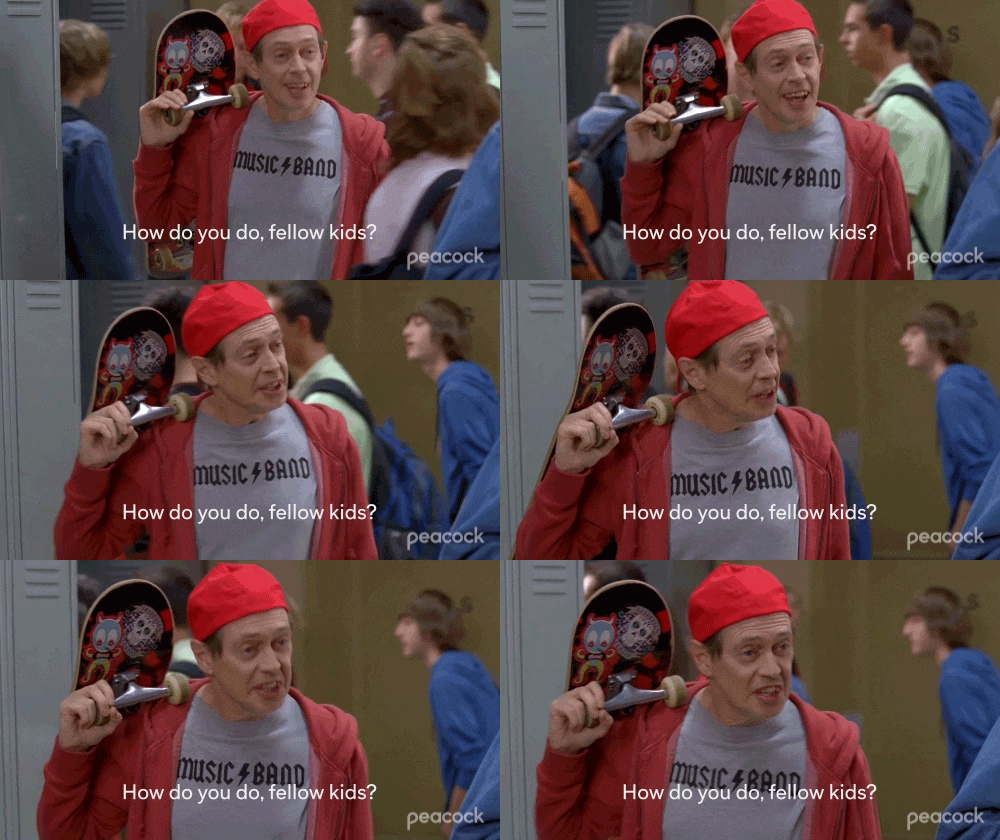
You know the scene even if you have never watched a single episode of 30 Rock. Steve Buscemi, backwards red cap, skateboard tucked under one arm, playing an undercover cop pretending to be a high schooler, walks up to a group of actual teenagers and says “how do you do, fellow kids?” It is the single greatest visual metaphor ever produced for an adult desperately trying to seem cool to people who are not fooled for one second.
That is basically the entire modern Myspace relaunch pitch. An aging platform, run by ad tech guys in their fifties, telling Gen Z it has the cure for their app fatigue. Maybe it works. Maybe it gets escorted out of the cafeteria. Either way, we will be watching, mostly out of morbid curiosity and a little bit of love for our old Top 8.
Sources
- The History of Domain Names: Myspace
- Failory: What Happened to MySpace After Losing to Facebook?
- YouTube: The Rise and Fall of Myspace: How Facebook Took Over
- Wikipedia: Myspace
- EBSCO Research Starters: Myspace
- Ultimate Pop Culture Wiki: Myspace
- DEV Community: The rise and fall of MySpace
- Cultural History of the Internet: The Creation, Rise, and Fall of Myspace
- ENEB: What can we learn from MySpace’s strategic failure?
- Cornell Blogs: The Science Behind Social Networking And Why MySpace Lost To Facebook
- Reddit r/business: Why did Facebook succeed and MySpace fail?
- High Scalability: Did the Microsoft Stack Kill MySpace?
- Britannica: Myspace
- Briefs: Myspace Plans a Relaunch Betting on App Fatigue
- Reddit r/BeAmazed: Tom Anderson Sold Myspace to Pursue Photography
- Medium: How Bad Code and Product Flaws Killed Myspace
- WhatJobs: Myspace Owners Tease Relaunch Amid Social Media Fatigue
- TechSpot: MySpace owners confirm they are planning another comeback
- The FPS Review: MySpace Is Getting a New Documentary
- Wikipedia: Timeline of social media
- Tubefilter: MySpace’s owners want to bring it back
- Reddit r/InternetIsBeautiful: Recovered Myspace music tracks database
- Digital Today: Myspace mulls relaunch as social media fatigue grows
- Exclaim!: Hot Docs 2026 ‘Myspace’ Review
- Medium: The Evolution of MySpace: From Peak to Downfall
- Reddit r/technology: Myspace eyes comeback as an antidote to social media fatigue
- Indian Express: MySpace eyes return
- Viant Technology: Tim Vanderhook bio
- EverybodyWiki: Viant Technology
- Euronews: MySpace comeback? Owners drop a major hint
- Deadline: MySpace Co-Founder Chris DeWolfe Misses Serendipity Of Social Media
- dot.LA: The MySpace Founders on Past, Present and Future of LA Tech
- Medium: About Aber Whitcomb
- Wikipedia: Aber Whitcomb
- Medium: MySpace Co-Founder Josh Berman interview
- Wikipedia: Colin Digiaro
- Wikipedia: Brad Greenspan
- EBSCO Research Starters: Brad Greenspan
- Irish Star: What Myspace founder Tom Anderson is up to now
- Who Owns MySpace? Viant Technology, Full History