
AI battle lines are being drawn: what’s next for deep tech
TL;DR
What is Pax Silica?
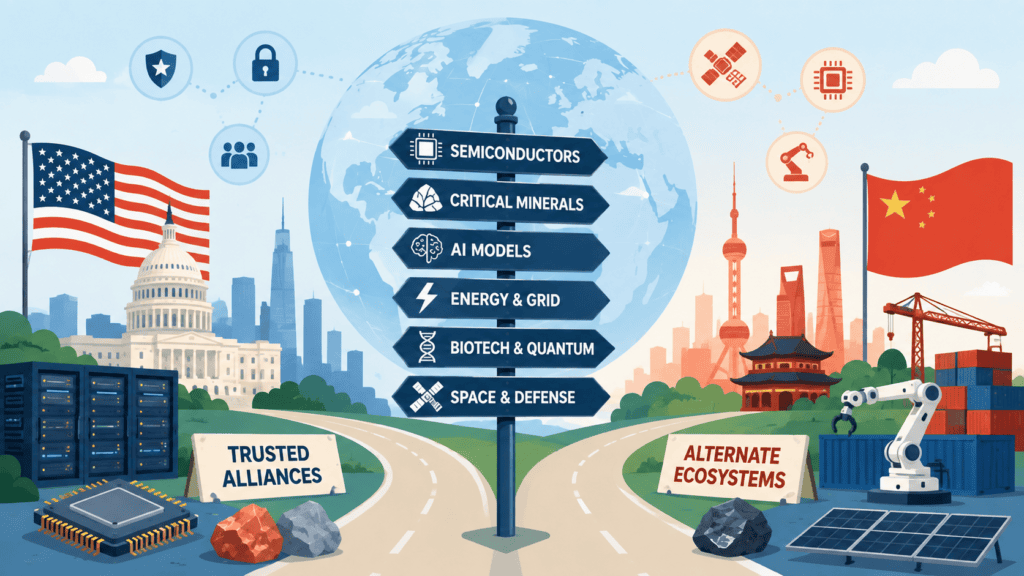
Pax Silica is a US State Department initiative launched in December 2025 to organize allied nations around secure supply chains for computer hardware, microchips, and critical minerals needed to build artificial intelligence. It now counts 24 signatory nations.
Is the US forcing allies to pick a side between America and China on AI?
Yes. A draft State Department diplomatic message sent to 35 partner nations states that countries cannot sign the Pax Silica Declaration while also joining China’s competing coalition. Dual membership disqualifies a country from accessing advanced American chips and capital.
What is China’s response to Pax Silica?
China launched the World Artificial Intelligence Cooperation Organization (WAICO) in July 2026. Headquarters are based in Shanghai, and it focuses on giving away free, customizable AI models running on domestic Chinese hardware instead of American microchips.
Is this conflict only about AI software?
No. The same competition is spreading across computer chips, rare earth minerals, quantum computing, biotechnology, and satellite networks. It affects any essential technology where a government can control access.
Why is the US government stepping directly into private industry?
Physical supply limits, not software design, are now the main bottleneck for AI progress. While data centers take 12 to 18 months to build, getting them connected to the power grid can take five to seven years. Washington invoked emergency powers under the Defense Production Act (DPA) to speed up energy and grid construction.
How does this affect venture capital and private equity investment?
US fund managers now face direct legal responsibility if they invest in restricted Chinese tech companies. Because of these rules, capital is moving away from basic software apps and flowing into physical hardware, energy projects, and defense technology.
Could this geopolitical rivalry expand beyond artificial intelligence?
Yes. Government restrictions already affect biotechnology, rare earth mineral refining, and space infrastructure. Each of these fields faces similar rules aimed at protecting national security.
The Pax Silica ultimatum, explained
In December 2025, the US State Department launched Pax Silica, an economic policy aimed at protecting the hardware, minerals, and computing power required for advanced artificial intelligence. Led by Under Secretary Jacob Helberg, the framework relies on a realistic premise: since no country can produce every part of the technology chain alone, governments should control the key bottlenecks where regulations can be enforced. Those key areas include critical mineral refining, semiconductor design, and frontier model deployment.
By mid-2026, 24 nations had signed Pax Silica, including Japan, South Korea, the UK, the Netherlands, Australia, Israel, and several Gulf states. In August 2026, Reuters reported on a leaked State Department cable sent to 35 countries that had signed a June “AI Opportunity Statement,” making the American stance clearer: “To be part of everything is to be part of nothing.”
The message left little room for doubt. Signing Pax Silica requires full commitment, not a loose partnership. Countries trying to balance relationships between Washington and China, such as Kazakhstan with its massive rare earth mineral reserves, are being told that double-hedging will no longer work. US officials argue that a country cannot be a trusted partner in one technology system while joining a competing group designed to rival it.
This stance creates a difficult choice for Europe. The European Union (EU) has long promoted “strategic autonomy” as a way to avoid choosing between Washington and Beijing. An ultimatum with no room for negotiation forces European policymakers into the exact dilemma they sought to avoid.
Why Washington is pushing now: the technical gap is closing
Timing plays a key role in this pressure. For years, the main reason to stay inside the American tech system was simple: American companies built the best models, plain and simple. Today, that gap is shrinking.
In June 2026, Chinese startup Z.ai released GLM-5.2, a publicly available model that reached the top of global open-model performance rankings on Artificial Analysis’s Intelligence Index. On benchmark tests like GDPval-AA v2, which measures real-world workplace tasks like programming and analysis, GLM-5.2 performed at levels close to leading American proprietary systems like OpenAI‘s GPT-5.5. Crucially, Chinese engineers trained the model using roughly 100,000 domestic Huawei Ascend 910B chips without relying on restricted Western hardware. It also costs a fraction of what top US models charge for data processing.
Because GLM-5.2 was released under an unrestricted MIT license, developing nations now have a cheap, functional alternative to American technology. Pax Silica is structured to counter this trend. When a country’s raw technical lead narrows, restricting access becomes the primary tool to maintain influence. However, critics like Meta‘s Mark Zuckerberg note that blocking access to rival models often speeds up foreign adoption of alternative open systems rather than preserving a lead.
China launched the World Artificial Intelligence Cooperation Organization (WAICO) in July 2026 as an open, alternative network to Pax Silica. Beijing is now considering export restrictions on its own top models, demonstrating the leverage Chinese policymakers believe they hold.
The physical bottleneck: why governments are funding factories
Beyond diplomacy, the main limit on AI growth today is physical infrastructure: concrete, copper, and electrical power. A company can build a modern hyperscale data center building in 12 to 18 months, but connecting that facility to a local power grid can take five to seven years through normal utility interconnection queues. Dozens of major data center projects were delayed or canceled between 2024 and 2025 for this exact reason.
To address the shortage, the executive branch used Section 303 of Title III of the Defense Production Act (DPA), legally classifying large energy projects and power grids as vital to national defense. Through five Presidential Determinations under DPA Title III in April 2026, the US Department of Energy gained direct authority to grant loans, commit to purchasing supplies, and speed up permits across transformers, transmission lines, power plants, natural gas logistics, and coal supply chains.
This policy follows historic models. During World War II, the federal government’s Defense Plant Corporation funded over 80 percent of new US factory construction, spending $38 billion ($700 billion in today’s dollars) while maintaining ownership of synthetic rubber, aircraft, and magnesium production facilities. After the war, those plants were sold to private businesses at a discount, sparking decades of post-war growth. In the late 1980s, the US government used similar methods to found SEMATECH, a public-private semiconductor partnership created to counter Japan’s manufacturing dominance.
A modern example is the US Department of Defense (DoD) investment in MP Materials. The government took a 15 percent equity position and set a ten-year guaranteed price floor of $110 per kilogram for rare earth output, well above spot market prices. That price floor protects the domestic refiner from being undercut by state-subsidized foreign competitors. Government purchase guarantees and equity stakes are becoming standard tools to fund heavy infrastructure projects that private investors view as too risky to build quickly on their own.
Capital is changing shape, and so is risk
For venture capital and private equity firms, the era of easy, software-only investing is shifting. Under the US Department of the Treasury‘s Outbound Investment Rule, which implements Executive Order 14105, American fund managers, general partners, and limited partners face personal legal liability if their money funds Chinese semiconductor, quantum, or AI companies. Because there is no advance government clearance process, firms must build their own technical diligence capability to trace beneficial ownership and computing limits before signing a term sheet.
The threshold that matters most applies to high-capacity AI models: US investors are barred from funding general-purpose models trained above roughly 10 septillion computing operations, a staggering computing workload that requires tens of thousands of top-tier chips running continuously for months, if those systems belong to a country of concern. Smaller models trained below that scale, down to 100 sextillion operations, require formal notification to the US government rather than an outright ban.
Consequently, investment theses are pivoting heavily toward physical infrastructure. Site selection software, small modular reactors, high-voltage transformers, liquid cooling systems, grid orchestration software, and mineral recycling now receive funding that once went to standard software plays. Sovereign wealth funds from Pax Silica partner nations, including Qatar, the UAE, and South Korea, frequently lead investment rounds in dual-use sectors like defense robotics and autonomous edge computing. Some venture capital firms are even splitting into separate regional entities so their capital pools isolate compliance exposure.
What this means for tech companies
Frontier AI laboratories like OpenAI and Anthropic now function as dual-use national security assets whether they choose that role or not. Advanced models trained above specified computing thresholds require mandatory state notification and safety audits, and deployment into non-aligned markets is increasingly off the table.
Chipmakers face similar reshaping. NVIDIA builds hardware-level export controls directly into products intended for non-aligned markets, while TSMC faces pressure to expand onshore fabrication inside the US even where it increases exposure to the exact geopolitical chokepoints the policy is meant to protect against.
SpaceX offers the clearest example of how this plays out in practice. Starlink was launched as a commercial satellite internet service, but its role in the Russia-Ukraine war showed how fast commercial technology becomes critical defense infrastructure. When Ukraine requested Starlink coverage extended into Crimea to support offensive strikes, SpaceX declined, citing sanctions compliance rules.
Rather than nationalizing the company, the government and SpaceX established structural separation through a dedicated division called Starshield. Starshield operates as a dedicated defense-grade satellite architecture with government-controlled user access under US Space Force contracts worth roughly $900 million, while standard Starlink service continues to serve commercial users separately.
Beyond AI: minerals, biotech, and quantum are all in play
National security rules are expanding well past artificial intelligence into other critical industries.
China controls roughly 98 percent of the world’s refined gallium supply and 60 to 70 percent of germanium, two metals essential for power electronics, radar, and fiber optics. This market concentration represents a single point of failure that Pax Silica and DPA Title III investments aim to fix through domestic price floors and processing investments.
In biotechnology, the BIOSECURE Act, enacted as part of the FY26 National Defense Authorization Act (NDAA) in December 2025, bars federal agencies and grant recipients from contracting with designated Biotechnology Companies of Concern. WuXi AppTec was added to the US Department of War‘s Section 1260H list in mid-2026, though a federal court granted a preliminary injunction against enforcement in August 2026 while the case is reviewed.
Quantum computing receives the strictest treatment of all. Under the Outbound Investment Rule, there is no notification tier for quantum hardware headed to a country of concern. American funds face a flat prohibition, reflecting how seriously policymakers take the threat quantum computing poses to existing cryptography.
How far this could realistically go
Pulling these threads together reveals three broad potential paths. None are mutually exclusive, and pieces of all three are already visible today:
- A permanent split into two technology zones: The US-led bloc runs on proprietary frontier models and allied hardware. The China-led bloc expands across non-aligned nations using cheap, open-weight models like GLM-5.2 running on domestic silicon. Multinational companies end up maintaining two separate technology stacks just to operate in both worlds, raising costs and generally slowing global software deployment.
- Long-term government funding for basic industry: If hyperscaler capital expenditure keeps running into energy shortages and grid permitting limits, temporary emergency measures like Defense Production Act interventions could become permanent fixtures. Government-owned, contractor-operated structures might extend into national compute centers and rare mineral refineries on a lasting basis.
- Split global investment markets: Outbound investment restrictions are pushing US funds and non-US funds to build separate legal entities with isolated capital pools. Over time, sovereign wealth funds in the Gulf and East Asia could become the primary backers of non-US tech development, while US-based funds align almost entirely with domestic industrial priorities. Cross-border venture deals between the two blocs would trend toward zero.
Regardless of which path dominates, the underlying shift looks durable. Technology policy has moved from something governments occasionally nudged to something they actively design, blurring the line between a private company’s balance sheet and a country’s industrial strategy.
STEM Search Group follows stories like this closely, not to react to a single headline, but because a policy shift this size rarely stays contained to the sector it starts in. A cable from the State Department, a Presidential Determination, or a new outbound investment rule tends to ripple outward in ways that are not obvious on the day they are announced, and connecting those dots early is worth more than reading the news after the fact. STEM Search Group keeps watching this space because deep tech rarely moves in a straight line, and the more interesting question is almost never what happened; it is why, and what it sets up next.
Sources
- The US is about to make its allies pick a side in the AI cold war – The Next Web
- Pax Silica – Wikipedia
- From Pax Americana to Pax Silica – WITA
- US to tell partners they must pick sides in AI race with China – CNA
- President Issues Defense Production Act Determinations Targeting U.S. Energy Sector – Pillsbury Law
- Treasury Issues Final Regulations Prohibiting Certain US Investment in Chinese Technology Companies – Akin Gump
- How China’s Visible Hand Led to America’s Invisible Capacity – Michael McNair, Medium
- BIOSECURE Act Enacted – Ropes & Gray
- Starshield – SpaceX
- Starlink in the Russo-Ukrainian war – Wikipedia
- Roadmap: The AI data center stack – Bessemer Venture Partners
- Competing for AI influence: China, the US & the middle powers – EU Tech Loop
- To watch an in-depth video report on how China officially established WAICO in Shanghai to challenge Western AI supply chains, see China proposes a new era in global AI governance with WAICO. This clip provides a clear visual breakdown of the Shanghai signing ceremony and Beijing’s strategic goals for open-source AI in the Global South.