
Who actually owns the AI stack, and where does the consolidation end
TL;DR
What’s actually happening in AI right now?
A small group of companies, mostly the biggest AI labs and chipmakers, are buying and building their way into chip design, energy, and cooling businesses that used to belong to separate specialists.
Why is this happening now?
Training and running frontier AI depends on a handful of physical bottlenecks, like chip packaging and power supply, that move too slowly for companies to just wait on, so they are buying direct control instead.
Should every AI company try to own its entire supply chain?
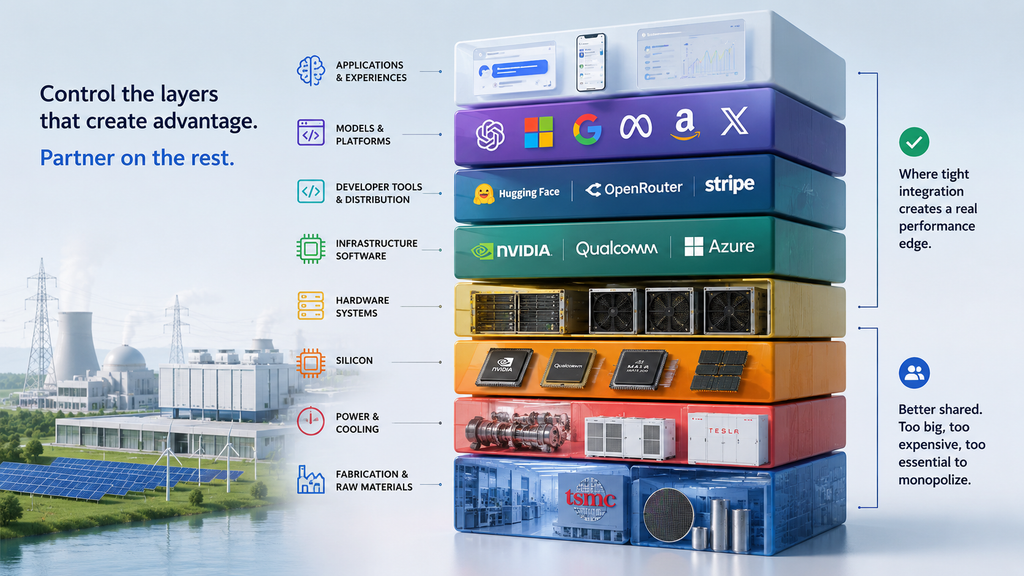
No. Owning a layer pays off when tight coordination between hardware and software creates a real performance edge, but it backfires for capital-heavy layers like chip fabrication, which work better shared across the industry.
Is frontier AI knowledge really concentrated in a handful of companies?
Yes, and unevenly. Published research stays public, but the operational know-how and hardware design details that actually make frontier systems work are visible only inside a small number of firms.
Is xAI still called xAI?
No. SpaceX acquired xAI in February 2026, and the combined AI division was formally renamed SpaceXAI in July 2026.
Are all these acquisitions you’ll read about already final?
Not most of them. Nvidia’s reported $12.9 billion purchase of Hugging Face is still unconfirmed and unsigned as of this writing, and SLB’s signed deal for the cooling company Kelvion is not expected to close until the first half of 2027.
Why everyone wants to own more of the stack
AI used to run through separate layers built by separate companies. Utilities generated power. Foundries fabricated chips. Cloud providers rented out compute. Labs trained models. Software companies shipped the applications people actually used.
That separation is breaking down. OpenAI, Microsoft, Google, Meta, Amazon, and SpaceXAI are all pushing into hardware and energy layers they used to treat as someone else’s job. Microsoft’s Maia 200 chip runs on a 3nm TSMC node with 216GB of HBM3e memory, built specifically to cut per-token inference costs across Azure. SpaceXAI’s Memphis Colossus cluster, which started at 200,000 Nvidia H100 chips with a stated path toward 1 million, runs on 35 on-site natural gas turbines and roughly $295 million in Tesla battery storage rather than waiting on a regional utility.
At the same time, chip and hardware companies are pushing up into software and distribution. Nvidia has reportedly agreed to buy Hugging Face for $12.9 billion, though the deal is not yet confirmed or signed. Qualcomm closed its $4.0 billion purchase of Modular AI to bring the Mojo language and MAX compiler into its own chip ecosystem. Stripe has agreed to acquire OpenRouter, the platform that routes AI traffic across hundreds of models, for more than $7 billion, giving Stripe a cut of the usage fees running through every model call it processes.
Everyone is trying to own more of the chain at once. The harder question is whether that is actually the right move for every layer, or only for some of them.
Which layers make sense to own, and which do not
Not every part of the AI stack behaves the same way, and the difference tells you exactly who should own what.
Some layers show clear technical payoff when one company controls both sides. Custom inference chips paired directly with the compiler software that runs on them improve performance per watt in ways a general-purpose GPU cannot match. Server racks designed alongside their own liquid cooling loops cut the risk of thermal throttling in high-density facilities. Developer tools built directly on top of a company’s own model APIs ship faster and generate usage data the company can act on immediately.
Other layers work better left alone as neutral, shared infrastructure, specifically because they are too capital-intensive or too broadly useful for any single company to own without distorting the market for everyone else.
- Leading-edge chip fabrication. An advanced semiconductor fab costs more than $20 billion to build. Spreading that cost across the entire industry, the way TSMC does, keeps manufacturing economical for every customer instead of just one.
- Baseload nuclear power. Long-term power purchase agreements let a tech company lock in clean energy without taking on the regulatory exposure and commodity risk of owning a power plant outright.
- Payment and billing rails. A neutral processor that does not favor one AI provider over another keeps the transaction layer usable for the whole market, the same logic that makes Stripe’s infrastructure valuable in the first place.
The pattern is simple even if the incentives are not. Own the layers where tight coordination creates a real performance edge. Leave the capital-heavy, broadly useful layers to specialists, or the whole industry ends up paying for duplicated infrastructure nobody needed built five times over.
The knowledge nobody outside a handful of companies can see
Chip and cooling deals get headlines because they involve real dollar figures. The part of this consolidation that matters more, and gets talked about less, is which kinds of knowledge are still public and which are not.
Published scientific theory, the papers on arXiv and at academic conferences, stays open to anyone. Below that, things narrow fast.
- Engineering recipes, the practical know-how for actually training and deploying models at scale, live mostly in system cards and blog posts from a small number of frontier labs.
- Operational telemetry, the data on how large training and inference clusters actually behave under load, stays inside private corporate documentation, visible only to major hyperscalers and cluster operators.
- Hardware co-design details are close to invisible outside the companies involved. Microsoft has said its Maia 200 chip specs, including its 750W power target and FP4 performance numbers, were shaped directly by OpenAI’s own inference workload data. That kind of detail lives inside confidential IP agreements and never becomes public.
- User interaction data, the real-time feedback from products like ChatGPT or Copilot that trains the next generation of models, is fully closed and owned entirely by whichever company runs the product.
Academic research staying public does not mean the field stays open. The layers with the most competitive value, the ones that actually determine whether a company can train a better model next year, are also the layers with the least outside visibility. That gap, not the acquisition headlines, is what “frontier knowledge controlled by a few” actually looks like once you get past the dollar figures.
So where does this actually end
Two forces put a ceiling on how far this consolidation can go.
The first is physical. Advanced chip packaging, high-voltage grid equipment, and nuclear fuel licensing all move on timelines measured in years, not funding rounds. TSMC’s advanced packaging process, known as CoWoS, has lead times sitting at 52 to 78 weeks even as the company expands capacity. Grid interconnection for a new data center can take three to five years. No acquisition shortens a wait like that. Companies can buy their way into a layer, but they cannot buy their way around a supply chain that physically cannot move faster.
The second is regulatory. A dollar figure like $12.9 billion for a company distributing open-source AI models draws exactly the kind of scrutiny that slows or blocks a deal outright, which is part of why the Nvidia and Hugging Face situation remains unconfirmed rather than closed. Antitrust regulators are also expected to start reviewing the softer versions of consolidation, the non-controlling equity stakes and talent-licensing arrangements that let a company gain influence over a competitor without a formal acquisition, sometime between 2026 and 2028.
Between those two limits, the honest answer to “where does this end” lands on a small number of companies controlling the layers where tight coordination pays off, staying dependent on an even smaller number of physical monopolies for everything else, until a packaging plant, a power grid, or a regulator simply cannot move any faster.
What this means for who gets hired
None of this stays contained to boardroom strategy. It changes who these companies need on staff.
A team building custom inference silicon needs engineers who can talk to both the model side and the chip design side, not people who only know one. A company running its own power generation needs energy engineers and grid interconnection specialists who have never worked in AI before but now matter as much as machine learning researchers do. This part is inference on our end, not something documented in the research behind this piece, but it tracks with what we are already seeing in specialized searches.
Building a team like that from scratch runs into the same wall every time. Typically, internal recruiting isn’t built to hire across chip design, energy infrastructure, thermal engineering, and applied AI at once. This is the kind of specialized, cross-disciplinary hiring challenge that STEM Search Group works on daily. STEM Search Group recruits across the full STEM ecosystem, including AI, data centers, manufacturing, and deep tech, and understands that filling a role like this takes more than matching keywords on a resume. If your team is trying to hire into any layer of this stack, from custom silicon to power infrastructure to applied AI, STEM Search Group can help you find people who are not actively job hunting but are exactly who you need.
Sources
- Q2 2026 Building, Backing, and Buying AI (PitchBook)
- Nvidia closes in on Hugging Face acquisition (TechCrunch)
- NVIDIA Reportedly Agrees to Acquire Hugging Face for $12.9 Billion, but Deal Isn’t Confirmed (XenoSpectrum)
- SLB to Acquire Kelvion, Expanding its Role Across Data Center Infrastructure (SLB)
- SLB Kelvion Acquisition Values Cooling Deal at $4.1bn (Financial News)
- Stripe agrees to acquire OpenRouter (Stripe Newsroom)
- Elon Musk’s SpaceX acquires xAI (CNN Business)
- XAI makes its rebrand to SpaceXAI complete with a new logo (Yahoo Finance)
- Maia 200: The AI accelerator built for inference (Microsoft)
- HBM4 volume shipping; CoWoS lead times stretch past 12 months