
More than skin deep: Deep tech in the South runs deeper than most people realize
TL;DR
What states are considered the South?
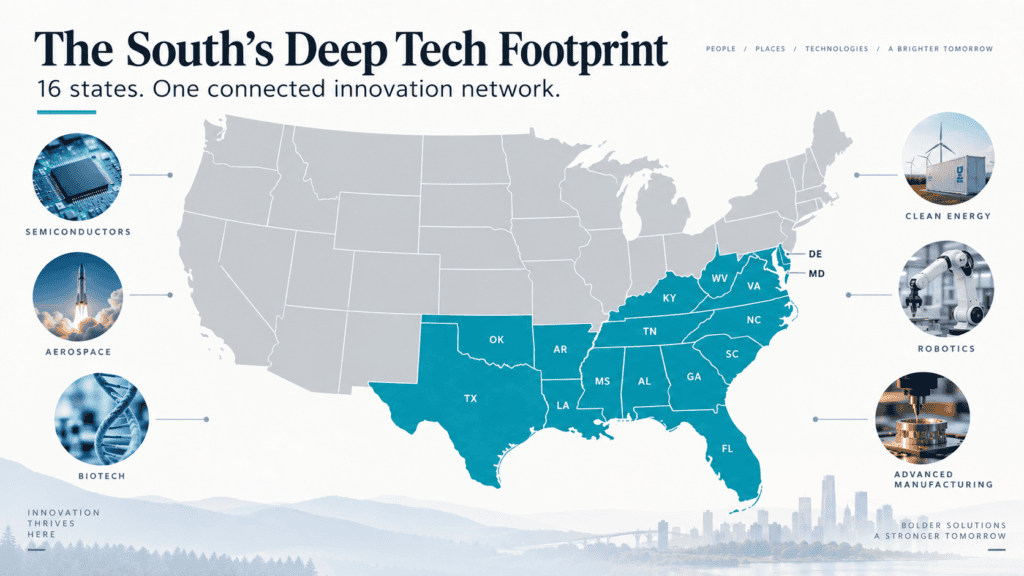
The U.S. Census Bureau defines the South as 16 states plus the District of Columbia. For this article, we are focusing on the 16 states: Delaware, Florida, Georgia, Maryland, North Carolina, South Carolina, Virginia, West Virginia, Alabama, Kentucky, Mississippi, Tennessee, Arkansas, Louisiana, Oklahoma, and Texas.
Is the South a major deep tech region?
Yes. Across those 16 states, companies and research organizations are working in semiconductors, aerospace, defense, biotechnology, nuclear technology, advanced materials, critical minerals, batteries, energy systems, robotics, autonomy, photonics, and advanced manufacturing.
Why does the South get overlooked in deep tech rankings?
Many rankings measure venture capital, startups, patents, software talent, and headquarters well. Physical deep tech also depends on fabs, laboratories, test facilities, industrial plants, mines, national labs, launch sites, utilities, manufacturing networks, and specialized supply chains.
What counts as deep tech?
Deep tech starts with meaningful scientific or engineering advances and usually gets harder as the technology moves toward commercial scale. It often requires specialized talent, expensive equipment, physical infrastructure, long development cycles, regulatory knowledge, and substantial capital.
Does every Southern state have the same deep tech strengths?
No. Each state contributes something different. That specialization is one reason the South makes more sense as a connected deep tech network than as one giant technology hub.
What does Southern deep tech growth mean for hiring?
Many of the hardest hires sit between disciplines: science and manufacturing, software and hardware, engineering and operations, research and commercialization. Those people can be difficult to identify by job title alone.
First, let’s define the South
People can argue about the South forever.
Is Texas Southern or Southwestern? Does Delaware really count? What about Maryland? Where does Oklahoma fit?
For this article, we can skip the cultural debate and use the U.S. Census Bureau’s South Region. The Census Bureau divides the region into three groups:
- South Atlantic: Delaware, Florida, Georgia, Maryland, North Carolina, South Carolina, Virginia, West Virginia
- East South Central: Alabama, Kentucky, Mississippi, Tennessee
- West South Central: Arkansas, Louisiana, Oklahoma, Texas
The Census definition also includes Washington, DC. We are leaving DC out because this article is focused specifically on deep tech activity across the Southern states themselves.
That leaves 16 states, and together they create a much broader technology footprint than the usual innovation map suggests.
The usual deep tech map only shows part of the picture
Ask generative AI to name America’s top deep tech hubs, and you will probably see familiar names: Bay Area, Boston, San Diego, Seattle, New York, Pittsburgh, Austin, and Research Triangle.
No doubt, they should be featured. The issue is what the typical ranking measures if you want the full picture.
Venture capital is easy to count. So are funding rounds, startup formation, patents, software talent, headquarters, and exits. Physical technology produces a very different set of signals.
A semiconductor fab can require billions of dollars before meaningful production begins. A rocket engine needs somewhere to be tested. A new battery chemistry needs materials, equipment, process engineering, safety systems, quality controls, power, and eventually a factory. A biotechnology breakthrough may still need a reliable way to manufacture a biologic at commercial scale.
Deep tech becomes easier to see when we start counting cleanrooms, pilot plants, national laboratories, rocket test stands, mines, advanced manufacturing facilities, chemical plants, ports, utilities, military installations, and specialized suppliers.
Follow those assets and the South gets interesting quickly.
South Atlantic: biotech, chips, energy, aerospace and materials
The eight South Atlantic states show how difficult it is to put Southern deep tech into one category.
Delaware has deep roots in chemicals, materials science, biotechnology, and biopharmaceutical manufacturing. The University of Delaware’s STAR Campus brings together engineering, life sciences, energy, mobility, and advanced research. Delaware also leads NIIMBL, a national institute focused on improving biologic medicine manufacturing.
Maryland has one of the strongest biotech and health technology ecosystems in the region. The Baltimore Tech Hub, designated in 2023, focuses on AI and biotechnology with applications in predictive healthcare, advanced biomanufacturing, medtech, and bio-based materials. Johns Hopkins, the University of Maryland, nearby federal research organizations, defense activity, and cybersecurity deepen that technical base.
Virginia deserves more attention in deep tech conversations. NASA Langley works across hypersonics, aerodynamics, advanced materials, structures, sensors, and autonomous flight. The Richmond and Petersburg region is also developing advanced pharmaceutical manufacturing capability around domestic medicine production and new manufacturing methods.
West Virginia is targeting advanced energy and materials manufacturing, including graphite, carbon materials, energy storage, and domestic supply chains. Its path into deep tech grows naturally from an existing industrial and energy base.
Then the technology mix shifts again.
North Carolina is already known for biotechnology, pharmaceuticals, and life sciences through Research Triangle. NC State’s CLAWS hub adds another dimension through silicon carbide, gallium nitride, RF electronics, photonics, power electronics, diamond, and gallium oxide.
Those materials have uses in aircraft, satellites, radar, communications, electric vehicles, high-power electronics, defense systems, and the electrical grid.
South Carolina combines advanced energy, grid technology, nuclear, automotive manufacturing, batteries, aerospace, and critical materials. SC Nexus focuses on generation, transmission, energy storage, and grid resilience. Rare-earth magnet production in Blacksburg ties the state into a broader domestic materials supply chain.
Georgia connects semiconductor packaging, batteries, automotive production, robotics, aerospace, logistics, and advanced manufacturing. Absolics is building advanced glass substrates used in semiconductor packaging in Covington, while Georgia Tech adds research depth in packaging, materials, manufacturing, and robotics.
Florida brings commercial space, launch infrastructure, satellites, avionics, photonics, defense electronics, and aerospace manufacturing. Kennedy Space Center supports government and commercial launch, spacecraft processing, engineering, research, and testing.
Eight states, each with a different place in the larger system.
East South Central: rockets, nuclear, batteries and industrial science
The East South Central states are Alabama, Kentucky, Mississippi, and Tennessee. This part of the South makes a strong case for looking beyond startup counts.
Alabama starts with Huntsville. NASA Marshall, Redstone Arsenal, missile defense, propulsion, systems engineering, defense electronics, space hardware, and advanced manufacturing have produced a technical base that took decades to build. Marshall has also done extensive work in additive manufacturing for rocket hardware, including new alloys, composite structures, and 3D-printed propulsion components.
Birmingham adds another deep tech lane to Alabama. Its 2023 federally designated Biotechnology Hub focuses on AI-driven biotechnology, drug discovery, diagnostics, and therapeutics. Alabama’s technology base stretches from propulsion systems to advanced medicine.
Mississippi has one of the country’s most important pieces of space infrastructure at NASA’s Stennis Space Center. Stennis is NASA’s primary and America’s largest rocket propulsion test site, with more than 5,200 people working there. The center also supports autonomous systems testing across air, land, and water.
Tennessee brings several fields together through Oak Ridge National Laboratory. Oak Ridge works across exascale computing, nuclear science, materials research, AI, advanced manufacturing, energy, and national security.
Frontier pushed scientific computing into the exascale era. The surrounding Oak Ridge ecosystem is also attracting advanced nuclear fuel and reactor activity while pairing computing with materials research and manufacturing.
Those capabilities reinforce one another. Computing helps model materials and industrial processes. Materials research feeds nuclear, aerospace, batteries, and manufacturing. AI helps researchers work through huge scientific datasets. Advanced manufacturing turns some of that work into physical systems.
Kentucky brings large-scale manufacturing experience into the picture. The state has invested heavily in automotive and battery production, and that market has already started changing.
Ford is converting former battery manufacturing capacity in Glendale into large-scale battery energy storage production. Current plans call for roughly $2 billion in investment, at least 20 gigawatt-hours of annual energy storage capacity, and production beginning in late 2027.
The product may change while much of the underlying capability remains useful: automation, chemical processing, manufacturing engineering, quality systems, power infrastructure, equipment, and people who know how to run high-volume production.
West South Central: minerals, autonomy, aerospace, energy and chips
The West South Central states are Arkansas, Louisiana, Oklahoma, and Texas, and existing industrial scale gives this part of the South a distinct advantage.
Arkansas is developing a position in lithium. The proposed South West Arkansas project would recover lithium from underground brines in the Smackover Formation and convert it into battery-quality lithium carbonate. Current plans call for nominal production of about 22,500 metric tons per year over a 20-year operating life.
Northwest Arkansas adds a separate strength. Large retail, transportation, warehousing, and distribution networks create real operating environments for warehouse robotics, supply chain automation, predictive systems, transportation technology, and industrial AI.
Louisiana combines large-scale aerospace manufacturing with one of America’s largest industrial energy systems.
NASA’s Michoud Assembly Facility in New Orleans has 43 acres of manufacturing space under one roof and specializes in large space structures and systems. The state’s industrial corridor adds petrochemicals, refining, pipelines, ports, process engineering, hydrogen, carbon management, and industrial energy.
Those assets matter because many physical technologies need more than a prototype. They need a place where large, complicated systems can actually be manufactured and operated.
Oklahoma adds autonomy, aerospace, defense, rare-earth magnets, and advanced manufacturing. Tulsa’s Tech Hub received about $51 million in implementation funding to support secure autonomous systems, including testing, certification, manufacturing, cybersecurity, and AI. Applications include agriculture, pipeline inspection, transportation, and defense.
Stillwater adds rare-earth magnet production connected to a broader domestic mine-to-magnet strategy.
Texas contains several overlapping deep tech markets.
Semiconductor manufacturing is expanding around Sherman and Taylor. Texas Instruments is adding major 300mm wafer capacity in Sherman, while Samsung has committed tens of billions of dollars to its Central Texas semiconductor footprint.
Texas also has critical minerals, commercial space, NASA Johnson Space Center, energy technology, petrochemicals, hydrogen, carbon management, grid infrastructure, defense, and advanced manufacturing. Several deep tech ecosystems operate within the state at the same time.
The connections across state lines tell a bigger story
Aerospace is one of the clearest examples.
Alabama has propulsion engineering and systems expertise. Louisiana has large-scale aerospace manufacturing at Michoud. Mississippi has propulsion testing at Stennis. Florida has launch infrastructure and spacecraft operations. Virginia adds hypersonics, aerodynamics, flight research, and advanced structures.
Together, those assets create an aerospace technology corridor spanning five states.
Critical materials follow another path. Lithium development is happening in Arkansas, while rare-earth projects connect Texas, Oklahoma, and South Carolina. Those materials eventually feed batteries, motors, aircraft, electronics, defense systems, power equipment, and manufacturing machinery.
Semiconductors create another network. Texas has large-scale chip manufacturing. North Carolina has wide-bandgap semiconductor research and prototyping. Georgia is working on advanced packaging substrates. South Carolina has energy and grid applications that depend heavily on power electronics.
Biotechnology stretches across Delaware, Maryland, Virginia, North Carolina, and Alabama, touching biologics manufacturing, predictive healthcare, pharmaceutical production, clinical research, and drug discovery.
Looking across those connections gives us something a simple metro ranking cannot capture: a regional system in which research, materials, manufacturing, testing, infrastructure, customers, and commercialization can sit in different places.
Power belongs in the deep tech conversation
Electricity has become one of the most important physical constraints in technology development.
Semiconductor fabs, AI infrastructure, advanced manufacturing plants, chemical operations, battery facilities, and data centers can consume enormous amounts of power. That brings transformers, switchgear, substations, transmission, generation, cooling, energy storage, nuclear technology, and power electronics directly into the deep tech stack.
South Carolina is investing in grid resilience and advanced energy technology. North Carolina has semiconductor research tied to high-power electronics. Tennessee combines advanced nuclear with scientific computing. Kentucky and West Virginia have growing energy-storage and materials activity. Texas and Louisiana already operate some of the country’s largest energy and industrial systems.
For a major industrial project, access to electricity can shape where it’s built and when production begins. That makes energy infrastructure part of the innovation story.
The South also has the customers
Physical technologies eventually need somewhere to operate.
The South has large concentrations of automotive plants, aerospace facilities, military installations, utilities, hospitals, farms, chemical plants, ports, warehouses, logistics networks, energy companies, and manufacturers.
These organizations serve as employers, customers, pilot sites, and test environments.
An autonomous system can be deployed on a farm in Oklahoma, inside a warehouse in Arkansas, around energy infrastructure in Texas or Louisiana, or within a defense environment in Alabama.
Power electronics developed in North Carolina can move into vehicles, aircraft, data centers, factories, or electrical equipment. Advanced materials can find their way into rockets, batteries, motors, medical devices, satellites, and transformers.
Commercialization gets easier when companies can test technology against real operating problems.
Scaling creates the hiring problem
Inventing technology and scaling technology require overlapping skills, but the work changes as a product moves toward commercial production.
A scientist may understand exactly why a material works without having manufactured it at commercial volume. An aerospace engineer may design a propulsion system while someone else has spent 20 years building, testing, certifying, and producing flight hardware.
A robotics researcher can develop an impressive autonomous system without having deployed hundreds of units inside an operation running around the clock. A founder can prove a process in a laboratory and then discover that commercial production requires an entirely different group of people.
The difficult hires often sit around:
- Plant construction and capital projects
- Process engineering
- Equipment installation
- Manufacturing scale-up
- Automation and controls
- Quality and yield
- Supply chain
- Regulatory affairs
- Environmental permitting
- Power infrastructure
- Testing and validation
- Scientific commercialization
- Technical operations leadership
“Lab-to-fab” is useful shorthand for the challenge. Someone has to turn scientific possibility into repeatable production.
The right person may be somewhere else
A semiconductor company in Texas may need somebody from Arizona, Oregon, California, New York, or North Carolina. A battery or energy-storage operation in Kentucky or Georgia may find its strongest manufacturing leader inside automotive.
A materials company in South Carolina or West Virginia may find the right process engineer along the Gulf Coast. A biotech manufacturer in Delaware, Maryland, Virginia, Alabama, or North Carolina may need talent from Boston, New Jersey, Pennsylvania, or California.
A space company in Florida might find propulsion expertise in Mississippi or Alabama, large-scale manufacturing experience in Louisiana, or flight research expertise in Virginia.
Job titles can hide a lot of that.
The useful questions are much more specific. What process did the person run? At what volume? What materials did they work with? What equipment did they install? What regulations applied? What failed during scale-up? What yield did they reach? Did they build the operation or inherit it?
Those details tell you whether experience actually transfers.
The map depends on what you are trying to build
A semiconductor company has different needs from a biotech company. A rocket company has different constraints from a battery manufacturer. A robotics company needs a different ecosystem from an advanced nuclear business.
The useful question is:
What does this technology need to reach its next stage?
The answer can lead to very different places:
- Delaware: biomanufacturing
- Maryland: biotech and predictive healthcare
- Virginia: aerospace, hypersonics, autonomy, pharmaceuticals
- North Carolina: biotech, semiconductors, power electronics, materials
- South Carolina: advanced energy, nuclear, manufacturing, critical materials
- Georgia: semiconductor packaging, batteries, automotive, robotics
- Florida: space and aerospace
- Alabama: propulsion, defense, biotechnology
- Mississippi: propulsion testing and autonomy
- Tennessee: nuclear, exascale computing, materials, manufacturing
- Kentucky: energy storage and high-volume manufacturing
- Arkansas: lithium, logistics, automation
- Louisiana: aerospace manufacturing and industrial energy
- Oklahoma: autonomy, aerospace, rare-earth magnets
- Texas: semiconductors, space, energy, critical minerals, industrial scale
- West Virginia: advanced energy and materials
Each state contributes a different combination of assets, expertise, infrastructure, and customers.
Deep tech in the South is also a talent map
The same forces shaping the Southern deep tech map are shaping its labor market.
Companies need scientists who understand commercialization, engineers who understand manufacturing, manufacturing leaders who can work with unfamiliar technology, supply chain leaders who can source emerging materials, regulatory experts who understand new products, and executives who can manage large capital programs while keeping projects moving.
For companies building or expanding complex technical operations, STEM Search Group helps identify where specialized talent actually sits, which adjacent backgrounds can transfer, and when a search needs to cross industries or state lines. Our work across engineering, manufacturing, technology, life sciences, healthcare, startups, and deep tech helps employers find people whose experience can matter far more than their job title suggests.
Sources
- U.S. Census Bureau, geographic levels, regions and divisions
- U.S. Census Bureau, Census regions and geographic definitions
- University of Delaware, STAR Campus
- University of Delaware, biopharmaceutical research and NIIMBL
- U.S. Economic Development Administration, Baltimore Tech Hub
- U.S. Department of Commerce, Absolics semiconductor packaging project
- NC State University, CLAWS Microelectronics Commons
- South Carolina Department of Commerce, SC Nexus
- NASA Langley Research Center
- U.S. Economic Development Administration, West Virginia Advanced Energy and Industrial Technology Manufacturing strategy
- NASA Marshall Space Flight Center
- U.S. Economic Development Administration, Birmingham Biotechnology Hub
- NASA Stennis Space Center
- Oak Ridge National Laboratory
- Kentucky state government, Ford Energy investment in Glendale
- Ford Motor Company, Ford Energy
- U.S. Department of Energy, South West Arkansas lithium project
- NASA Michoud Assembly Facility
- U.S. Economic Development Administration, Tulsa Tech Hub
- NIST CHIPS Program Office, USA Rare Earth
- NIST CHIPS Program Office, Texas Instruments Sherman
- Samsung Semiconductor, Central Texas operations and Taylor update