
Hidden Labor Market Signals: More Than JOLTS and Unemployment Data

TL;DR FAQ
If unemployment is only 4.1%, why does my job search feel so hard?
Because the unemployment rate tells you how many people are out of work, not how fast people get hired. Hiring has sat at 3.3% for almost two years, the same pace as 2011-2012. Fewer openings get filled, so searches run longer. More than 1 in 4 unemployed people have been looking for six months or more.
Are layoffs about to spike?
We’re not making predictions. Right now, the layoff rate is 1.0% and new jobless claims are near multi-decade lows. The risk is that with hiring this thin, even a modest rise in layoffs would push unemployment up fast. The watch list above shows what we’re tracking to see which way it breaks.
Is AI taking jobs?
Some, but mostly out of sight. Explicit AI layoffs fell to under 3% of announced cuts in October. The bigger effect shows up as buyouts, hiring freezes, and roles left unfilled, which means fewer openings for people already looking. AI-exposed workers now make up 19.5% of the long-term unemployed, up from 14.7% in late 2022. Some of it may reverse: about one in five workers cut for AI were later asked back.
Is a six-month gap on a resume a red flag?
Not like it used to be. With 27.6% of unemployed people searching 27 weeks or longer, long gaps are common. We still look at why someone left and what they did with the time, same as always.
I have a job. Should I be looking?
Listening costs you nothing. In September, the typical stayer’s raise was 3.4% against 3.7% inflation, a real-terms pay cut, while switchers averaged 4.7%. Just don’t move for money alone. If a move goes wrong, landing the next job takes longer than it used to.
I’m hiring. Why am I getting so many applicants but so few I’d actually hire?
Two things are happening at once. Junior roles have a deep pool, since recent grads face higher unemployment than the overall workforce. Experienced specialists like controls, robotics, and semiconductor technicians are mostly employed and not quitting. Add AI resume rewrites and auto-apply tools, and volume goes up while signal goes down.
Does a college degree still help?
Yes, but it may be tied more to compensation than to avoiding unemployment. Unemployment for degree holders is 2.6% versus 4.1% overall. The advantage is just smaller than in any era we compared: their rate is 63% of the overall rate today, versus 43% in 2000.
But manufacturing is on the rise, correct?
It depends on the company. Some networks are closing plants and automating while new plants in autos, chips, steel, and defense ramp up. Manufacturing openings rose more than 50% year over year in September, but hires haven’t followed, because tariff and fuel costs are hard to forecast and companies are holding off on sign-off. On plant searches, expect commute and relocation questions earlier with gas at $4.31.
When will we know which way this breaks?
Mid-December numbers will tell us a lot. The November jobs report, October JOLTS, the November ISM report, and the Fed’s decision all land in the first half of the month. That said, it might be a slow thaw until 2027.
Preface: where we’re coming from
We’re taking you behind the curtain a little. When most of your team has been in the recruiting agency arena for 20+ years, you learn a thing or two about a thing or two when it comes to hiring and the economy. You’ve seen the Y2K boom of 2000, the dot-com bust of 2003, the Great Recession hangover of 2010, the COVID aftermath of 2021, and a hot 2022 market. So you learn that understanding the job market takes more than JOLTS and unemployment data alone.
Today, we’ll share some of the signals we track to make sure our company isn’t caught flat-footed. Before we do, though, our goal isn’t to scare you. We plan on having a big 2027.
That said, if your job search has felt slower, or you’re hiring and not seeing the flow of top candidates you’re used to, and the recent JOLTS and unemployment numbers don’t explain it, that’s because those are pieces of the puzzle, not the whole thing.
The bottom line first
The headline numbers everyone loves to point to say boom. The numbers underneath say we look more like the dot-com bust of 2003.
The good? Unemployment is 4.1%, and October added 165,000 jobs.
The bad? Employers are hiring at the same rate as in 2011-2012, and 27.6% of unemployed job seekers have been searching for six months or more, a higher share than at any point in the dot-com bust.
But there is reason for optimism: the market is frozen rather than falling. Layoffs get a lot of the headlines, but overall, they haven’t changed much (trust us, we know that doesn’t make anyone in a niche seeing big changes feel any better; we’re just looking at it at the macro level). Pair that with data showing almost nobody is quitting, and companies stretching existing staff with overtime and temps instead of adding permanent headcount.
Manufacturing shows the same split at the company level: we’re seeing plant closures alongside major new builds.
You have additional factors at play at the same time in tariffs, gasoline prices, and AI, and their full impact is unknown. There’s risk they break the freeze in the wrong direction, sure, but what we’re not going to do is make a prediction or give you a slanted piece. You get enough of that here on LinkedIn and social media as is.
We will, however, share data points that might explain a little more about what you’re seeing or experiencing.
Today’s data vs. the other eras of the millennium
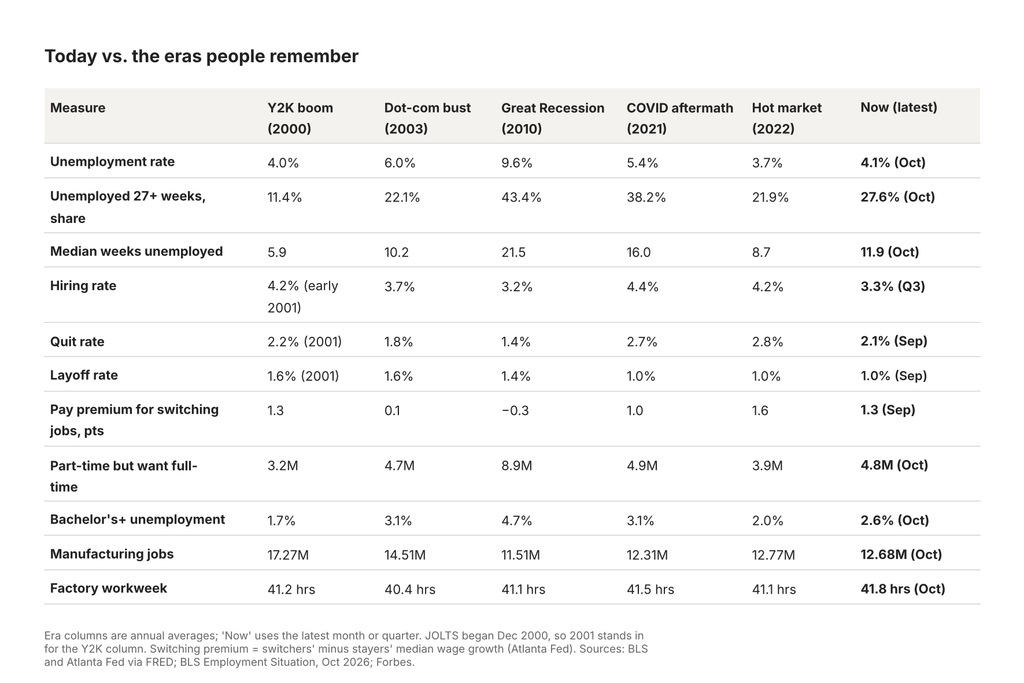
Today’s market pairs a boom-era unemployment rate with bust-era search times, hiring, and underemployment. Read across each row, and you’ll see why we’re saying today, the “Now” column, most closely resembles 2003. The exceptions are unemployment and layoffs.
Signal 1: Job searches now look like a downturn
In October 2026, 27.6% of unemployed Americans reported having looked for work 27 weeks or longer. That is higher than at any point in the dot-com bust, when unemployment topped out above 6% (remember, current unemployment is 4.1%).
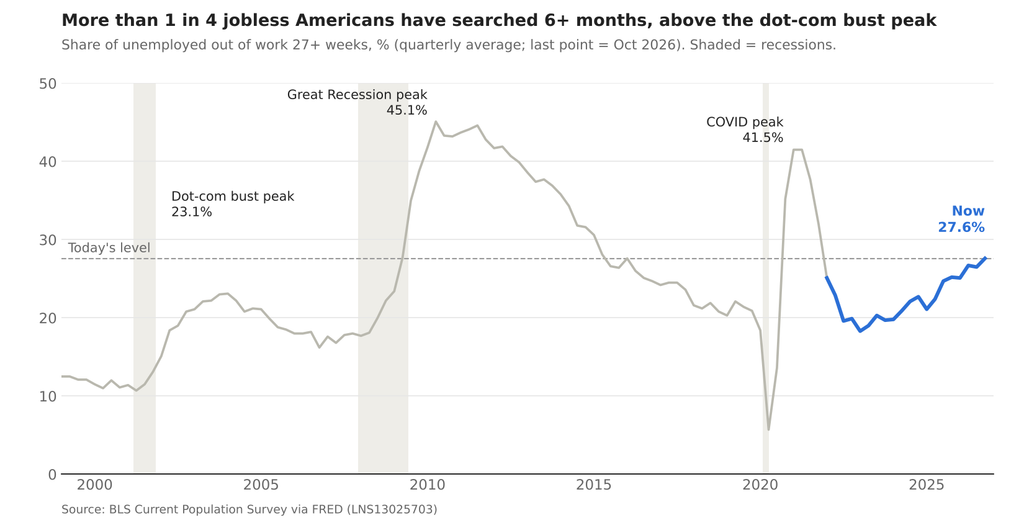
The typical search has stretched too. Median time unemployed was 5.9 weeks in 2000 and 10.2 weeks in 2003. It averaged 10.1 weeks in 2025 and hit 11.9 weeks in October 2026.
Why most people miss it. The unemployment rate and jobless claims both look healthy. But benefits mostly end after 26 weeks, so long-term job seekers drop out of the claims data that headlines watch. An economist quoted by the Society for Human Resource Management (SHRM) said a rise this large has not happened in any past expansion.
What it means for recruiting. The active candidate pool is deeper than the headline rate suggests, and six-month resume gaps are now common rather than a red flag. National data on search length by industry is published once a year, so an industry-specific read for 2026 won’t exist until early 2027.
Signal 2: Hiring is at recession pace while layoffs stay low
The hiring rate has sat at 3.3% for almost two years. That is the pace of 2011-2012, when unemployment was 8-9%, and below the dot-com bust low of 3.6%.
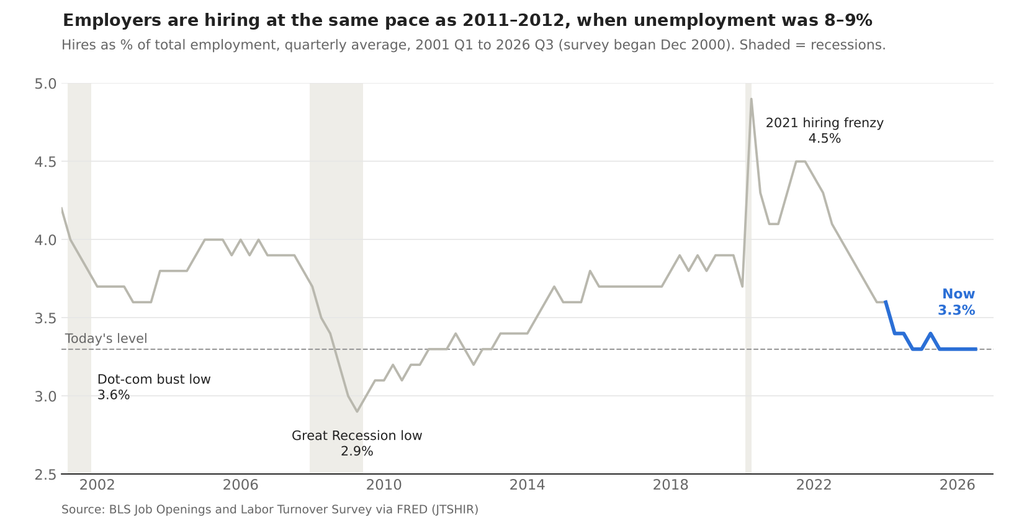
We’ll say it again: we understand layoffs are still happening, and some industries and jobs are at greater risk than others. Still, current data shows that, overall, unemployment is 4.1% because only a small fraction of the workforce is being let go. The layoff rate was 1.0% in September 2026 and averaged 1.1% in 2025, compared with 1.6% in 2001-03 and 1.7% in 2009. New jobless claims fell to 194,000 in late October, among the lowest readings in decades.
Why most people miss it. Payroll growth is a net number: hires minus separations. It can look healthy while very few people are actually changing jobs.
The risk to watch. This balance is fragile. With hiring this thin, even a modest rise in layoffs would push unemployment up quickly, because there’s no hiring cushion to absorb displaced workers. Take manufacturing, where job openings rose more than 50% year over year to 584,000 in September, yet hires haven’t followed. In other words, companies are posting roles, then deciding slowly.
Signal 3: Workers are staying put, but the reward for making a move has increased
The quit rate averaged 2.0% in 2025 and has run 1.9-2.1% through September 2026, near the 2003 level of 1.8%. That looks like workers acting as if jobs are scarce, not like a low-unemployment market.
The pay gap between people who change jobs and people who stay is the more useful tell. In 2025 it nearly vanished: switchers’ wages grew 4.4% and stayers’ 4.3%, a gap last seen in 2003-04. By September 2026, it had reopened, to 4.7% for switchers versus 3.4% for stayers.
Why most people miss it. Inflation changes the math. Consumer prices were up 3.7% year over year in September (BLS). A typical stayer’s 3.4% raise is now a real-terms pay cut, while a switcher’s 4.7% is still a gain.
What it means for hiring. The focus is shifting toward sourcing and recruiting passive candidates, but it will take more to get them to move. They’ll want to see a clear premium and real certainty, because they also see how hard it is to land a job if a move goes wrong.
Why it’s a good time to listen if approached. As a passive candidate, you have a concrete, current reason to listen: staying might be costing you money. On the other hand, don’t chase money alone, because the market is tighter if you end up with buyer’s remorse.
Signal 4: Leading indicators point to cautious stretching, not hiring
Employers are getting more out of the people they already have, through overtime and temp labor, before adding permanent staff. That’s a classic hesitation pattern, and it usually comes before either new hiring or cuts.
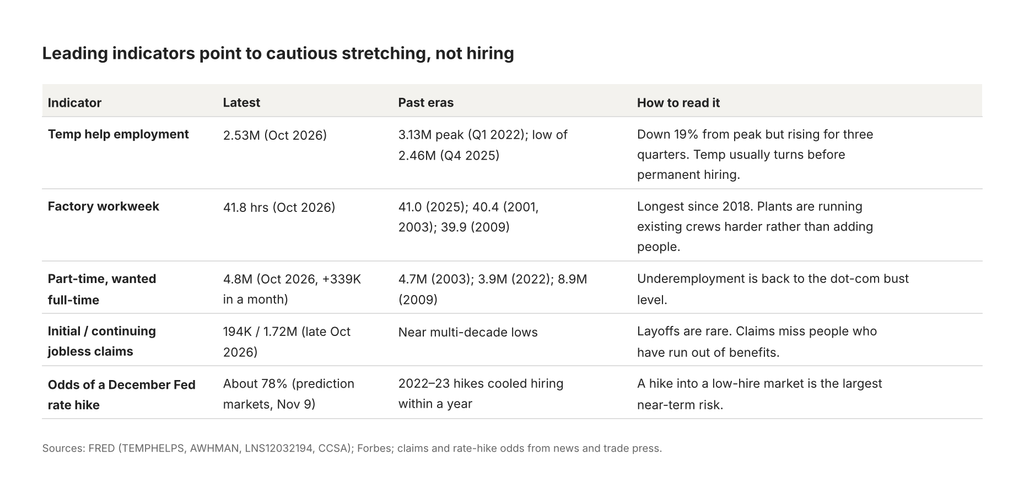
Why most people miss it. Hours and temp staffing sit deep in the jobs report tables. The odds of a rate hike jumped after the strong October report, and Fed official Mary Daly has said more hikes may be needed.
Signal 5: College degrees protect workers less than in any past downturn
A degree is less of a safety net than in any era we compared. In October 2026, unemployment for people 25+ with a bachelor’s degree was 2.6% versus 4.1% overall. Put another way, the degree-holder rate is 63% of the overall rate. In 2000 it was 43%, and even in 2003 and 2010 it was around half. This isn’t an anomaly either; for five straight years, recent graduates (ages 22-27) have had higher unemployment than the overall workforce.
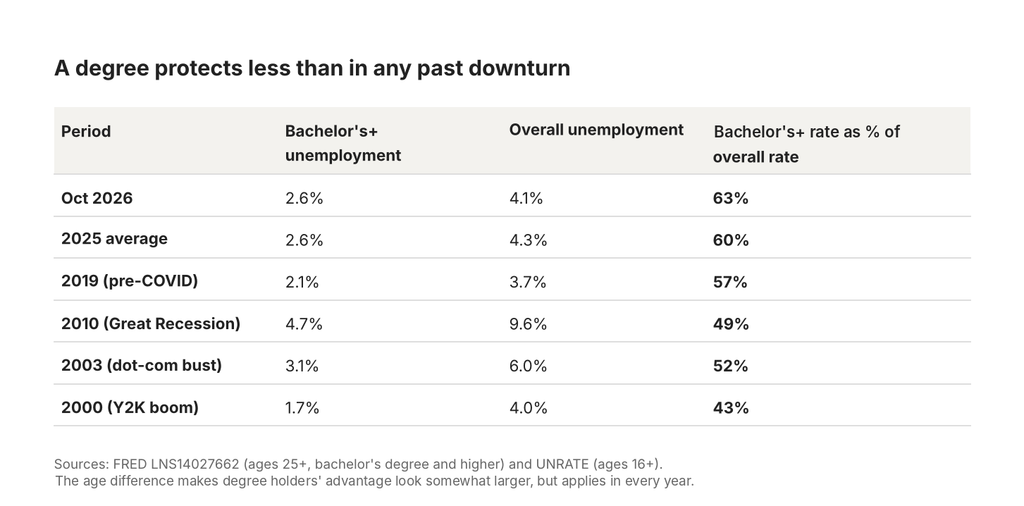
It is not a white-collar collapse. Professional and business services added 70,000 jobs in October, the most since July 2022. Consulting, accounting, and law grew; administrative support and call-center roles shrank. The losses are concentrated in what are often considered more routine and junior tasks. These are also the tasks AI is being relied on for, but more on that later.
Junior candidates are plentiful. Recent grads have higher unemployment than the overall workforce, and 42.5% work jobs that don’t require a degree. A client hiring at the 0-5 year level has a buyer’s market. They’ll see lots of applicants and can be selective.
Experienced specialists are still scarce. Demand for skills like controls, robotics, and semiconductor technicians is outrunning supply. A client looking for a senior or specialized person won’t find a wide pool, even though the headline market looks loose.
Signal 6: Manufacturing is splitting into two economies
National factory jobs are growing this year, but the picture splits sharply from company to company. Established networks are closing plants and automating, while new plants in autos, chips, steel, and defense are being built. A slowdown at one client can sit right next to a hiring ramp at another.
The long-run picture puts that growth in perspective. Manufacturing employment fell from 17.27 million in 2000 to 11.51 million in 2010, then climbed slowly to about 12.8 million by 2019. COVID knocked it down to 11.65 million in mid-2020, and the rebound peaked at about 12.9 million in early 2023. From there, factories shed roughly 300,000 jobs over three years, bottoming at 12.59 million in early 2026. This year’s gains brought it to 12.68 million in October, only about 8,000 above January 2025.
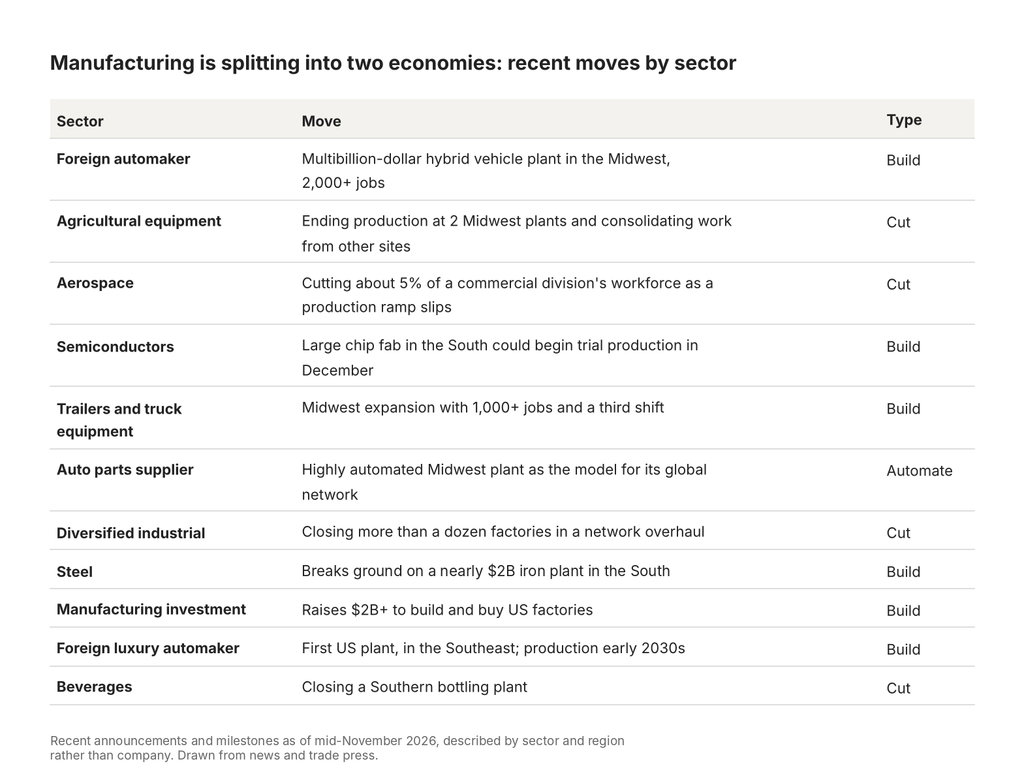
There’s more to the story than numbers alone, but manufacturing has very real trends.
Automation is absorbing growth. North American robot orders rose nearly 25% in Q3, led by semiconductors, biopharma, and autos. Output can rise without matching headcount, and demand is shifting toward controls, robotics, and maintenance skills.
Skill shortages coexist with layoffs. Community colleges, led by Arizona, are rushing to train semiconductor technicians. For experienced technicians displaced from mature plants, the gap is weeks to months rather than years: entry programs run two to twelve weeks, with employer apprenticeships of 12-18 months for full proficiency.
Policy whiplash freezes decisions. Manufacturers can’t predict their costs. Tariff refunds outran collections from May through July, net customs receipts swung from -$25.6B in June to +$19.2B in October, tariff lists on Canadian goods keep changing, and the Iran war is pushing up fuel and material prices. When costs are this hard to forecast, companies don’t cancel open roles; they postpone sign-off until the picture clears.
Signal 7: Three shocks at once, and no playbook for the mix
Three pressures are hitting employers at once. Tariffs are at levels last seen in the early 1940s, gasoline is up 53% since January, and AI is shifting which jobs exist a little faster than PCs or the internet did. Each has its own precedent. The closest combined one is the 1970s, when oil shocks and a brief 1971 import surcharge came alongside high inflation and Fed rate hikes, but nothing then resembled AI. Rising costs, unsettled policy, and changing skill needs together help explain why hiring has stalled even while unemployment stays low.
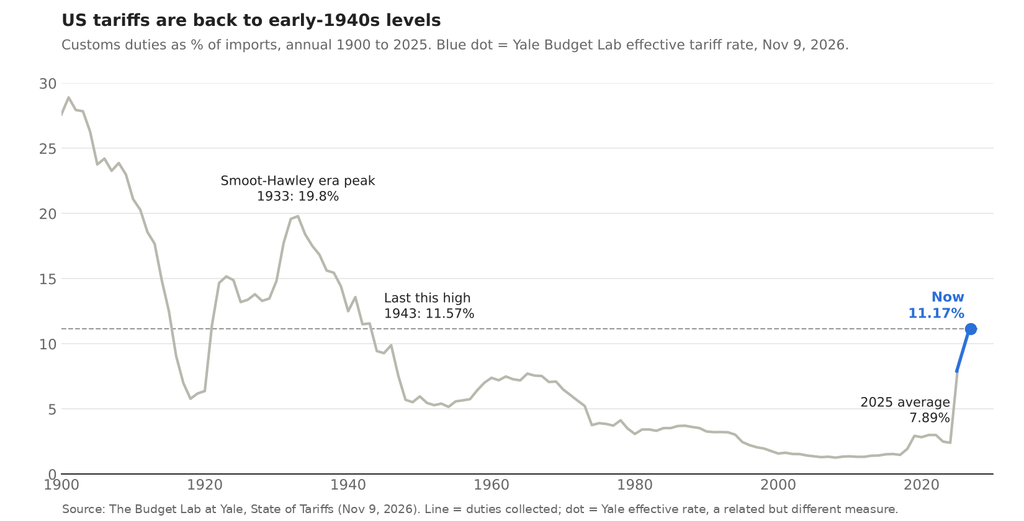
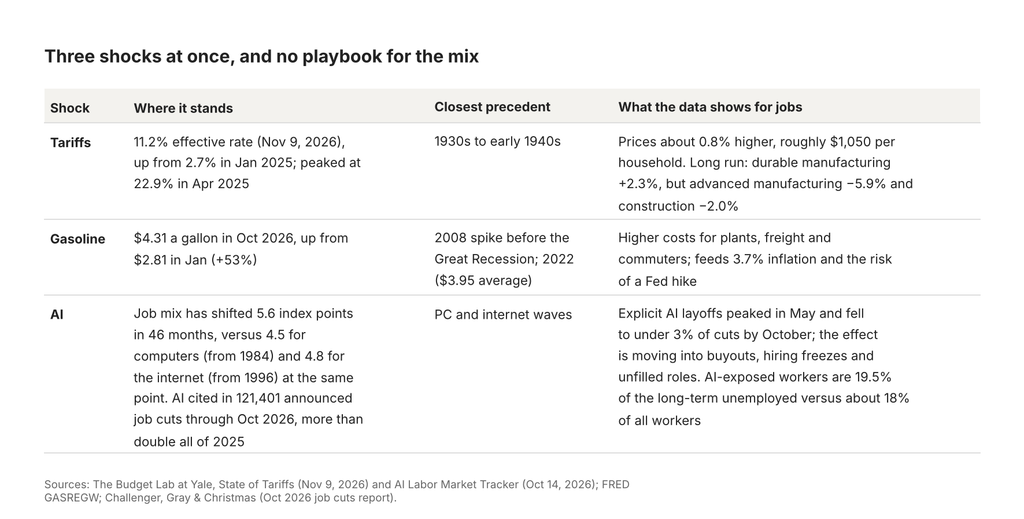
The AI effect is spreading, mostly out of sight. Employers cited AI in 121,401 announced job cuts through October, more than double all of 2025. But explicit AI layoffs peaked in May and fell to 1,265 in October, under 3% of the month’s cuts. The effect is moving into quieter channels: voluntary buyouts (e.g., Microsoft made news when it offered exits to roughly a quarter of its staff while restructuring around AI), hiring freezes tied to AI rollouts, and heavier workloads on smaller teams. None of these count as layoffs; they show up as fewer openings for people already looking. That matches the data. AI-exposed workers’ share of the long-term unemployed rose from 14.7% in Nov 2022 to 19.5% in Sep 2026, while their share of all workers held near 18% and their share of the newly unemployed edged up only from 12.7% to 13.1%. Their long-term share shows no link to the layoff rate, which has held near 1.1%. Some of this may reverse: one survey found about one in five workers cut for AI were later asked back.
What the combination implies. These are our inferences, not findings.
- Growth without hiring. Tariffs and fuel push costs up while a possible Fed hike caps demand. Firms are answering with overtime, equipment, and AI rather than headcount: Q3 GDP grew 3.4% on a 12.7% jump in business investment, robot orders rose 25%, and large employers are trimming staff through buyouts and hiring freezes instead of layoffs. The closest analog is the 2003 “jobless recovery.”
- Winners and losers inside manufacturing. Yale’s model projects that tariffs protect durable manufacturing over the long run, while input-heavy advanced manufacturing shrinks. That cuts against October’s electronics-led gains, so near-term reshoring may give way to cost pressure on STEM-heavy plants.
- For now, AI shrinks openings more than it cuts jobs. Buyouts, freezes, and roles left unfilled reduce openings without showing up as layoffs, so AI-exposed candidates who are already out of work wait longer. Some of this may reverse: early rehiring suggests employers overestimated what AI could take on, and rehired workers often return at higher pay.
- Volatility is its own shock. The tariff rate swung from 2.7% to 22.9% to 11.2% in under two years, and refunds outran collections in mid-2026 (Treasury net rate below zero May-July). Waiting on hiring decisions is a rational response.
- Gas hits plant roles hardest. Commuting costs matter more for on-site jobs, so expect commute and relocation questions earlier in plant searches.
One note on layoff data. Independent layoff trackers (TrueUp, Layoff Data, layoffhedge and others) mix WARN filings with press reports, and their totals vary widely, so this section relies on Challenger’s counts. For WARN notices, state workforce agency postings are the official record; Stanford’s Big Local News scraper and WARN Firehose aggregate them nationally.
Watch list: what would change the picture
The key question is which way the stalemate breaks: hiring picks up, or layoffs start. These indicators will show it first. Thresholds are our own reading of the history above, not official cutoffs.
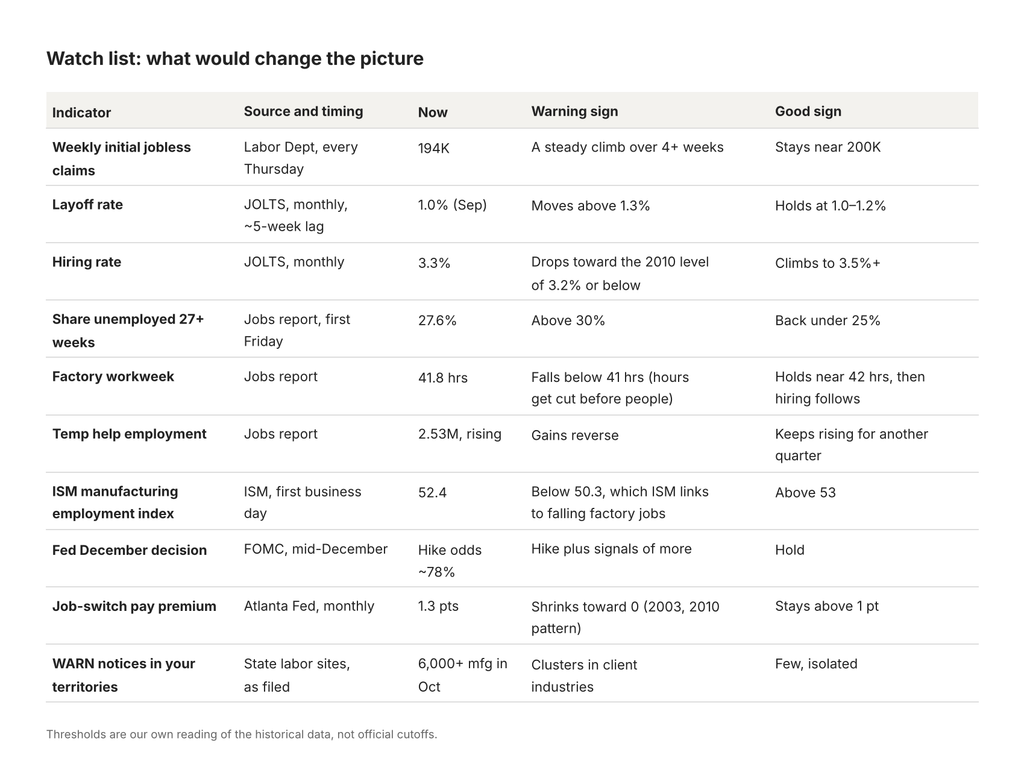
Also worth tracking for the three shocks: the Yale tariff tracker (now 11.2%; a move back toward 15%+ would renew the freeze), weekly gas prices (FRED GASREGW; $4.31 in October, versus a 2022 average of $3.95), and the most AI-exposed workers’ share of the long-term unemployed in the Yale AI tracker (19.5%; a climb above 21% would confirm the pattern).
The November jobs report, October JOLTS, the November ISM manufacturing report (out December 1), and the Fed decision all land in the first half of December, so mid-December is the next real checkpoint.
It’s not all doom and gloom
Hiring might be slower than we’d all like, but job creation is always great to see and a reason for optimism. At least now you have some extra context for why you read about all those new jobs, yet it still feels slow. Or why AI hasn’t made layoff numbers skyrocket, even though you see another headline every day about it coming for your job.
And choosing optimism doesn’t mean sticking your head in the sand. There’s always more to the story.
When your search calls for passive candidate recruiting, call us
We touched on passive candidate recruiting and why it matters earlier, but let’s paint a fuller picture of why your company needs experts like STEM Search Group now more than ever.
- Almost nobody is quitting, so the experienced specialists you need are mostly passive and need a real reason to move
- AI resume rewrites and auto-apply platforms make finding the needle in the haystack nearly impossible
There’s more noise, more pressure to get every hire right, more of everything.
Let us solve your hardest hiring challenges so you and your team can focus on everything else on your desk. We thrive at finding the hard-to-find.
Sources:
- https://fred.stlouisfed.org/series/LNS13025703
- https://fred.stlouisfed.org/series/UEMPMED
- https://fred.stlouisfed.org/series/UNRATE
- https://fred.stlouisfed.org/series/JTSHIR
- https://fred.stlouisfed.org/series/JTSQUR
- https://fred.stlouisfed.org/series/JTSLDR
- https://fred.stlouisfed.org/series/TEMPHELPS
- https://fred.stlouisfed.org/series/AWHMAN
- https://fred.stlouisfed.org/series/LNS12032194
- https://fred.stlouisfed.org/series/LNS14027662
- https://fred.stlouisfed.org/series/MANEMP
- https://fred.stlouisfed.org/series/CCSA
- https://fred.stlouisfed.org/series/GASREGW
- https://fred.stlouisfed.org/series/FRBATLWGT12MMUMHWGJSW
- https://fred.stlouisfed.org/series/FRBATLWGT12MMUMHWGJST
- https://www.bls.gov/cpi/
- https://fiscaldata.treasury.gov/datasets/monthly-treasury-statement/
- https://www.bls.gov/news.release/empsit.htm
- https://www.bls.gov/cps/aa2019/cpsaat32.htm
- https://www.bls.gov/cps/aa2020/cpsaat32.htm
- https://www.bls.gov/cps/aa2012/cpsaat32.pdf
- https://www.bls.gov/cps/tables.htm
- https://www.atlantafed.org/chcs/wage-growth-tracker?panel=2
- https://www.epi.org/indicators/unemployment/
- https://interactives.budgetlab.yale.edu/tools/state-of-tariffs/
- https://budgetlab.yale.edu/research/tracking-impact-ai-labor-market
- https://www.manufacturingdive.com/news/bls-manufacturing-employment-situation-october-jolts-september-2026/873897/
- https://www.manufacturingdive.com/news/3m-intel-lear-buitoni-layoffs-closures-warn-act-notices-october-2026/873819/
- https://www.manufacturingdive.com/news/north-american-robot-orders-grex-nearly-25-percent-q3-2026-a3/873300/
- https://www.manufacturingdive.com/news/manufacturing-accelerator-rebuild-raises-21b-new-funding-facility-expansion/873235/
- https://www.manufacturingdive.com/news/us-steel-invest-1-9-b-first-of-its-kind-direct-reduced-iron-plant-osceola-arkansas/818948/
- https://www.supplychaindive.com/news/deere-to-end-production-at-2-iowa-plants-to-align-with-demand/874059/
- https://www.supplychaindive.com/news/3m-closes-16-factories-plans-changes-at-10-more-in-network-revamp/873536/
- https://www.supplychaindive.com/news/audi-investing-4b-to-build-its-first-us-plant-in-georgia/872866/
- https://www.supplychaindive.com/news/pepsico-shutters-tennessee-bottling-plant-amid-soda-slump/833586/
- https://www.cnbc.com/2026/11/09/boeing-layoffs-commercial-airplane.html
- https://www.koreaherald.com/article/10929626
- https://www.truckingdive.com/news/hyundai-translead-ups-illinois-investment-by-150m-1250-jobs/833902/
- https://www.wardsauto.com/news/lear-to-open-automated-factory-as-blueprint-for-global-network/873985/
- https://apnews.com/article/chips-semiconductor-education-community-college-arizona-ef9cf98fcf9d4bfc48ccdc5177da03f0
- https://www.manufacturing.net/operations/news/22977941/community-colleges-rush-to-expand-semiconductor-training-as-labor-shortage-looms
- https://www.fox10phoenix.com/news/maricopa-community-colleges-offering-course-for-those-who-want-to-work-at-semiconductor-factories
- https://www.estrellamountain.edu/news/semiconductor-technician
- https://xenospectrum.com/en/us-semiconductor-community-college-training/
- https://www.sunyocc.edu/programs/semiconductor-technician
- https://www.wsj.com/economy/jobs/is-ai-taking-white-collar-jobs-what-the-latest-numbers-tell-us-dd31b115
- https://www.forbes.com/sites/fionariley/2026/11/06/october-saw-better-than-expected-job-growth-but-339000-more-people-are-working-part-time-who-wanted
- https://www.cnbc.com/2026/11/06/long-term-unemployment-october-jobs-report.html
- https://www.cnbc.com/2026/11/06/jobs-report-october-2026.html
- https://www.shrm.org/topics-tools/news/talent-acquisition/bls-hr-jobs-unemployment-nov-2026
- https://www.cpapracticeadvisor.com/2026/11/02/more-than-1-in-4-unemployed-americans-are-now-long-term-unemployed/192985/
- https://www.ibtimes.co.uk/low-hire-low-fire-2-million-americans-face-long-term-unemployment-past-26-week-benefit-limit-1831156
- https://www.foxbusiness.com/economy/us-jobs-report-october-2026
- https://www.reuters.com/technology/microsoft-is-offering-buyouts-around-60000-employees-business-insider-reports-2026-10-26/