
Boom or bust? What’s really happening with Southeast data centers as we enter 2027
TL;DR FAQ
Q: Which Southeast market is building the most data center capacity right now?
A: Atlanta had 2,882 megawatts under construction in the first half of 2026, more than any other primary market CBRE tracks.
Q: Which Southeast states are adding the biggest new data center projects?
A: The largest new projects are in Alabama, Kentucky, Louisiana, Mississippi, and Arkansas, plus Spartanburg County and rural North Carolina.
Q: Where are Southeast communities pausing new data centers?
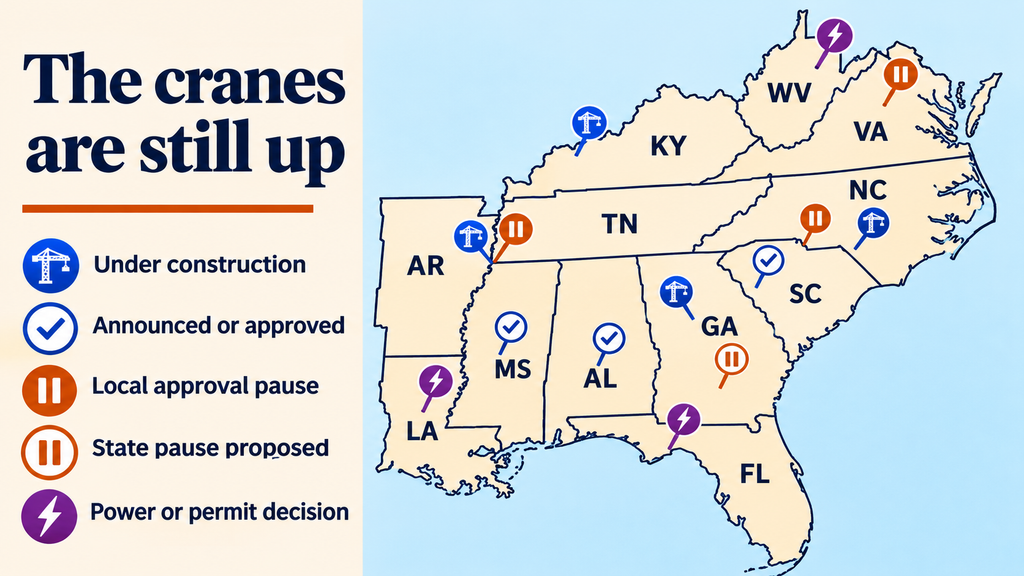
A: Charlotte, Memphis, and Loudoun County have paused new data center applications or approvals, and Georgia’s governor-elect wants a pause on state approvals.
Q: Is any Southeast state making data centers easier to build?
A: West Virginia is, because a 2025 law bars counties and cities from adopting rules that limit certified high-impact data centers and microgrids.
Q: Do data centers raise household power bills?
A: It depends on spare grid capacity and contract terms, and a 2026 study found one 500 MW load could lower or raise rates.
Q: How many permanent jobs does a data center create?
A: A typical 250,000-square-foot data center has about 50 full-time workers, roughly half of them contractors, according to Virginia’s legislative auditors.
Q: Which construction roles are hardest to fill for data center work?
A: Electricians and mechanical trades are the tightest in the Carolinas, and foremen and superintendents are also hard to find, according to ABC Carolinas.
On November 16, Spartanburg County Council approved a $2.75 billion, 457-megawatt data center on a 3 to 2 vote. Three weeks earlier and about 75 miles up I-85, Charlotte City Council voted unanimously to keep new data center applications on hold until October 2027.
Those two votes describe the Southeast data center market better than any single forecast. Construction is at record levels, and Atlanta now leads North America in capacity being built. The questions slowing the next wave are about who pays for the power, what a community gets back, and who is available to build and run these sites. Here is the short answer from the latest data: approved projects keep building, and new approvals are getting harder. The scarcest input in the region is the electricians, superintendents, and engineers who deliver the work.
Atlanta now leads North America in data center construction
CBRE counted a record 7,481 megawatts (MW) of data center capacity under construction across its primary North American markets in the first half of 2026, up 24.8% from a year earlier. Atlanta accounted for 2,882 MW of that total after a 52.3% jump, passing Northern Virginia for the first time.
Capacity in this market is measured in megawatts of electricity a building is designed to draw, so the unit itself tells you why power supply now decides where projects go.
Most of the space being built already has a customer. CBRE reported that tenants had committed to 80.4% of capacity under construction, up from 74.3% a year earlier. Keep that figure in mind when someone predicts a fast slowdown. Preleased buildings tend to finish, so construction and commissioning work continues even if new approvals stall.
New approvals are slowing, but approved projects keep moving
Across the 12-state footprint, recent decisions split cleanly. Counties with land and industrial sites are still saying yes, while large metros and newly elected officials are pressing pause on anything not yet approved.
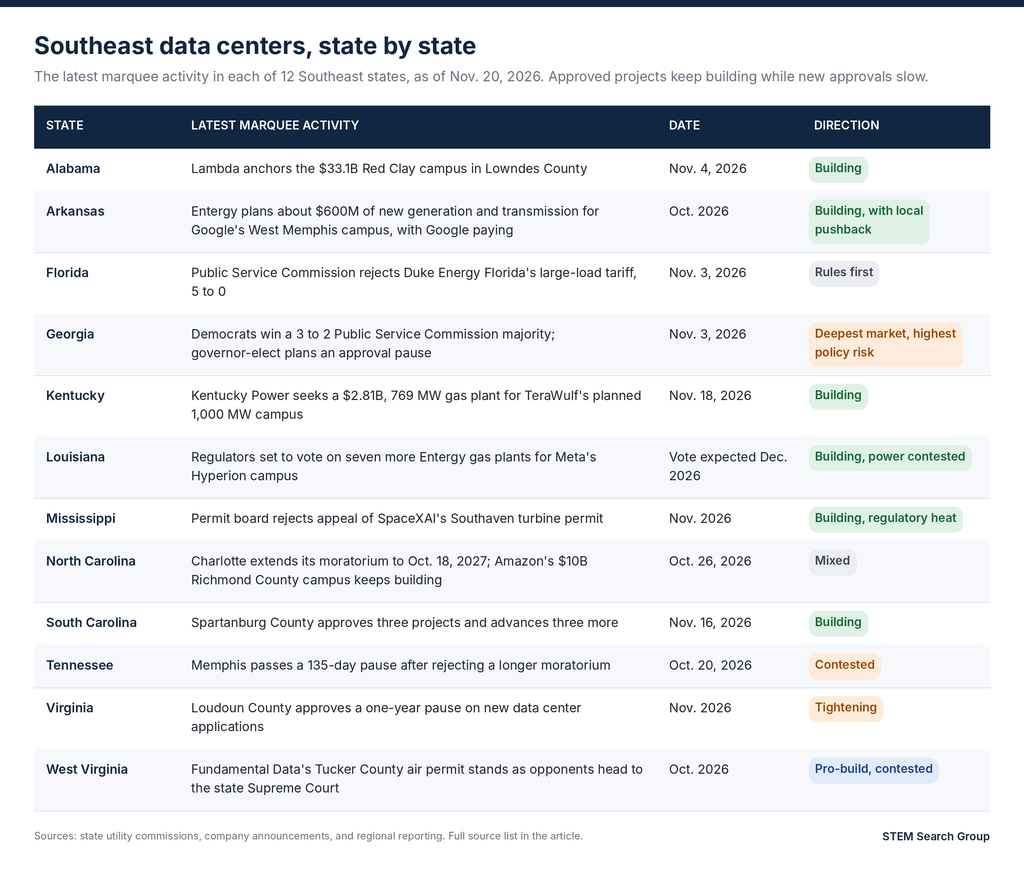
Approval rarely ends the argument. In Spartanburg, two council members voted against Valara. Councilman Monier Abusaft said he lost trust in the developer after its draft agreement left out promised commitments on landscaping and lighting. The final agreement locks in Valara’s development rights for 10 years, shielding the project from future county moratoriums and zoning changes, according to Fox Carolina.
Lowndes County followed a similar path. The commission approved Project Red Clay and a $1.15 billion tax abatement on a 3 to 2 vote in October. Days later, a lawsuit alleged the approval violated Alabama’s Open Meetings Act.
The local fights track a national shift in opinion. In a Pew Research Center survey of 10,548 U.S. adults conducted July 20 to Aug. 9, 2026, 60% said they would be uncomfortable with a new data center in their area. The share saying data centers are mostly bad for home energy costs rose from 38% in January to 50%. Pew also reported that voters in at least 38 jurisdictions voted to limit or ban data centers in the November midterms.
Rural megasites keep Alabama, Kentucky, Louisiana, and the Carolinas building
The largest new commitments are landing in rural counties with land, transmission, and willing local governments.
Alabama. Lambda’s $33.1 billion Red Clay campus in Lowndes County is the largest economic development project in the county’s history, according to Yellowhammer News. Construction is expected to start in the first quarter of 2027 and run up to five years, with Alabama Power serving the site pending regulatory approval.
Kentucky. TeraWulf is building a 482 MW data center on the site of a retired aluminum smelter in Hawesville, with Anthropic signed to a 20-year lease, according to the company’s filing with state regulators. On Nov. 18, Kentucky Power asked regulators to approve a $2.81 billion, 769 MW gas plant to serve TeraWulf’s planned 1,000 MW campus in Eastern Kentucky. Gov. Andy Beshear’s August executive order requires data center developers to show how they will protect residential ratepayers.
Louisiana. Entergy Louisiana wants approval for seven more gas plants, on top of three approved in 2025, to power Meta’s Hyperion campus in Richland Parish. Together, the 10 plants would total about 7.5 gigawatts. The Public Service Commission fast-tracked the review by a 4-to-1 vote and is set to decide in December.
South Carolina. Beyond Spartanburg’s six projects, Google has two data centers planned in Dorchester County. One could use about 978 million gallons of water a year, according to published county estimates reported by the SC Daily Gazette.
North Carolina. Charlotte’s pause covers only the city. In Richmond County, Amazon has broken ground on a $10 billion campus planned at 20 buildings, with construction expected to run about seven years, according to WSOC.
Memphis, Southaven, and West Memphis now work as one market
Three states meet at Memphis, and the largest projects there straddle the borders. Employers hiring for this corridor are drawing on one labor pool split across Tennessee, Mississippi, and Arkansas.
Tennessee. On Oct. 20, the Memphis City Council rejected a longer moratorium by a 6-to-6 vote and instead passed a 135-day pause on new data center approvals. The Tennessee Valley Authority approved a rate structure in August that charges data centers higher rates plus fees for the capacity they need. In Nashville, a DC BLOX subsidiary has challenged the city’s temporary pause in federal court.
Mississippi. SpaceXAI’s Southaven plant powers its data center operation that stretches into Memphis, and in November the state permit board rejected an appeal of the air permit for 41 gas turbines there. The state also alleges the company started construction without water permits, with possible fines above $6 million, according to Mississippi Today. Near Jackson, Amazon Web Services is investing about $25 billion across Madison County, Ridgeland, Warren County, and Clinton.
Arkansas. Google is building a $4 billion first phase in West Memphis, and Entergy Arkansas plans about $600 million of generation and transmission for the campus with Google covering the cost, according to Baxtel. Serverfarm topped out the first building of its Clarksville campus in October. Pulaski County’s quorum court, which covers Little Rock, passed data center regulations in September, and the issue shaped several local races this fall.
Georgia, Virginia, and Florida are tightening the rules, while West Virginia loosens them
The region’s most established markets are writing new limits, and one state is removing local ones.
Georgia. The Southeast’s deepest market now carries the most policy risk. The incoming commission majority and the governor-elect’s planned pause target new approvals, so the projects that put Atlanta at the top of CBRE’s construction ranking keep building.
Virginia. Loudoun County, the center of Northern Virginia’s Data Center Alley, approved a one-year pause on new data center applications this week, which staff estimate could affect 33 active applications for data centers and substations. Gov. Abigail Spanberger’s Executive Order 22, signed Sept. 18, created a statewide accountability framework that proposes ending by-right approval for data centers above 25 MW. Prince William County voted 8 to 0 to largely eliminate by-right data center development.
Florida. On Nov. 3, the Public Service Commission voted 5 to 0 to reject Duke Energy Florida’s large-load tariff after staff found it did not comply with a new state law requiring data centers to pay their own electricity costs. In Polk County, hundreds packed a public workshop on a proposed hyperscale campus in Auburndale.
West Virginia. The state is moving the other way. House Bill 2014, passed in 2025, bars counties and cities from adopting rules that limit certified microgrid districts or high-impact data centers. In Tucker County, Fundamental Data’s air permit for a gas-fired plant to power a planned data center complex remains valid after an appeals court dismissed challenges in August, and opponents say they will take the fight to the state Supreme Court.
Who pays for the power depends on grid headroom and contract terms
The strongest current evidence on power bills comes from an October 2026 study by the Energy Systems Integration Group (ESIG) and The Brattle Group. It modeled a 500 MW customer on a 15-year contract with a sample Southeast utility. That utility’s peak demand is 3,000 MW, so the new load adds one-sixth to it.
The result turned on headroom, meaning spare generation and transmission the utility already has:
- With enough headroom, rates for existing customers fell about 0.88 cents per kilowatt-hour (kWh), roughly 6% on average over the contract.
- Without headroom, the utility had to build new infrastructure, and existing customers’ rates rose 0.44 cents per kWh. That works out to about $4.40 for every 1,000 kWh a customer uses.
- In a worst case, where the load arrives four years late, reaches half its contracted size, and leaves five years early, the modeled increase reached 1.32 cents per kWh.
Contract design changed the outcome. Assigning new generation and transmission costs directly to the large customer eliminated the rate increase for existing customers, even in that worst case. The authors describe the results as illustrative, and the study did not estimate distribution costs or the combined effect of several large loads on one system.
Some Southeast utilities are already writing those protections into tariffs. In late October, the Santee Cooper board approved a permanent High Impact Load rate for data centers and other large customers. They must pay the added cost of serving them and sign 15-year agreements with financial guarantees. It replaces the utility’s 2025 experimental rate, which required customers to pay for transmission upgrades in full at signing. Lambda says it will pay the full cost of power and grid infrastructure for its Alabama campus through upfront commitments that apply even if plans change.
Georgia moved the decision to the ballot box. Democrats will hold a 3-to-2 majority on the Public Service Commission, which regulates Georgia Power, for the first time in 30 years. Gov.-elect Bottoms has said she will sign an executive order pausing new data center approvals until consumer protections are in place.
Water and noise fixes exist, but each one moves a cost somewhere else
Cooling design decides most of a data center’s water footprint. Google’s Berkeley County campus near Moncks Corner uses evaporative cooling, which cools servers by evaporating water. It used more than 900 million gallons of water in 2025, according to SC Daily Gazette reporting on Google’s figures.
Some newer AI campuses circulate coolant through a sealed loop instead. Lambda says its Lowndes County campus will use closed-loop cooling that significantly reduces water use. The trade-off is electricity: when the loop sheds heat through dry coolers instead of evaporation, the fans work harder, and electricity use climbs on hot days. A closed loop can still send its heat to an evaporative tower. The useful question for any project is how much water it withdraws and consumes on its hottest day.
On-site power creates a similar swap. Valara received state permission in September to generate up to 457 MW on its Spartanburg site, according to The Post and Courier, after an initial approval for about 50 MW. Generating on site takes load off the shared grid. It also brings continuous combustion, emissions, and equipment noise to the property line. Noise is already a policy question nearby, where Charlotte’s task force is using its moratorium to study distance and noise rules.
Batteries are sized for short gaps. A campus drawing a steady 500 MW uses 12 gigawatt-hours (GWh) of energy a day, while a four-hour battery sized to that full load stores 2 GWh. That arithmetic is why round-the-clock supply for a large campus still leans on the grid or on fuel-burning generation.
Innovations that could ease power, water, and noise, mostly after 2028
Several technologies now moving from pilots to signed contracts could take pressure off the grid and off neighbors. Most of them arrive later than the projects being approved this fall, and at a smaller scale.
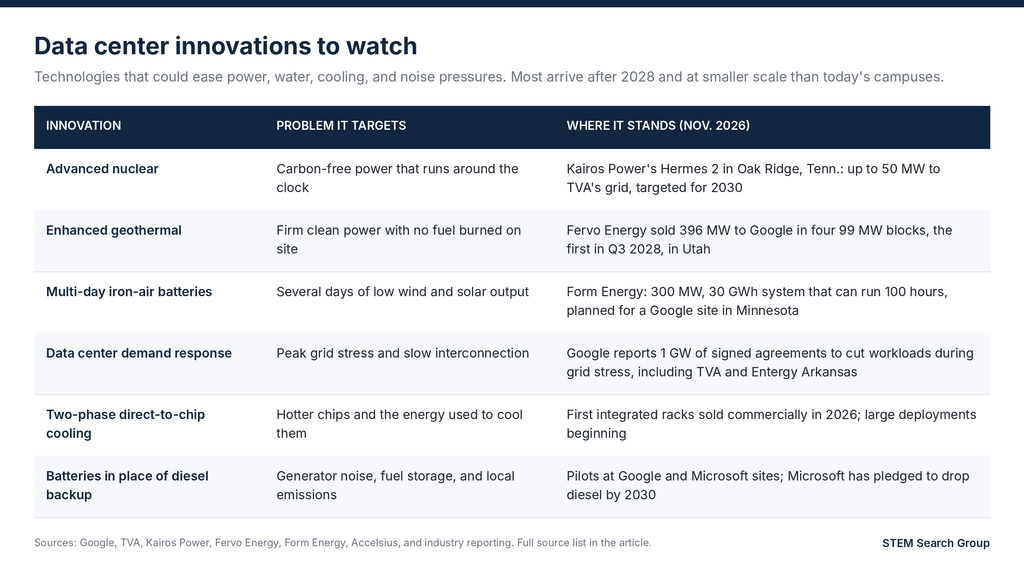
Two of these already touch the Southeast. Kairos Power’s Hermes 2 reactor in Oak Ridge, Tennessee, will sell power to TVA under an agreement that supports Google data centers in Montgomery County, Tennessee, and Jackson County, Alabama. Google also counts TVA and Entergy Arkansas among the utilities where it can scale back machine learning work during grid emergencies, though the company says this flexibility is early-stage and limited to certain sites. Form Energy builds its iron-air batteries at a factory in Weirton, West Virginia.
The scale gap is the catch. Hermes 2’s 50 MW is one-tenth of the 500 MW campus in the ESIG model, and Fervo’s first Utah block is almost two years away. For projects breaking ground in 2027, gas generation, grid upgrades, and efficient cooling remain the working toolkit.
Cooling and backup power could change sooner. Two-phase cooling uses a refrigerant that boils at the chip and condenses back into liquid, moving heat with less pumping than a water loop. Accelsius, a Texas supplier, reports up to 35% lower operating costs than single-phase liquid cooling in a study with analysis by engineering firm Jacobs. The heat still has to leave the building, so the water question shifts to how the facility rejects it.
Backup generators are where neighbors could notice the change first. Google has estimated that data centers worldwide hold more than 20 gigawatts of diesel backup, and residents near Loudoun County data centers have compared generators running through a grid emergency to airplanes landing. Batteries run far quieter and burn nothing on site. Their limit is duration, since data centers sometimes need backup for days, which is why multi-day storage like Form’s matters for backup as well as for the grid.
Each brings its own hiring needs: nuclear licensing and operations staff in East Tennessee, battery integration engineers, and commissioning teams with liquid-cooling experience.
Most of the jobs come during construction, and the trades are already stretched
The hiring story is strongest while buildings go up. Virginia’s Joint Legislative Audit and Review Commission (JLARC) reported that about 1,500 workers are on site at the peak of building a single data center. That phase usually takes 12 to 18 months. Once it opens, a typical 250,000-square-foot facility runs with about 50 full-time workers, roughly half of them contractors.
Lambda’s Alabama numbers follow the same shape at campus scale. The company expects more than 1,000 construction jobs over a build of up to five years and more than 225 full-time operations, technical, and support roles once the campus runs. Some early coverage reported 1,000 jobs for the life of the project, which blurred construction and operations together.
The contractors doing this work are pulling away from everyone else. In Associated Builders and Contractors’ October survey, contractors with data center work averaged 11.5 months of backlog, meaning work under contract but not yet done. The 88% without data center work fell to 7.6 months. In September, 39% of contractors with more than $100 million in annual revenue had data center work, compared with 1 in 10 smaller firms.
ABC Carolinas says labor is tightest for electricians, mechanical trades, and data center specialists. Competition is heavy for foremen, superintendents, and project engineers in Charlotte, the Triangle, the Upstate, and North Carolina’s data center corridor. Hospitals, manufacturers, and commercial builders in those same markets hire from that pool, so a new campus approval in Spartanburg affects their searches too.
Where hiring pressure will land in 2027
The approvals, tariffs, and construction schedules above point to five groups of roles that Southeast employers should plan around now:
- Electrical and mechanical construction leadership. Superintendents, foremen, and project engineers will be in demand as projects in Spartanburg, Lowndes County, Hawesville, Richland Parish, West Memphis, and Richmond County move through construction in 2027.
- Commissioning and controls engineers. Commissioning teams test power and cooling systems before a building goes live, and every phase of a multi-building campus repeats that work. Experience with direct-to-chip and two-phase liquid cooling is a growing part of that skill set.
- Utility large-load and regulatory teams. New rates and filings at Santee Cooper, TVA, Kentucky Power, and Entergy, plus Georgia’s new commission majority, mean utilities need people who can study, price, and contract large loads.
- Data center operations leaders. Operating staffs are small, so each facility manager, critical-environment lead, and site director carries more of the risk.
- Permitting, compliance, and community relations. Spartanburg’s Valara dispute shows that development agreements need people who can negotiate commitments and then deliver on them.
When data center hiring calls for more than a job ad
STEM Search Group is an executive search and niche role recruiting firm that solves difficult hiring challenges in engineering, energy and climate, AI and technology, and manufacturing. Its work includes recruiting infrastructure, operations, engineering, and IT leaders for data center organizations. The hardest Southeast searches in 2027 will target electrical superintendents, commissioning leads, and utility large-load engineers already committed to someone else’s campus, and job postings rarely reach them. If you are staffing a data center build, a utility interconnection team, or a plant competing for the same electrical talent, the firm’s proactive recruiting reaches passive candidates. It also gives you a realistic read on availability and pay before your schedule depends on a hire.
Sources
- CBRE, North America Data Center Trends H1 2026
- CBRE, North American data center demand continues to outpace supply despite record construction activity
- South Carolina Public Radio, Data centers clear Spartanburg County Council, with more in the pipeline (Nov. 17, 2026)
- Fox Carolina, Spartanburg County council takes up 6 data center development agreements (Nov. 17, 2026)
- Post and Courier, Spartanburg data center gets OK from SC regulators to generate 457 megawatts (Sept. 21, 2026)
- SC Daily Gazette, Spartanburg data center not subject to public power plant rules, SC regulators rule
- Lambda, Lambda to build new data center in Lowndes County, Alabama (Nov. 4, 2026)
- Alabama Reflector, Lowndes County Commission sued over approval of hyperscale data center (Oct. 21, 2026)
- WFAE, Charlotte extends its data center moratorium for 11 months (Oct. 27, 2026)
- City of Charlotte, Frequently Asked Questions: Data Centers and Moratorium
- WCCB Charlotte, Charlotte City Council votes unanimously to extend data center moratorium (Oct. 27, 2026)
- Atlanta News First, Georgia’s newly flipped utility commission targets power bills, shutoffs, and data centers (Nov. 6, 2026)
- Atlanta Journal-Constitution, How will Georgia’s data center deluge fare after midterm elections? (Nov. 2026)
- Pew Research Center, Americans’ views of data centers have turned more negative (Sept. 22, 2026)
- Pew Research Center, Key facts about data centers
- Energy Systems Integration Group, Impacts of Large Loads on Electricity Rates: A Quantitative Assessment (Oct. 2026)
- American Public Power Association, Report quantifies how large loads affect electricity rates for existing customers in four regions (Oct. 27, 2026)
- American Public Power Association, Santee Cooper board approves new rates for 2027 and 2028 (Nov. 10, 2026)
- Santee Cooper, FY 2026-27 budget presentation to the SC House Ways and Means Committee
- SC Daily Gazette, Google funds $1.3M freshwater habitat at Cape Romain (Nov. 20, 2026)
- Post and Courier, Why Google can’t endlessly recycle water for its cooling centers
- Virginia Joint Legislative Audit and Review Commission, Data Centers in Virginia, Report 598 (Dec. 9, 2024)
- Contractor Magazine, ABC Construction Backlog Falls to 8.1 Months in October (Nov. 10, 2026)
- Contractor Magazine, ABC’s Construction Backlog Indicator Surges to 8.7 Months Amid Growing Data Center Projects (Oct. 13, 2026)
- ABC Carolinas, Mid-Year 2026 Construction Economic Forecast
- ABC Carolinas, Job openings in construction: what today’s numbers mean for Carolinas contractors
- TeraWulf, Energy plan submitted to the Kentucky Energy and Environment Cabinet (Aug. 2026)
- Kentucky Lantern via States Newsroom, Kentucky Power asks state to build a $2.8 billion gas-fired power plant for big data center (Nov. 18, 2026)
- Union of Concerned Scientists, Louisiana regulators fast-track proposal tripling number of gas plants to power Meta data center (Apr. 15, 2026)
- WBRZ, PSC votes 4-1 to fast-track Entergy’s proposal to power Meta data center
- Mississippi Today, Permit board rejects appeal of SpaceXAI air permits in Southaven (Nov. 12, 2026)
- Route Fifty, SpaceXAI started Southaven data center construction without water permits, state alleges (Nov. 2026)
- WLBT, Council tables ordinance putting moratorium on data centers
- City of Memphis, Council member bulletin on the 135-day data center moratorium
- West Kentucky Star, Memphis rejects data center moratorium in favor of 135-day review (Oct. 2026)
- Arkansas Advocate, Arkansas’ most populous county passes data center regulations (Sept. 23, 2026)
- Arkansas Advocate, Data center backlash playing out in Arkansas’ local races (Nov. 2, 2026)
- Baxtel, Arkansas data center market
- Google, Google’s $4 billion investment in Arkansas
- WSOC, Construction begins on $10B Amazon project in Richmond County
- Virginia Mercury, Loudoun County pauses new data center applications for a year (Nov. 20, 2026)
- McGuireWoods, Virginia data centers: fast-changing landscape (Sept. 2026)
- Florida Phoenix, Florida Public Service Commission rejects Duke Energy’s data center plan (Nov. 3, 2026)
- FOX 13 Tampa Bay, Proposed Auburndale data center draws scrutiny over power demand, water use and impact
- West Virginia Press Association, Frustration mounts amid evidence state is lagging in data center protection
- States Newsroom, WV Intermediate Court dismisses environmental groups’ challenges to Fundamental Data permit (Aug. 27, 2026)
- WLRN/NPR, Plans for a data center threaten scenic wilderness and dark skies in West Virginia (Oct. 31, 2026)
- Google, Our first advanced nuclear reactor project with Kairos Power and Tennessee Valley Authority
- World Nuclear News, Google, Kairos Power, TVA announce collaboration
- Fervo Energy, Fervo Energy and Google sign 396 MW PPA (Sept. 1, 2026)
- Utility Dive, Analysts say Fervo-Google geothermal deal underscores baseload power scarcity (Sept. 2026)
- Google, Google is coming to Minnesota and advancing clean energy goals (Feb. 24, 2026)
- pv magazine USA, Google to deploy world’s largest iron-air battery for Minnesota data center (Feb. 24, 2026)
- Google, A new milestone for smart, affordable electricity growth (Mar. 19, 2026)
- POWER Magazine, Google signs deal for demand response capacity for data centers
- HPCwire, Accelsius announces general availability of NeuCool IR150 (Apr. 20, 2026)
- Accelsius, Two-phase cooling reference design with Jacobs
- Data Center Knowledge, Google thinks data centers, armed with batteries, should anchor a carbon-free grid
- Battery Technology, Cummins wins its largest BESS contract for US data center project
- Facilities Dive, AI boom could shift diesel generators from backup to everyday use
- Arcadis, Replacing diesel generators with battery energy storage
- Yellowhammer News, Lambda announces $33.1 billion AI data center in Lowndes County, largest economic development project in county history (Nov. 4, 2026)
- DCD, Accelsius claims 300MW customer win with new operator in Canada
- WMC Action News 5, State rejects appeal over SpaceXAI’s air permit for Southaven facility (Nov. 11, 2026)