
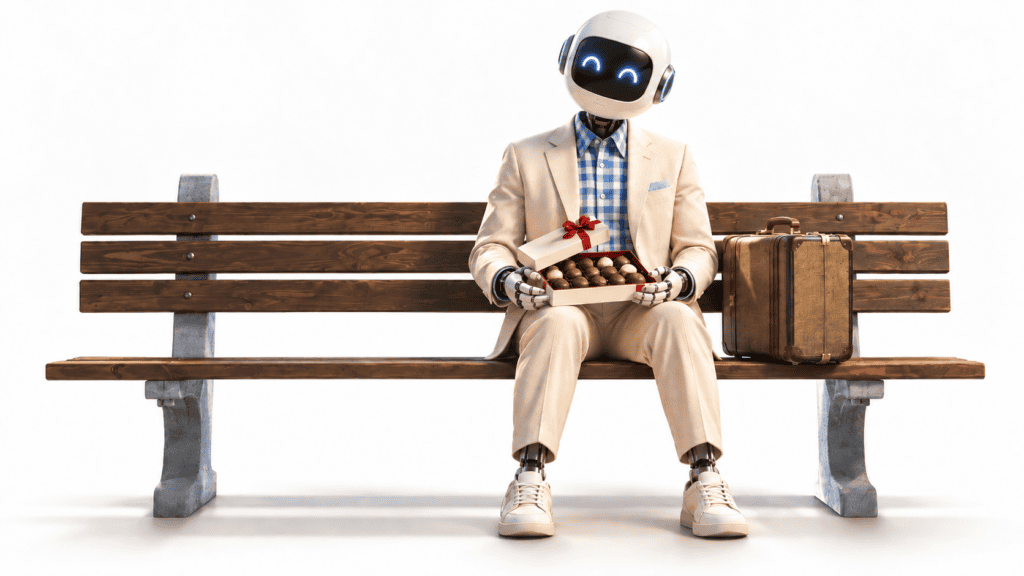
AI is like a box of chocolates
TL;DR
Is AI changing how people work?
Yes. AI is already changing how people write, build, analyze, create, communicate, make decisions, and solve problems.
Is that a bad thing?
Sometimes. Some jobs and tasks will shrink or disappear, while new work and new opportunities will emerge. The impact will not be evenly distributed.
Is there reason to be excited about AI?
Yes. AI can help people move faster, learn quicker, create more, and do things that once required skills they did not have.
Is there reason to be concerned?
Also yes. The technology is moving quickly, and serious questions remain around jobs, safety, misuse, control, and how much power ends up concentrated in a small number of hands.
Have people faced disruptive technology before?
Many times. New technologies have repeatedly changed work, society, and daily life, sometimes for the better and sometimes with consequences people did not anticipate.
Do we know where AI ultimately leads?
No. That is part of what makes this moment both exciting and uncomfortable.
So what can we do?
Focus on what we can control: stay curious, keep learning, adapt, grow, and do not lose sight of the people and parts of life that matter most.
There seem to be two AI camps
Depending on who you listen to, artificial intelligence is either the greatest thing since your personal favorite, the wheel, sliced bread, air conditioning, or something else, or we are a few model releases away from The Matrix.
Plenty of smart people have defended both sides.
Then last week, Jacob Coxon, formerly of Anthropic, the company behind Claude, and OpenAI, the company behind ChatGPT, posted something on X that spread pretty quickly:
“The people building AI earnestly believe that it could kill us all by the end of the decade.”
That gets your attention, especially when the warning comes from somebody who worked inside two of the frontier AI labs building this technology.
So, what do we think?
People ask us about AI all the time.
Usually it is: “Will AI take my job?” “What are our kids even going to do for work?” “What should I be learning?”
Every so often somebody goes straight for: “Will AI kill us all?”
We are on this journey with everyone else. We are not AI scientists. Well, technically, we do have a scientist on the team, but he is an atomic physicist, so this is a little outside his specialty.
We spend a lot of time looking at employment, skills, companies, hiring, and where demand is moving.
And yes, we are already seeing changes.
In software engineering, junior opportunities have declined. The emphasis has shifted heavily toward senior talent, especially senior engineers who already know how to build with AI.
Frontend roles have taken a hit. Design has taken a hit. Backend engineering remains important, while data engineering has grown as companies realize AI token usage and outputs are better managed with good data, pipelines, infrastructure, and systems behind them.
Recruiting is changing too.
AI sourcing and matching have had a real impact. Candidates can rewrite a resume for a job in seconds and use auto-apply tools to submit applications at a scale that was impossible a few years ago.
That convenience has created its own problem: more applications, more AI-generated resumes, more applicant flooding, and more AI slop.
Then employers use more AI to sort through the applications that AI helped generate.
Welcome to 2026.
Innovation has scared us before
This part does not need a history class.
A few examples make the point.
People thought ATMs would wipe out bank tellers. People expected computers to eliminate huge amounts of office work. Industrial robots really did replace repetitive factory jobs. Agricultural machinery dramatically reduced the number of people required to produce food.
Those fears were not completely wrong. Technology did eliminate jobs and tasks.
It also changed jobs, created new ones, and shifted which skills mattered.
We are seeing the same thing now, although AI may be moving much faster and touching a much wider range of work.
Fear that technology will hurt society is nothing new either.
People worried writing would weaken human memory. Electricity could literally kill you. Cars killed people in large numbers and completely changed cities. Nuclear technology gave humans the ability to destroy entire cities.
The internet was supposed to destroy privacy, spread misinformation, enable crime, and damage social interaction.
Some of those concerns were exaggerated. Some proved accurate.
History does not tell us AI is safe. It tells us humans have faced disruptive, dangerous, and sometimes frightening technologies before.
AI may be different in one important way
Speed.
METR measures how difficult a task an AI model can reliably complete by comparing it with how long the same task would take a human expert. On its benchmark of software engineering, machine learning, and cybersecurity tasks, frontier models have been roughly doubling their task-completion time horizon every three to four months since 2024.
Anthropic says Claude now authors more than 80% of the code merged into its own codebase.
So, AI is already helping humans build AI faster, and the amount of that work being handed to AI appears to be growing quickly.
Nobody knows where that curve goes. Progress could slow, today’s architectures could hit limits, or improvements could keep coming quickly.
That uncertainty is the point.
We do not know enough to dismiss the people warning about AI. We also do not know enough to declare that human work, or humanity itself, is finished.
We get to choose how we respond
We can live in doom and gloom, or we can believe in a brighter tomorrow.
Believing the glass is half full does not mean keeping your head in the sand. It means believing that human beings have a pretty good track record of adapting, solving problems, building safeguards, and figuring things out when circumstances change.
We have no new advice to give, and no new secret. In fact, we find the most useful advice has been around for a long time.
Get comfortable with the uncomfortable
In Conversations with God, Book Three, Neale Donald Walsch wrote:
“Life begins at the end of your comfort zone.”
AI is going to make some people uncomfortable.
Jobs will change. Skills will change. Industries will change. Things you spent years becoming good at may become easier, cheaper, or automated.
Waiting for everything to settle down probably is not a strategy.
Control the controllables
Epictetus was talking about this almost 2,000 years before ChatGPT showed up in The Discourses, 2.5.4-5:
“The chief task in life is simply this: to identify and separate matters so that I can say clearly to myself which are externals not under my control, and which have to do with the choices I actually control.”
You cannot control what OpenAI, Anthropic, Google, Meta, SpaceXAI, Washington, China, your employer, or your competitors do next.
You can control whether you pay attention, learn, experiment with the technology affecting your profession, and adapt.
Be curious
Albert Einstein famously said:
“I have no special talent. I am only passionately curious.”
That is probably a useful trait right now.
Try the tools. Ask what they are good at and where they fail. Figure out what parts of your job they can make easier, then figure out what parts of your job become more valuable because AI exists.
Curiosity beats fear.
Be a lifelong learner
Alvin Toffler once quoted Herbert Gerjuoy in Future Shock:
Tomorrow’s illiterate will not be the man who can’t read; he will be the man who has not learned how to learn.
The people who struggle most with technological change are often the ones waiting for someone to hand them a new playbook.
There probably will not be one. Technology is moving too quickly for that.
Learn something. Try it. Keep what works. Throw out what does not. Learn something else, then repeat.
That keeps your cadence but removes one of the extra single-sentence breaks.
Release your inner savant
Author and savant Daniel Tammet once said:
“Who knows there may be abilities hidden within everyone that can be tapped in some way.”
AI may be the tool you needed to tap into them.
Someone who knows an industry inside and out but has never been much of a coder can suddenly build things. Someone who struggles with writing can communicate an idea more clearly. Someone with deep technical knowledge can analyze far more information than before.
Embrace the power of positivity
In Discovering the Power of Positive Thinking, Norman Vincent Peale wrote:
“Change your thoughts and you change your world.”
You can acknowledge legitimate risks without assuming the worst possible outcome is inevitable.
There are very smart people worried about AI. There are very smart people excited about it. There are very smart people who think both groups are getting parts of the story wrong.
Nobody knows exactly where this goes.
Your mindset will not determine the future of AI, but it will affect how you experience it.
Prioritize what actually matters
Randy Pausch wrote in The Last Lecture:
“The key question to keep asking is, Are you spending your time on the right things? Because time is all you have.”
When conversations turn toward AI, jobs, money, productivity, and the future, it is easy to make work feel bigger than everything else.
Your career matters. Your income matters. Being useful matters.
So do the people you love, the time you spend with them, your health, your community, your faith, your friendships, and the parts of life that have nothing to do with a job title.
AI may change what we do for work.
It should not change what matters most.
So, yes, AI is a little like a box of chocolates
We really do not know exactly what we are going to get.
Some of it could be incredible. Some of it will probably be messy. Some of it may cause real harm. Apparently, some very smart people think one of the chocolates could kill us.
We won’t know what’s in the box until we bite into it. Most of us will not be the people invited into the room deciding what gets built next, how fast it moves, or where it ultimately leads. What we can control is how we respond: our mindset, our curiosity, our willingness to learn, and our ability to keep growing as the world changes around us.
Sources
- https://www.ft.com/content/20c07191-8da6-440f-b04b-8ea0ebdd9153
- https://www.anthropic.com/institute/recursive-self-improvement
- https://metr.org/time-horizons/
- https://hai.stanford.edu/ai-index/2026-ai-index-report/economy
- https://www.nber.org/papers/w23285
- https://www.ers.usda.gov/topics/farm-economy/farm-labor
- https://www.perseus.tufts.edu/hopper/text?doc=Perseus%3Atext%3A1999.01.0174%3Atext%3DPhaedrus%3Apage%3D275
- https://www.universeresearch.org/uploads/2/0/6/3/20639392/en_conversations_with_god_3.pdf
- https://penguinrandomhousebacklistvault.com/book/?isbn=9798217290055
- https://einstein-virtuell.mpiwg-berlin.mpg.de/VEA/SC34867118_MOD-423586597_SEQ-1362500545_SL-757501340_en.html
- https://files.eric.ed.gov/fulltext/ED085334.pdf
- https://www.scientificamerican.com/blog/observations/brain-gain-a-person-can-instantly-blossom-into-a-savant-and-no-one-knows-why
- https://www.pealefoundation.org
- https://www.cs.virginia.edu/~robins/News_Stories/Time_is_All_That_Matters.htm