
AI Layoffs Are Not the Whole Story. Strategy Is.
TL;DR FAQ: Are AI Layoffs and Corporate Restructuring Redefining the 2026 Job Market?
▼ Q: Why are large companies like Oracle and Snap conducting massive layoffs in 2026 while still profitable?
A: These reductions represent a strategic shift toward a capital-intensive, AI-driven economy where capital is being aggressively reallocated from human labor to technological infrastructure. For example, Oracle is reducing its workforce by at least 10,000 roles to fund massive data center construction, moving money from “headcount” to “chips.”
▼ Q: Which specific job roles are most at risk from AI-driven “flattening” in the current workforce?
A: The “Great Flattening” is primarily impacting middle-management roles focused on “coordination,” such as task tracking, status reporting, and information relay. As AI tools reach a state of adequate performance for these administrative tasks, organizations are expected to eliminate nearly half of their middle-management layers by the end of 2026.
▼ Q: How is AI adoption changing the daily responsibilities and “span of control” for remaining managers?
A: For the managers who remain, the typical “span of control” has doubled from three direct reports in 2019 to six in 2025. These leaders are being reinvented as “Insight Architects,” tasked with providing the high-level strategy and emotional intelligence that AI cannot offer, though this has led to significantly higher levels of burnout.
▼ Q: Is AI the only reason for high-profile layoffs at companies like Disney and Morgan Stanley?
A: No, AI often acts as a secondary tool for broader business model evolutions. Disney is using restructuring to break down divisional silos and consolidate marketing efforts, while Morgan Stanley is utilizing “geography arbitrage” to move professional roles to lower-cost global hubs to protect margins despite record profits.
▼ Q: What are “ghost jobs” and “ghost roles,” and how do they impact today’s job seekers?
A: “Ghost roles” are positions that exist on paper due to bureaucratic inertia long after the strategic need has vanished. “Ghost jobs” are fake listings used to build talent pipelines or test salary benchmarks, which creates significant “noise” in the market: only 38% of searchable roles are currently considered genuinely relevant by candidates.
▼ Q: What is the long-term strategic outlook for the American workforce in an AI-first economy?
A: The market is witnessing a “Great Inversion” where AI targets the “middle” of the organization rather than just entry-level roles. Employers are prioritizing capital reallocation over simple recession prep, signaling a permanent move toward leaner, technically-dense structures where value is measured by direct impact on productivity.
If you step back and look at the recent wave of layoffs, something feels different.
It isn’t the headlines. We’ve seen these cycles before. We’ve seen the boom-and-bust of the dot-com era and the lean years of 2008.
What feels different this time is the reasoning.
Many of these companies are not cutting because they are in trouble. They aren’t reacting to a sudden drop in demand or a market crash. Instead, they are making deliberate, clinical decisions about how an “AI-era” organization should actually operate.
This isn’t about survival. It’s about re-architecting.
Not All Layoffs Deserve the Same Narrative
It is easy to lump everything together and say “AI is replacing jobs.” But that narrative is too simple. It misses the nuances of why leadership is pulling the lever.
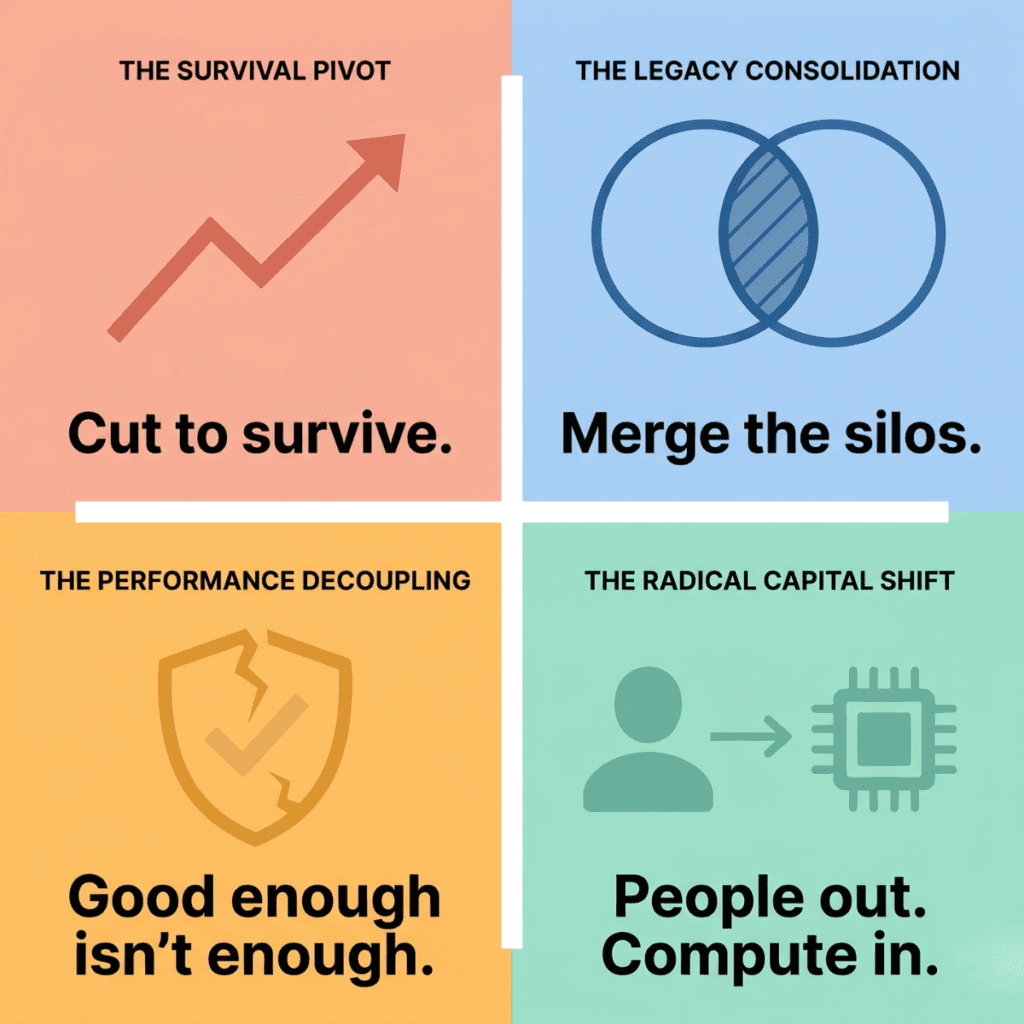
If we don’t separate these cases, we lose the ability to see where the market is actually going. Here is how the strategies currently diverge:
➔ The Survival Pivot: Snap Snap cut around 1,000 employees, which is roughly 16% of its workforce. The AI narrative was front and center: productivity gains, less repetitive work, and faster teams.
That is real, but it’s only half the story. Snap has struggled to reach consistent profitability. For a company in that position, cost control isn’t a theory; it’s a necessity. They are trying to make the business sustainable before the market forces their hand. AI isn’t just a tool here; it’s a lifeline.
➔ The Legacy Consolidation: Disney Disney’s cuts across marketing, ESPN, and tech look like a classic “clean-up” move. This is a company dealing with overlapping teams and the need to streamline operations across divisions that historically operated in silos.
If you have separate teams running similar campaigns across streaming, sports, and theatrical releases, consolidation is inevitable. This reads as restructuring first and AI second.
➔ The Performance Decoupling: Morgan Stanley This is where the shift becomes sobering. Morgan Stanley cut about 2,500 roles while the firm was performing well. It sends a clear message: Performance alone is no longer a shield. A professional can hit every target and still be impacted if the structure around them changes. If a task can be automated or consolidated, the role itself becomes vulnerable. This is a fundamental shift in how “stability” works in the modern labor market.
➔ The Radical Capital Shift: Oracle Oracle is a different conversation entirely. With cuts reaching 10,000+ roles, this isn’t simple cost-cutting; it’s a major capital reallocation.
At the same time they are letting people go, they are investing billions into AI infrastructure and data centers. We should be clear: this is a trade. They are trading human capital for compute power. It may make sense on a spreadsheet, but treating a workforce as an interchangeable cost while prioritizing hardware is a high-risk long-term move.
The Hidden Trap: AI Infrastructure is Not a “Free Trade”
There is a piece of this story that often gets glossed over in the boardroom.
AI is expensive. Very expensive.
Companies are not just replacing people with software and pocketing the difference. They are taking on massive new line items:
- Compute & Storage: The “utility bill” that never stops growing.
- Integration & Maintenance: The hidden cost of making AI actually work.
- Vendor Dependence: Trading a salary for a recurring API fee you don’t control.
A company can reduce headcount and show immediate margin improvement. But over time, those infrastructure costs can grow just as fast as the headcount once did. The cost didn’t disappear; it just moved from the HR department to the IT department.
The Question We Aren’t Asking
Most leadership teams right now are asking: “How much work can AI take off this team, and how many people does that let us cut?”
That is a logical question, but it is incomplete. The better question, the one that will define the winners of the next decade, is:
“What could this team produce if AI removed the friction from their work?”
Two Paths: Efficiency vs. Capability
Imagine two competing firms adopting the same AI tools.
- Firm A focuses on Efficiency. They reduce headcount by 20% and keep their output exactly where it was. They look great on the next quarterly earnings call.
- Firm B focuses on Capability. They keep their team and use AI to triple their output, moving three times faster than they did last year.
Six months in, Firm A looks “lean.” Twelve months in, Firm B has captured the market.
Same tools. Different intent. One is a race to the bottom; the other is a race to the future.
The Bottom Line: Systems Scale, but People Decide
The “middle layer” of the corporate world is shrinking. Roles focused solely on coordination and reporting are under immense pressure because AI is getting very good at those tasks. This leads to flatter organizations and faster decision-making, but it also increases the strain on the people who remain.
We can be “Pro-AI” and still say this clearly: People still matter.
AI handles repetition and coordination. It does not replace judgment. It does not replace context. It does not replace the person who knows how a system actually behaves under pressure.
The companies that win will not be the ones that cut the most. They will be the ones that use AI to make their people more effective, not just fewer.
Because in the end, systems scale. But people decide how those systems are used.
Sources:
- https://www.financialexpress.com/world-news/us-news/amazon-citi-dell-lead-fresh-wave-of-layoffs-as-ai-reshapes-jobs-in-2026/4203829/
- https://www.informationweek.com/it-staffing-careers/2026-tech-company-layoffs
- https://www.siyglobal.com/blog/7-leadership-trends-for-2026
- https://www.benzinga.com/news/social-media/26/04/51826040/snap-to-slash-1000-jobs-ai-productivity-picks-up
- https://news.az/news/snap-shares-surge-on-major-ai-driven-layoffs
- https://letsdatascience.com/news/snap-cuts-16-workforce-citing-advances-in-ai-04365fbc
- https://www.theguardian.com/film/2026/apr/14/disney-to-cut-jobs-ceo-layoffs
- https://www.businesstoday.in/latest/corporate/story/disney-layoffs-entertainment-mnc-plans-to-cut-1000-jobs-report-heres-who-will-be-affected-524767-2026-04-09
- https://www.finalroundai.com/blog/layoffs-usa-2026
- https://www.peoplematters.in/news/strategic-hr/capital-one-plans-layoffs-of-over-1100-employees-at-former-discover-headquarters-48677
- https://www.bankingdive.com/news/capital-one-discover-job-cuts-layoffs/813908/
- https://medium.com/@marc.bara.iniesta/the-42-that-never-recovered-labor-market-data-reveals-managements-permanent-decline-3e730e7ff658
- https://www.gurufocus.com/news/8794340/snap-snap-announces-job-cuts-and-strategic-changes-shares-rise-6
- https://www.barchart.com/story/news/1316608/snapchat-owner-cuts-16-of-global-staff-in-latest-round-of-job-cuts
- https://www.lse.co.uk/news/snap-to-cut-1000-jobs-shares-spark-i9fm3zhavj4g5lf.html
- https://www.ctvnews.ca/business/article/snap-to-cut-1000-jobs-after-activist-pressure-bets-on-ai-efficiency/
- https://in.tradingview.com/news/invezz:b62457eb2094b:0-snap-stock-rises-on-plan-to-cut-1-000-jobs-and-500-million-costs/
- https://www.sahmcapital.com/news/content/irenic-urges-snap-to-cut-costs-exit-specs-boost-buybacks-improve-governance-ahead-of-meeting-2026-04-01
- https://www.hindustantimes.com/trending/us/disney-layoffs-new-ceo-josh-damaro-announces-1-000-job-cuts-a-month-after-taking-top-role-101776217779201.html
- https://www.techdogs.com/tech-news/td-newsdesk/after-netflix-disney-plans-to-cut-around-1000-jobs-from-the-marketing-department
- https://timesofindia.indiatimes.com/technology/tech-news/disney-layoffs-ceo-josh-damaros-memo-announcing-1000-job-cuts-tells-employees-that-fast-movin/articleshow/130264918.cms
- https://www.gurufocus.com/news/8783270/disney-dis-to-cut-1000-jobs-in-strategic-reorganization
- https://www.varindia.com/news/Disney-planning-to-lay-off-1000-employees-under-new-CEO-Josh-D%E2%80%99Amaro
- https://intellectia.ai/news/stock/disney-to-cut-1000-jobs-as-part-of-strategic-reorganization
- https://nationaltoday.com/us/tn/nashville/news/2026/04/13/oracle-pursues-zoning-change-for-east-bank-campus-amid-layoffs/
- https://www.nashville.gov/featured-initiatives/east-bank-development
- https://www.hrkatha.com/uncategorized/capital-one-to-cut-over-1100-jobs-as-discover-integration-continues/
- https://www.paymentsdive.com/news/capital-one-job-cuts-discover-workers-integration-riverwoods/760945/
- https://straussborrelli.com/2026/03/05/capital-one-illinois-warn-act-investigation
- https://www.dailyherald.com/20260306/business/capital-one-to-eliminate-1139-jobs-connected-with-former-discover-facility-in-riverwoods/
- https://www.entrepreneur.com/leadership/as-companies-cut-managers-the-smart-ones-are-investing-in/498397
- https://www.northbaybiz.com/2026/03/24/flatten-down-the-hatches/
- https://surgeadvisory.com/blog/the-ghost-in-the-org-chart/
- https://employmenthero.com/uk/news/ghost-jobs-fake-job-listings-uk-job-seekers/