
Deep Tech as Industrial Infrastructure
The era of deep tech only being thought of as scientific projects is over. The industrial phase has begun.
TL;DR FAQ: How is deep tech becoming industrial infrastructure?
▼ Q: What does it mean that deep tech is becoming industrial infrastructure?
A: Deep tech is no longer just scientific projects in labs—it’s now embedded into the fundamental systems that power modern industrial production. Factories, energy grids, and manufacturing facilities are being built with intelligent systems, digital twins, and AI-driven optimization as core infrastructure, not optional add-ons.
▼ Q: Why has deep tech funding become more selective?
A: AI’s massive capital requirements have reshaped funding across all sectors, leaving less capital available elsewhere. Investors now favor deep tech companies that can demonstrate real industrial deployment—actual customers, offtake agreements, and integration into existing production lines—not just R&D progress or technical specs.
▼ Q: How are factories being transformed beyond traditional automation?
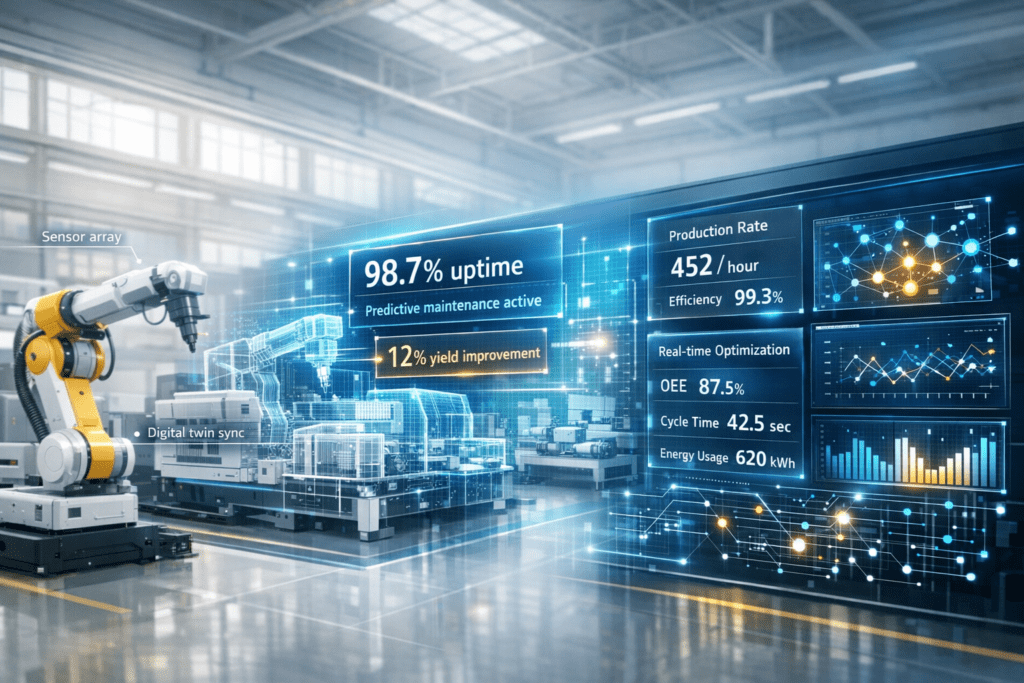
A: Modern factories are being designed as intelligent systems with predictive maintenance, AI-assisted scheduling, and real-time data visibility across entire production lines. This isn’t about replacing workers—it’s about reducing downtime, increasing yield, and controlling risk in capital-intensive manufacturing where mistakes cost millions.
▼ Q: What are digital twins and why are they critical for industrial operations?
A: Digital twins are live digital replicas of machines, production lines, or entire plants that continuously ingest sensor data and allow teams to simulate changes before touching physical equipment. This shifts manufacturing from “build-test-break-fix-repeat” to “simulate-optimize-deploy-monitor,” dramatically reducing waste and making multimillion-dollar capital decisions less risky.
▼ Q: What specialized roles are emerging as deep tech becomes infrastructure?
A: Digital twin engineers, industrial data engineers, OT cybersecurity specialists, hybrid automation engineers, and smart factory project managers. These aren’t speculative innovation lab positions—they’re tied directly to facility buildouts, commissioning timelines, and production ramp targets with contractual penalties attached.
▼ Q: Where is industrial deep tech hiring concentrated geographically?
A: Hiring is shifting to regional industrial hubs—semiconductor fabs in Arizona and Ohio, battery gigafactories across the Southeast, energy infrastructure in Texas, and advanced manufacturing throughout the Midwest. The talent wars of the next decade will be fought over engineers who can commission multibillion-dollar facilities on schedule.
▼ Q: Why can’t traditional recruiters find talent for industrial deep tech roles?
A: The hybrid professionals needed—digital twin engineers, OT cybersecurity specialists, engineers deploying AI in capital-intensive environments—aren’t on LinkedIn waiting for offers. They’re already solving hard problems at scale. STEM Search Group combines deep domain expertise (including a Research Atomic Physicist and Materials Science Engineer) with AI-powered sourcing to find specialists who understand both physical production systems and advanced software stacks.
For years, deep tech lived in a world of long timelines and longer pitches. Venture capitalists bet on breakthrough science. Founders promised paradigm shifts. Everyone talked about what was possible.
That era isn’t over, but it’s no longer a distant abstraction.
Something fundamental has shifted. Deep tech is moving out of the lab and into being part of the fundamental backbone of our industrial economy. If you follow the capital, the factory construction, and the hiring patterns, the change is unmistakable.
We’ve entered the industrial phase of deep tech.
Capital Has Gotten Disciplined (And That’s Good)
Over the past two years, funding has become surgical. Fewer deals. Larger rounds. Higher bars for entry.
Some observers call this a slowdown. When they do, they’re not telling the whole story.
This is the market finding equilibrium. AI’s explosive capital requirements have reshaped the entire funding landscape. Massive rounds going to foundation models and compute infrastructure mean less capital available everywhere else. SaaS multiples have compressed. The bar has risen across the board.
Investors still chase moonshots, they always will. But with finite capital and higher opportunity costs, they’ve gotten pickier about which moonshots they back.
The result: deep tech companies that can sell into industry, that can generate real revenue from real customers with real budgets, are suddenly much more attractive. Not because investors have lost their appetite for ambitious bets, but because those bets now need to pencil out faster.
Deep tech is becoming a revenue story, not just a vision story.
This means:
- A robotics company needs customers willing to deploy at scale, not just pilot programs
- A battery startup needs offtake agreements, not just performance specs
- A semiconductor innovation needs adoption from fabs with production schedules, not just technical validation
- A manufacturing technology needs to integrate into existing lines without shutting them down
The companies winning funding can answer: “Who’s buying this? When? And for how much?”
Traditional capital-intensive industries have always required money and approvals. What’s changed is that deep tech is now competing for capital in an AI-dominated funding environment, and the ones that survive are the ones that can show industrial deployment, not just R&D progress.
An Overlooked AI Story Is Happening Inside Factories
While the tech world obsesses over Gen AI chatbots, agents, and benchmark leaderboards, a quieter push is unfolding on factory floors.
Plants aren’t just being automated, they’re being designed and upfitted as intelligent systems. Connected. Sensor-heavy. Data-driven at every layer.
This looks like:
- Predictive maintenance instead of reactive firefighting
- AI-assisted scheduling instead of manual planning spreadsheets
- Real-time visibility across entire production lines, not siloed data in departmental dashboards
There aren’t initiatives driven by replacing workers. It’s about reducing the downtime that kills margins, increasing the yield that determines competitiveness, and controlling the risk that makes capital-intensive manufacturing so unforgiving.
The companies reshoring production or expanding domestic capacity aren’t building 20th-century factories. They’re building 21st-century ones, and the difference is intelligence baked into the foundation.
Digital Twins: Simulating Real World Outcomes
Inside these intelligent facilities, the a real game-changer is the digital twin.
A digital twin isn’t a pretty 3D rendering for investor decks. It’s a live digital replica of a machine, production line, or entire plant. It continuously ingests sensor data and allows teams to simulate changes before touching any physical equipment.
The old industrial model was simple but expensive: Build → Test → Break → Fix → Repeat
The new model is fundamentally smarter: Simulate → Optimize → Deploy → Monitor
Before changing a production process? Run it in the digital environment. Before ramping output? Model the stress points and bottlenecks. Before investing $50 million in new equipment? Test the impact virtually.
This approach:
- Dramatically reduces waste
- Shortens feedback loops from months to days
- Makes capital decisions less risky in industries where mistakes cost millions
It also fundamentally changes who companies need to hire.
The New Talent Stack for Industrial Deep Tech
This shift is creating an entirely new class of specialized roles:
- Digital Twin Engineers who understand simulation software, control systems, and data modeling at the intersection of physical and digital
- Industrial Data Engineers who can connect sensor networks to enterprise systems and transform raw signals into actionable intelligence
- OT (Operational Technology) Cybersecurity Specialists who protect connected factories from increasingly sophisticated threats—because a hacked assembly line is no longer theoretical
- Hybrid Automation Engineers who understand not just PLCs and control systems, but also data pipelines and AI/ML tools
- Smart Factory Project Managers who can speak both plant floor operations and software development fluently
These aren’t speculative hires for “innovation labs.” They’re tied directly to facility buildouts, commissioning timelines, and production ramp targets with contractual penalties attached.
When a leading manufacturer invests millions in building or upfitting a smart factory, it’s to reach a specific operational milestone, higher throughput, tighter quality control, lower downtime, or new product capability. That milestone immediately translates into very specific, time‑sensitive hiring needs across both the plant floor and the software stack.
Geography Is Shifting With the Work
This transformation isn’t confined to one part of the country or only in tech hubs like Silicon Valley, Boston, or Seattle.
Look at the map:
- Semiconductor fabs rising in Arizona and Ohio
- Battery gigafactories spanning the Southeast corridor
- Energy infrastructure projects accelerating across Texas
- Advanced manufacturing hubs emerging throughout the Midwest
Deep tech hiring is becoming regional, industrial, and asset-focused. The center of gravity is moving away from software campuses and toward physical production sites.
The talent wars of the next decade won’t be fought over remote-first product managers. They’ll be fought over engineers who can commission a $2 billion fab on schedule.
From “What If?” to “How Fast?”
The throughline connecting selective funding, intelligent factories, and digital twin deployment is execution.
Deep tech is maturing. The questions have changed:
“What’s theoretically possible?”
↓
“What can be deployed at scale, inside regulated environments, under real cost pressure?”
“How revolutionary is the science?”
↓
“How fast can we reach commercial production?”
“What’s the TAM in 2030?”
↓
“What’s our unit economics at 10,000 units per quarter?”
When funding narrows, investmentsstrategic intent sharpens. When intent sharpens, hiring becomes deliberate. Roles become tied to outcomes, not optional innovation theater.
The Industrial Phase Has Begun
Deep tech is no longer primarily about inventing something novel. It’s about embedding that invention into the systems that power modern civilization.
Factories are becoming intelligent organisms. Energy grids are being optimized in real time. Physical production is being simulated before a single dollar is spent on tooling.
This isn’t flashy. It’s not driven by hype cycles.
It’s infrastructure.
And the companies that understand this shift, particularly how it reshapes talent needs, capital deployment, and competitive advantage, are the ones positioning themselves to lead the next decade of industrial innovation.
The age of the science project is ending.
The age of industrial deep tech has arrived.
Finding Talent for the Industrial Phase
If you’re building in this space, your talent strategy can’t look like a SaaS company’s hiring playbook. The people you need, digital twin engineers, OT cybersecurity specialists, AI engineers deploying in capital-intensive environments, aren’t waiting on LinkedIn. They’re already deployed, solving hard problems at scale, and most recruiters don’t even know what questions to ask them. STEM Search Group does. Our team includes a Research Atomic Physicist, a Materials Science Engineer, and three leaders with 20+ years each in executive search and niche individual contributer recruiting. We combine domain expertise with AI-powered sourcing and agentic tech stacks because finding hybrid talent for the industrial phase requires both, not one or the other.
Most firms are looking for rinse-and-repeat business. They love the easy, hate the hard. We love the hard to find. You don’t need a recruiting firm, you need a partner who finds the unfindable. That’s us. That’s STEM Search Group.