
Deep tech’s vertical bet isn’t about owning the stack. It’s about not becoming too slow to need to.
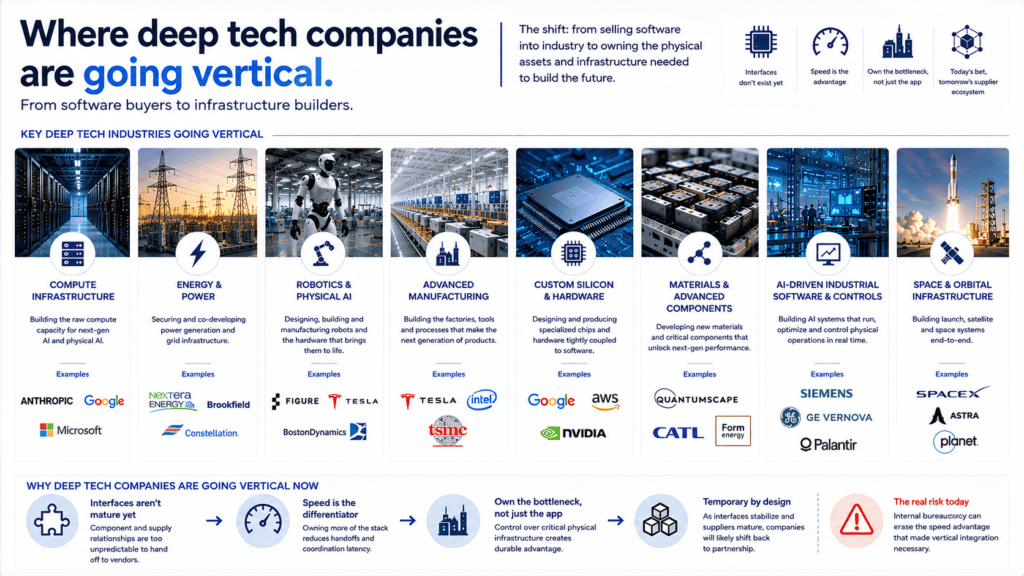
TL;DR
Is vertical integration new in tech?
No. Software and manufacturing have been converging for over a decade through digital twins, IT and OT integration, and embedded control systems.
What’s actually different about deep tech’s current vertical integration trend?
AI and physical AI companies are now becoming the owners of physical assets like power plants, factories, and custom silicon, rather than buying software from companies that own those assets.
Why are companies like Anthropic, Figure AI, and Tesla building or co-developing physical infrastructure instead of buying from suppliers?
The component and supply relationships they need do not exist yet at a mature, standardized level, so the interfaces between hardware and software are too unpredictable to hand off to an outside vendor.
Will vertical integration in deep tech last forever?
No. Innovation theory and past industry cycles, including autos and semiconductors, show that once component interfaces stabilize and suppliers mature, companies tend to shift back toward specialization and partnership.
What is the biggest risk to companies that vertically integrate right now?
Internal bureaucracy and management layers can erase the coordination speed advantage that justified integrating in the first place, which is a bigger threat than a competitor’s technology.
Where is the talent for all this new hiring supposed to come from?
Mostly from existing pools of power engineers, mechatronics designers, and industrial manufacturing specialists who already work for utilities, defense primes, and traditional manufacturers, meaning this is a reallocation of scarce talent rather than the creation of a new one.
Should candidates in these fields expect deep tech jobs to be permanent?
It depends on whether the company is building a durable capability for a long-term bottleneck or a temporary one for a phase that ends once suppliers mature, and workers should ask that question directly before joining.
There is a version of this article that has been written a hundred times already. It goes something like: software companies are getting into hardware now, physical infrastructure is the new frontier, buckle up. If that is the article you were expecting, you can stop reading here.
Because someone is going to read a piece like this and think: we have been integrating software and hardware for years. Digital twins. IT and OT convergence. Predictive maintenance sensors bolted onto factory floors since the 2010s. They are right. That work is real, and it did not start in 2023.
But there is a difference between what happened then and what is happening now, and it is not a difference of degree. It is a difference of ownership.
Software used to sell into industry. Now it is becoming industry.
The last decade of software-meets-hardware convergence followed a consistent shape. GE sold digital twin software to aircraft manufacturers. Siemens sold predictive maintenance platforms to utilities. The software vendor never owned the turbine, the plant, or the factory floor. It sold a layer that sat on top of someone else’s physical assets.
What deep tech is doing now is a different shape entirely.
- Anthropic did not license simulation software to a power company. It secured direct access to roughly 3.5 gigawatts of custom compute capacity through co-development agreements with Broadcom and Google.
- Figure AI did not wait for a tier-one supplier to build humanoid actuators. It built its own manufacturing facility, BotQ, designed to scale to 100,000 units over four years, because that supplier base does not exist yet.
- Tesla converted an entire assembly line at its Fremont facility, one that used to build Model S and X vehicles, to make Optimus robots, with its own actuators, motors, and battery packs built in-house.
- NextEra Energy and Brookfield stopped selling power wholesale to data centers and started co-developing the campuses themselves, including redeveloping former nuclear sites specifically for AI compute.
None of this is a software company buying tools. It is a software and AI company becoming the plant owner, the factory owner, the utility. That is the actual shift, and it is worth naming precisely instead of folding it into a vague story about “convergence,” because convergence already happened. Ownership is the new part.
Why now, and why this specific set of industries
There is a useful piece of innovation theory here, developed by Clayton Christensen, called the theory of interdependence and modularity. The short version: when the interface between two parts of a system is unpredictable, meaning nobody yet knows exactly how the pieces need to fit together, the same organization has to build both pieces together. Once that interface becomes stable and well understood, it can be handed off to independent suppliers, and the market modularizes.
That is a better explanation for what is happening in AI compute, robotics, and defense right now than “innovation is moving fast.” It is not about speed in the abstract. It is about which interfaces are still unstable.
- Nobody has a settled spec yet for how a rack-scale AI cluster’s power, cooling, networking, and silicon need to interact, so the companies building the clusters are building all of it themselves.
- Nobody has a mature spec for a humanoid actuator that needs to move at the torque, weight, and latency required by a vision-language-action model, so Figure and Tesla are designing actuators from scratch instead of buying off a catalog.
- The interface for grid interconnection and behind-the-meter power generation is being renegotiated in real time, with utility interconnect queues running 5 to 7 years while data centers can be built in 12 to 18 months, so compute companies are becoming power developers out of necessity, not ambition.
This also explains why integration is not winning everywhere in deep tech, and this matters because it keeps the argument honest instead of universal. DeepSeek did not need to own a power grid or a fab to compete on frontier reasoning performance, because the model layer’s interfaces, open weights, and published architectures are already stable and shareable. ASML still does not build chips. Arm still does not fabricate silicon. Contract manufacturers still run most biomanufacturing at scale. Those interfaces stabilized decades ago, so specialization still wins there. Integration is not a universal law of deep tech. It is a response to a specific condition: an interface that has not settled yet.
Which means this is not permanent, and companies making these decisions should say so out loud
If integration is a response to unstable interfaces, then it has an expiration date, because interfaces stabilize. This already has precedent inside deep tech itself.
Biotechnology went through a full vertical integration wave earlier in this decade, with venture-backed companies trying to own computational drug design, wet-lab execution, and late-stage clinical trials all under one roof. Most of that retreated. AI-driven biotech platforms now license molecules to established pharmaceutical partners instead of running their own trials, because clinical trial risk and regulatory complexity turned out to be exactly the kind of stable, well-understood interface that a specialized partner handles better than a generalist owner.
The same pattern has already happened once in the physical industry. Automakers spent the mid-20th century building River Rouge-style complexes that owned everything from iron ore to the finished car. Once component standards matured, the industry shifted to tiered supplier networks, and companies that kept trying to own everything internally lost ground to competitors who could source better components faster from outside specialists. Semiconductors did the same thing in reverse: design went fabless once foundries like TSMC became reliable enough to trust with production.
So when a robotics company builds its own actuator supply chain today, or a compute company signs a nuclear co-location deal, the honest way to describe that decision is a bet, not a permanent strategic position. The bet is: how long will this specific interface stay unstable? If a tier-one supplier for humanoid actuators exists in five years, the company that built its own factory to solve a problem that no longer exists is now carrying capital intensity it does not need. If the interface never stabilizes, that company built a real and lasting moat. Nobody knows yet which one is true, and companies should be clear-eyed that they are placing a bet rather than executing a permanent doctrine.
The bigger risk isn’t the market maturing. It’s the org chart
Here is the part that gets missed in most of the coverage of this trend: even if the market stays immature and the bottleneck is real for another decade, that does not guarantee the integrated company keeps winning.
Ronald Coase’s original theory of the firm runs in both directions. A company integrates when its internal coordination costs are lower than the cost of using the market. But internal coordination costs are not fixed. They grow through management layers, approval chains, budget cycles, and risk-averse sign-off processes as the organization scales.
That means the same logic that justified vertical integration in the first place can quietly reverse itself. A company integrates to move faster than the market. If its own bureaucracy becomes slower than the market would have been, it has recreated the exact coordination problem it integrated to avoid, except now that problem lives inside its own walls, where it is much harder to fix. You cannot just switch suppliers to escape your own org chart. You have to restructure yourself, which is slower and more political than swapping a vendor.
This is not a hypothetical. It is the story behind most of the cautionary tales about large integrated companies losing their edge: General Motors, IBM during its hardware era, Kodak. None of them lost because they were wrong to integrate. They lost because integration bought them a speed advantage that they then spent on process instead of protecting.
For deep tech companies right now, this means the real competitive question is not “should we own the actuator supply chain” or “should we co-develop the reactor.” Those are usually the right calls given where the interfaces sit today. The real question is whether the organization can hold onto the coordination speed that justified the decision, once headcount triples and the company has five reporting layers between an engineer and a decision-maker.
The talent is the part nobody is being honest about
Every one of these vertical moves requires people, and the people required did not appear out of nowhere. This is the part of the story that gets treated as a footnote, and it should not be.
- Power systems engineers, high-voltage transmission specialists, and substation project directors were already scarce before AI compute companies started competing for them, and they were already working for utilities, industrial manufacturers, and regional grid operators who need them just as badly.
- Mechatronics engineers, custom actuator designers, and embedded controls specialists were already split between traditional industrial automation, aerospace, and defense before humanoid robotics companies entered the same hiring pool.
- Advanced packaging and photonics specialists were already concentrated in a handful of semiconductor firms before hyperscalers started building their own custom silicon programs.
This is a reallocation of an existing, limited labor pool, not the creation of a new one. When Anthropic, Figure, or a hyperscaler hires a grid interconnection engineer, that person is very likely leaving, or being pulled away from, a utility or a manufacturer that also cannot find enough of them. The same 5 to 7 year interconnect queues driving companies toward direct power ownership are, in part, a symptom of exactly this kind of strained engineering labor supply.
This creates a real decision point for both employers and candidates that most job postings do not address honestly.
For employers: if the capability you are hiring for is a bet on a temporary bottleneck, that should shape how you build the team. A stockpiled, transitional capability should be resourced, scoped, and managed differently than a permanent one. Treating a five-year bet like a lifetime department is how you end up with the bureaucracy problem described above, before the ink is even dry on the org chart.
For candidates: ask directly whether the role you are being recruited into is a durable function or a phase-specific one. A mechatronics engineer joining a humanoid robotics company today should ask what happens to their role if a mature actuator supplier exists in five years. A power engineer joining an AI infrastructure company should ask whether the company plans to keep owning generation assets long-term or exit that business once grid queues shorten. These are fair questions, and a company that has thought seriously about its own strategy should have real answers to them.
What this actually means going forward
Vertical integration in deep tech right now is not a permanent doctrine, and it is not simply a repeat of what software and manufacturing have already been doing for a decade. It is a response to a specific and identifiable condition: unstable interfaces between hardware and software in a handful of sectors where the standard supplier relationships have not caught up yet.
That condition will not last forever in every sector, the way it already stopped applying in biotech and never applied at all to companies like ASML or Arm. Companies making integration decisions today are making a time-bound bet, whether they say so or not. The ones that will hold their advantage are the ones that keep their internal coordination faster than the market would be, and are honest with the people they hire about which side of that bet they are actually on.
This is also where a firm like STEM Search Group tends to get pulled into the conversation. Most of the hiring difficulty described above does not come from a shortage of any single skill. It comes from companies trying to evaluate and hire across disciplines that have never shared a recruiting process before: a power engineer and a machine learning researcher, a mechatronics designer and a compiler engineer, using a single playbook built for one or the other. Getting that hiring right, and being honest with candidates about whether a role is durable or transitional, is a large part of what determines whether a company’s vertical bet turns into a moat or a liability.
Sources
- Roadmap: the AI data center stack, Bessemer Venture Partners
- Can America build things? Tracking U.S. progress in robotics and drone manufacturing, WisdomTree
- The next big theme: April 2026, Global X ETFs
- Critical and Emerging Technologies Index, Belfer Center for Science and International Affairs
- AI and deep tech investments landscape, Nishith Desai Associates
- Private-sector data center plans advance for Paducah and Savannah River sites, American Nuclear Society
- Bessemer predicts: robotics and physical AI, Bessemer Venture Partners
- How a surge in defence and dual-use technology investment could reconfigure the global AI race, Chatham House
- VCs backing AI-native enterprise software startups in 2026, Sky9 Capital
- Who are the best tech VC firms for raising capital in 2026, Visible.vc
- Vertical SaaS vs. vertical AI: a distinction with a key difference, Reformation Partners via Medium
- What is vertical AI? The category defining the next era of software, York IE
- Vertical AI is the future of early-stage tech investing, Value Add VC
- What is modularity theory, Christensen Institute
- Why understanding modularity theory is key to market creation, Christensen Institute
- Interdependence vs. modularity: getting the scope of the business right, Harvard Business School