
ERE’s AI training headline sends HR and TA the wrong message
TL;DR
Will job seekers take lower pay for AI training?
Some will. ICIMS found 14% of 1,000 U.S. job seekers would accept lower pay in exchange for AI training. The published result does not tell us how much less they would accept or show that taking a pay cut is the typical response.
What pay cut would the typical worker accept for AI training?
Zero in the New York Fed sample. Among workers without employer-provided AI training, about 61% would give up no salary for an otherwise identical job with extensive AI training, and the median response was 0%.
Do workers expect companies to provide AI training?
Many do. An Express Employment Professionals and Harris Poll survey found 83% of U.S. job seekers said companies need to formally train employees on AI rather than expect them to learn on their own.
Are employers raising expectations because of AI?
Yes. ZipRecruiter found 57% of surveyed U.S. hiring managers and TA professionals said they expect more productivity from their workforce because of AI. Only 22% reported mandatory AI training for all employees.
Are employers providing the AI tools employees use at work?
Often, they are not. Google and Ipsos found 27% of U.S. employees said their organization provided AI tools. Epoch AI and Ipsos found free plans were the most common source of AI access among recent workplace AI users overall.
Is job-related AI training paid time under the FLSA?
For non-exempt employees, training generally counts as work time unless all four federal tests for excluding training time are met. One of those tests is that the training is not directly related to the employee’s job.
Are AI skills associated with higher pay?
Yes, in current labor-market data. PwC found jobs requiring AI skills carried an average 62% wage premium globally. Payscale found 56% of surveyed employees believed developing AI skills should lead to higher pay.
ERE picked the most provocative number
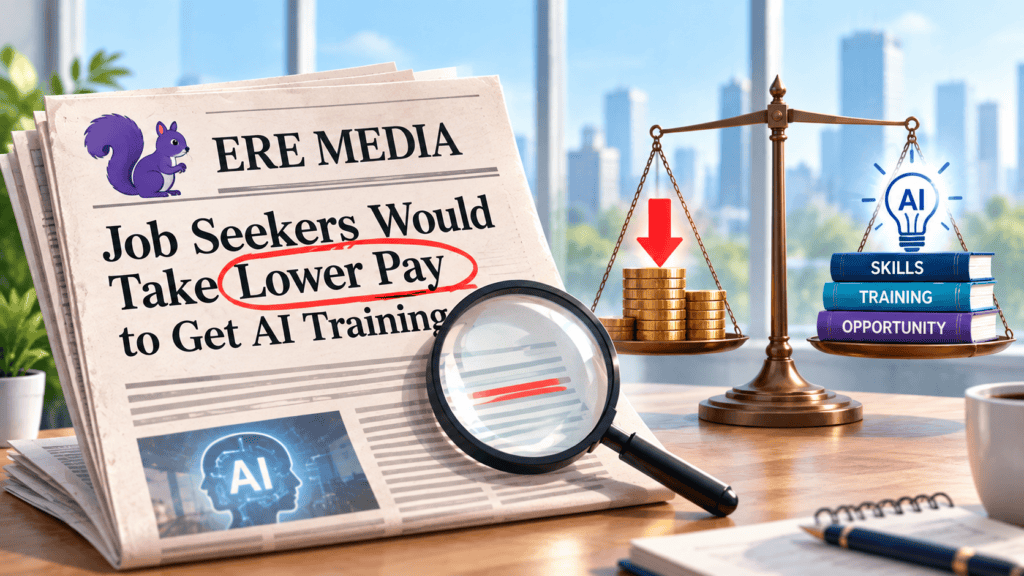
ERE published a story this week titled Job Seekers Would Take Lower Pay to Get AI Training.
The number behind the headline is real. ICIMS surveyed 1,000 U.S. job seekers and found 14% would accept lower pay in exchange for AI training. The same research found 42% would find an employer offering AI training more attractive than a similar employer that did not.
Both numbers are real. ERE chose the 14% for the headline.
That choice matters because ERE writes for talent acquisition leaders, recruiters, sourcers, and other people who influence hiring decisions. Its readers help shape compensation, offers, recruiting strategy, and the employee value proposition. A headline saying job seekers would take lower pay for AI training can make a 14% response sound like a broader labor-market behavior.
The article itself is more careful. It gives the 14% figure in the first sentence, includes the 42% attraction figure, discusses employer investment in upskilling, and ends with ICIMS Head of Talent Insights Trent Cotton arguing that employers should rethink, reskill, and redeploy workers as skills change.
The article contains a better story than the headline sells.
ICIMS also found that 47% of job seekers worked on their AI skills in the previous six months. The share teaching themselves rose from 22% to 30% in one year, while employer-provided training stayed roughly flat at about one in six.
Workers are already investing in AI skills. Employers are also putting AI into more jobs and asking more from people who use it. The useful HR question is how much of that shift’s cost companies should expect employees to absorb.
Ask workers who should provide the training
Express Employment Professionals and The Harris Poll asked a version of that question directly. Their research found 83% of U.S. job seekers said companies need to formally train employees on how to use AI rather than expect them to learn on their own. Hiring managers were close behind: 86% said formal AI training should be a company priority.
Google and Ipsos found similar pressure from another angle. In a nationally representative survey of 4,464 employed U.S. adults, 65% expressed some interest in formal workplace AI training. Only 14% said their organization had offered AI-related training during the prior 12 months. Twenty-seven percent said their organization provided AI tools, and 37% said it provided guidance on AI use at work.
Those findings still leave room for personal responsibility. Employees have a reason to build portable skills, stay current, and invest in their own careers. An employer does not become responsible for every AI course, certification, or skill an employee wants to pursue.
The line gets clearer when the employer changes the job. If a company expects employees to use an approved AI platform, follow its data rules, redesign workflows around AI, and produce more because AI is available, the company has created an implementation requirement. Training, approved tools, governance, and reasonable learning time belong in that implementation plan.
Workplace AI combines general skills, such as model literacy, with company-specific data, workflows, security rules and quality standards. Some of that knowledge travels with the employee. Some exists because of how a particular company has chosen to use AI.
That distinction matters when deciding who pays.
The New York Fed asked the pay question more directly
The Federal Reserve Bank of New York gives us a better look at what workers would actually trade for AI training.
Using a November 2025 supplement to its Survey of Consumer Expectations, researchers asked workers without employer-provided AI training what percentage of salary they would give up for an otherwise identical job offering extensive AI training.
The distribution matters:
- About 61% would give up nothing.
- About 20% would give up a positive amount up to 10% of salary.
- About 19% would give up more than 10%.
The average willingness to give up salary was 11.4%. The median was 0%.
A smaller group willing to make a large trade can pull an average upward. The worker in the middle of this distribution would give up no salary for the training. That is useful context when a headline focuses on the share of people willing to make the trade at all.
The Fed also asked workers who already had employer-provided AI training what salary increase they would require to accept an otherwise identical job without it. The average was 24.2%, and the median was 15%.
That result needs context too. The Fed notes that selection and loss aversion may help explain the gap. Workers who value AI training may sort into jobs that provide it, and people can value a benefit more once they already have it.
The larger point is straightforward: workers value AI training in very different ways. A minority will trade compensation for it. A majority in the Fed sample would give up no salary at all. Compensation strategy should reflect the distribution, not the most clickable slice of it.
Employers are raising the AI bar faster than training it
ZipRecruiter surveyed more than 1,000 U.S. hiring managers and talent acquisition professionals in June 2026. Fifty-seven percent said they expect more productivity from their workforce because of AI. Seventy-four percent called AI skills a strong advantage or requirement for at least some roles, and 50% expected candidates to arrive as practical or advanced AI users.
Training is much less consistent. Twenty-two percent reported formal, mandatory AI training for all employees. Another 23% provided it to specific departments, 34% relied on optional resources, and 17% provided no training.
Payscale found a similar shift in job design. Sixty-one percent of employers surveyed said they were rewriting job descriptions because of AI transformation, 40% said they could not find candidates with enough AI fluency, and 74% planned to invest in AI upskilling during the next 12 months.
That creates a basic operating question. When a business raises the performance standard because employees now have AI, what investment did the business make to help employees reach that standard?
HR and TA should separate two types of investment. Job enablement covers the tools, company-specific workflows, security rules, governance, and skills needed to perform the current job. Career development builds broader, portable expertise that can increase someone’s value across employers, such as advanced machine learning engineering or a substantial external credential.
A manufacturer installing new CNC equipment would budget for the machine, setup, safety requirements, and the instruction needed to run it. AI may be software, but the implementation logic is similar when the company expects it to change how the job gets done.
The employee still has responsibility here. Curiosity, practice, and career development matter. The employer also has responsibility when it changes the job’s tools and standards. Those responsibilities can overlap.
Workers are already filling gaps with their own AI access
The tool question is easy to miss because AI products are unusually easy for an employee to acquire without the employer.
Google and Ipsos found only 27% of U.S. employees said their organization provided AI tools. Epoch AI and Ipsos looked specifically at 469 U.S. workers who had used AI for work during the previous seven days. Across that group, 46.4% said the main AI subscription they used for work was a free plan, 12.7% personally paid for it, and 36.9% had an employer-provided subscription at least some of the time.
Occupation matters. Among AI-using workers in computer, engineering and science occupations, 66.8% had employer-provided access at least some of the time. In sales and office occupations, that figure was 24.4%. In trades, production and transportation, it was 10%. Epoch cautions that these occupational subgroup samples are small enough that the percentages should be treated as directional rather than precise estimates.
A personal or free account does not automatically equal shadow AI. Some employers allow those tools, and a free account can be appropriate for some work. Risk grows when employees use unsanctioned tools for company work without the controls required of approved software.
Microsoft and LinkedIn documented that problem in their 2024 Work Trend Index. Globally, 78% of AI users said they were bringing their own AI tools to work. Microsoft’s detailed data showed the U.S. figure at 63%. Microsoft warned that unmanaged use can put company data at risk.
The 2026 Microsoft Work Trend Index adds another useful piece. Across 20,000 AI-using knowledge workers in 10 countries, organizational factors such as culture, manager support, and talent practices were associated with more than twice the reported AI impact of individual mindset and behavior, 67% versus 32%. Microsoft explicitly describes this as an association rather than proof of causation.
Employee initiative matters. An enterprise AI strategy also needs approved tools, clear rules, support, and management practices that let employees use those tools effectively.
If AI is becoming part of the job, the infrastructure to use it belongs in the operating plan.
Training requires time, not just a course link
Workera surveyed 1,000 full-time salaried employees at U.S. organizations with at least 5,000 employees in July 2026. Among the challenges employees reported when trying to develop AI skills, 56% cited having no time allocated during work hours and 43% cited a lack of relevant training materials.
The sample is limited to large enterprises, so those percentages should not be treated as a measure of every U.S. workplace. The operating problem is still easy to recognize.
A company can buy an AI platform and assign a training module. Employees still need time to practice on real work, understand where the tool fails, learn the company’s data rules, and develop judgment about when AI should and should not be used.
A license gives an employee access. Training and practice build capability.
For employers expecting measurable productivity gains from AI, that difference matters. The implementation plan needs to account for the time required to move people from access to competent use.
Job-related training can also be compensable time
For non-exempt employees, the Fair Labor Standards Act creates another reason to define the training correctly.
U.S. Department of Labor guidance says attendance at lectures, meetings, training programs, and similar activities can be excluded from working time only when all four conditions are met:
- The training occurs outside normal working hours.
- Attendance is voluntary.
- The training is not directly related to the employee’s job.
- The employee performs no productive work during the training.
Training required to perform an employee’s current job would generally be directly related to that job, so employers should be careful about treating that time as unpaid. Required attendance can also affect the voluntary-attendance test.
The facts matter, employee classification matters, and state law can add requirements. Employers should have employment counsel review the policy before telling non-exempt employees to build required AI skills on their own time.
The market is putting a price on AI skills
The compensation data makes ERE’s framing even more interesting.
PwC’s 2026 Global AI Jobs Barometer analyzed more than one billion job advertisements and found that jobs requiring AI skills carried an average 62% wage premium compared with jobs in the same sector that did not require those skills. PwC also reported 69% growth in jobs requiring specific AI skills, compared with 9% across the total jobs market in its analysis.
The 62% figure needs context. It compares jobs in PwC’s dataset. It does not mean an employee deserves a 62% raise after learning ChatGPT, and it does not prove AI skills alone caused the pay difference.
Payscale found the tension from both sides of the labor market. Fifty-six percent of employees surveyed said they should receive higher pay for developing AI skills. Fifty-eight percent of employers reported paying a premium for AI skills now or planning to within 12 months. Twenty-three percent said they had previously paid a premium but now considered AI fluency a baseline requirement.
That last number may be the most useful warning for workers and employers. Some AI skills will become ordinary job skills. Others will remain scarce and valuable. Compensation will depend on the skill, the role, and what that capability lets the employee actually do.
AI training can still be a meaningful recruiting advantage. ICIMS found 42% of job seekers were more attracted to an employer that offered it. A candidate may reasonably choose a slightly lower offer because one job provides exceptional development, better technology, stronger mentorship or a better long-term career path.
That is an individual tradeoff. It is weak evidence for a compensation strategy built around paying below market because training is available.
ERE, do better
ERE’s article contains useful reporting. It states the 14% figure immediately. It includes the larger 42% attraction figure. It covers the shortage of AI fluency and employer plans to invest in upskilling. Cotton’s final quote argues that employers owe workers an effort to rethink, reskill, and redeploy them as work changes.
The headline sends a different signal: Job Seekers Would Take Lower Pay to Get AI Training.
That is where ERE should do better.
The HR and TA community needs a clearer discussion about what happens when AI becomes part of the job: which skills employers require, which tools employees can safely use, who pays for them, when learning happens, how proficiency is measured, and how increased capability affects market pay.
Another useful ICIMS finding in the same research: 42% of job seekers find employers offering AI training more attractive. That tells employers training has recruiting value without suggesting that lower compensation should follow.
Use training to improve the job. Give employees approved tools and enough time to learn how to use them well. Be clear about which skills employees are expected to bring and which skills the company will teach. Then pay people according to the market value of the work and capabilities the job requires.
ERE reaches the people making those decisions. They deserve the whole story, especially when the smaller number makes the better headline.
What HR and TA leaders can do now
- Budget AI implementation as a package. Include approved tools, onboarding, governance, role-specific training, and protected learning time.
- Separate job enablement from career development. Fund the training employees need to perform the current job. Build a separate policy for advanced, portable education such as degrees, external certifications, or specialized technical programs.
- Define AI expectations in the job. Spell out which tools people will use, what AI proficiency means for the role, and where human judgment remains required.
- Keep compensation tied to the market. Treat AI training as part of the employment proposition without assuming it justifies a below-market offer.
- Give people a sanctioned path. Approved accounts, data rules, and practical guidance reduce the incentive to solve work problems with personal tools outside company controls.
- Measure capability instead of attendance. A completed webinar tells you very little. Test whether employees can use approved AI safely and effectively in the work they actually perform.
- Read the distribution before using a survey in a comp meeting. Ask for the exact question, sample, median, range, and size of the trade before turning one percentage into policy.
What we hear in the talent market
At STEM Search Group, we recruit across Engineering, AI & Technology, Automotive, Manufacturing, Robotics & Autonomy, Materials & Chemical, Medical Device, Biotech & Life Sciences, Healthcare & Behavioral Health, Aerospace & Space, Energy & Climate, Enterprise & Services, Startup, Deep Tech, and Scientific markets.
These are niche talent markets where employers cannot rely on active applicants alone. Finding the right person often means recruiting someone who is already employed, doing well, and needs a compelling reason to consider another opportunity.
Those conversations give us a direct view into what candidates are looking for. We hear what gets their attention, what questions they ask, what makes an opportunity worth exploring, and what causes them to walk away. That is especially true with passive candidates because they are comparing a new opportunity against a job they already have, rather than simply looking for their next paycheck.
AI training can make an opportunity more attractive. So can access to better technology, interesting work, career growth, strong leadership, and competitive compensation. The mix will be different for every candidate. That is exactly why employers should be careful about turning a finding that 14% would accept lower pay for AI training into a broader assumption about what candidates value.
For STEM Search Group, that is the part of this conversation we know firsthand. We spend our time talking with the people employers are trying to hire, including hard-to-find passive candidates who aren’t actively applying for jobs and may never show up in a job-seeker survey.
Sources
- ERE: Job Seekers Would Take Lower Pay to Get AI Training, September 24, 2026. ERE article
- ICIMS: Workers Are Teaching Themselves AI Skills Faster Than Employers Train Them, September 2026. ICIMS September 2026 research
- Federal Reserve Bank of New York: Use of Gen AI in the Workplace and the Value of Access to Training, April 14, 2026. New York Fed research
- Express Employment Professionals / The Harris Poll: 8 in 10 Employees Say They Need AI Training After Their Companies Already Rolled Out the Tools, April 22, 2026. Express / Harris Poll research
- Google / Ipsos: AI Works for America Poll, February 19, 2026. Google / Ipsos research
- ZipRecruiter: More Jobs, Higher Bar: The 2026 AI Employer Report, July 29, 2026. ZipRecruiter 2026 AI Employer Report
- Payscale: The AI Workforce Impact Preview Report, 2026. Payscale research
- Epoch AI / Ipsos: Most AI use at work happens on free plans, except in science and tech, August 14, 2026. Epoch AI / Ipsos research
- Workera: 2026 State of Skills Intelligence Report, September 2026. Workera findings
- Microsoft / LinkedIn: 2024 Work Trend Index Annual Report: AI at Work Is Here. Now Comes the Hard Part, May 2024. Microsoft 2024 Work Trend Index
- Microsoft: 2026 Work Trend Index Annual Report: Agents, human agency, and the opportunity for every organization, May 2026. Microsoft 2026 Work Trend Index
- PwC: 2026 Global AI Jobs Barometer, June 2026. PwC 2026 AI Jobs Barometer
- U.S. Department of Labor: Fact Sheet #22: Hours Worked Under the Fair Labor Standards Act. Department of Labor Fact Sheet #22
- Electronic Code of Federal Regulations: 29 CFR 785.27, General. 29 CFR 785.27