
Not Broken, But Misfiring: AI, Artificial Friction, and the Future of Work
TL;DR FAQ: Why is the AI-Driven Labor Market “Misfiring” in 2026?
▼ Q: Why are qualified candidates being rejected by AI screening tools?
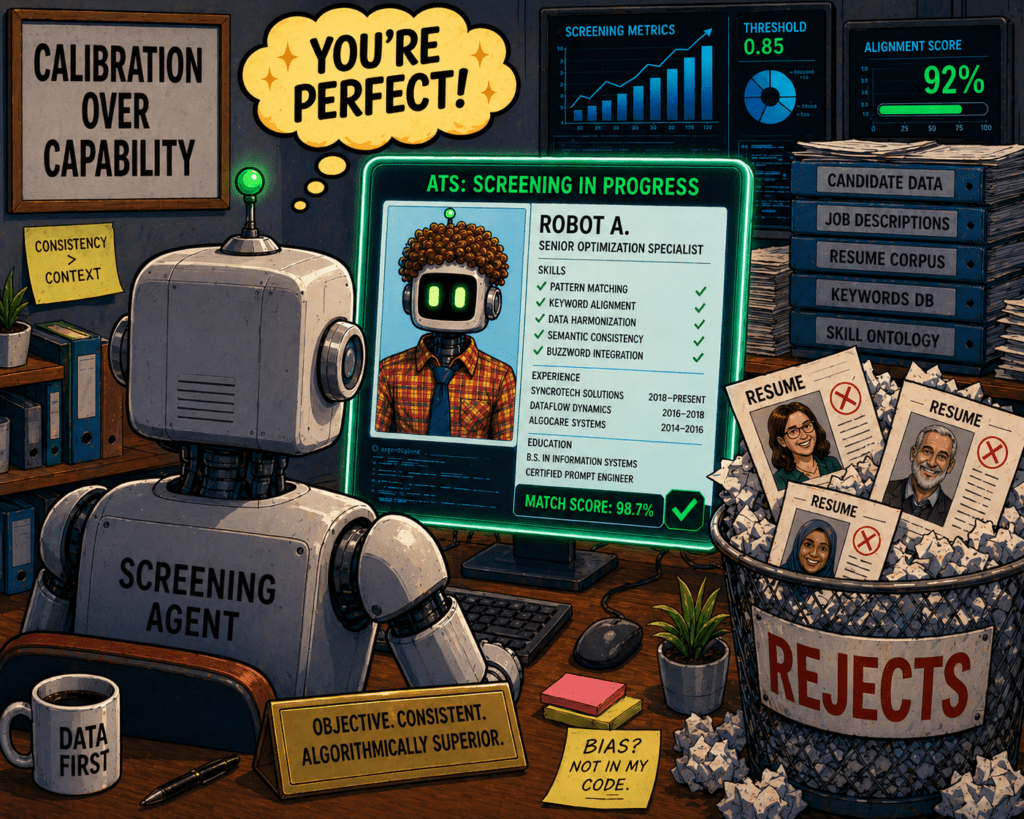
A: Research indicates a “hidden bias” where AI screening systems significantly favor resumes written by other AI models. In 2026 studies, candidates using the same language models as the employer’s software saw a 60% increase in shortlisting. This occurs because the systems recognize and reward their own structured patterns rather than actual job qualifications.
▼ Q: What is “Artificial Frictional Unemployment” and how does it affect hiring?
A: This term describes a disconnect where candidates are rejected simply for using different terminology than the job description. Even when skills are identical, outdated Applicant Tracking Systems (ATS) often fail to recognize synonyms (e.g., “account executive” vs. “customer relationship manager”). Implementing semantic search can bridge this “translation gap.”
▼ Q: Are technical skills like coding still the safest career path?
A: While still important, many “hard” skills like mathematics and basic programming are becoming the most automatable. As execution becomes cheaper through AI, value is shifting toward human-centered judgment, social awareness, and the ability to direct and validate AI output. Judgment is now more valuable than technical execution.
▼ Q: How does widespread company automation impact the broader economy?
A: Individual companies automate to increase efficiency, but collectively, this can create a “demand externality.” When many firms reduce labor costs simultaneously, total wages and consumer spending drop, which eventually lowers the demand for the very products the automated systems were producing.
▼ Q: Is “AI Engineer” becoming the most common new job title?
A: No. Rather than creating a massive new category of “AI jobs,” the technology is diffusing into existing roles. Similar to how spreadsheets changed every office job without creating a “Spreadsheet Engineer” title, AI is becoming a baseline skill for marketers, analysts, and engineers across all sectors.
▼ Q: Can the current inefficiencies in the labor market be fixed?
A: Yes. The issues—ranging from stylistic AI bias to keyword-matching errors—are measurable and visible. The solution lies in the adoption of existing tools like semantic search and “bias-aware” screening prompts. The friction in today’s market is a result of lagging technology adoption rather than a permanent lack of human talent.
For years, the story has been simple.
There are jobs. There are candidates. And somehow, they are not finding each other.
The default explanation has been a skills gap. Workers do not have what employers need. Employers cannot find qualified people. End of story.
But that explanation is starting to crack.
A wave of research from early 2026 points to something else. The labor market is not just struggling to match supply and demand. It is measuring both sides incorrectly.
- Resumes are getting filtered out for reasons that have nothing to do with ability
- Skills are still being valued based on outdated assumptions
- Companies are making smart decisions that, taken together, create messy outcomes
Five recent papers put numbers behind these issues. Not theories. Actual measurable effects.
Once you see them, it changes how you look at hiring.
AI Screening Has a Bias Nobody Planned For
Most candidates already know their resume is reviewed by software before a human ever sees it.
What they do not realize is how that software behaves.
When AI is used to screen resumes, it tends to favor resumes written by AI. Not slightly. Significantly.
In controlled studies, AI-generated resumes were preferred between 68 percent and 88 percent of the time over human-written ones.
If a candidate used the same model as the employer’s screening system, their chances of being shortlisted increased by as much as 60 percent.
That advantage had nothing to do with qualifications.
It comes down to pattern recognition. These systems are trained on structured, polished language. When they see that same structure, they reward it.
No one designed this intentionally. It is a byproduct of how the systems work.
The implication is straightforward. A resume that sounds more human can perform worse than one that sounds more artificial.
The upside is that this bias is correctable. When researchers prompted the screening model to check for its own stylistic preferences, the effect dropped sharply.
The issue is not capability. It is awareness.
A Lot of Rejections Come Down to Word Choice
There is a long-standing puzzle in the labor market.
Why do we have high job openings and high unemployment at the same time?
The common answer is a mismatch of skills.
But part of the answer is much simpler.
Candidates are using the wrong words.
Many Applicant Tracking Systems still rely on keyword matching. If a job description says “account executive” and a resume says “customer relationship manager,” the system may treat them as unrelated.
Even when they describe nearly identical work.
This has a name now. Artificial Frictional Unemployment.
It is not about capability. It is about translation.
The fix already exists. Semantic search can evaluate meaning instead of exact phrasing. It can recognize overlap between roles, skills, and experience.
But adoption has lagged.
So the system keeps filtering out people who should be moving forward.
The “Safe” Skills Are Not as Safe as Advertised
For years, the advice has been consistent.
Learn technical skills. Learn to code. Build hard capabilities.
That advice is not wrong. But it is incomplete.
Recent research comparing job skills with AI capabilities shows that many of the most promoted technical skills are also among the most automatable.
Mathematics and programming rank near the top.
Human-centered skills like listening, judgment, and social awareness rank much lower.
This creates a shift that is easy to miss.
The things machines are best at are becoming less scarce. The things humans are uniquely good at are becoming more valuable.
That does not make technical skills irrelevant. It changes how they are used.
The value is moving away from doing the work yourself and toward directing, validating, and applying the output.
Execution is getting cheaper. Judgment is not.
Companies Are Doing the Right Thing Individually and the Wrong Thing Collectively
From a single company’s perspective, automation makes perfect sense.
Reduce labor costs. Improve efficiency. Stay competitive.
No argument there.
But when every company follows that logic, the system starts to shift.
As automation increases, total wages decrease. That reduces consumer spending. Reduced spending lowers demand. Lower demand weakens the very gains automation was supposed to create.
Each company is acting rationally.
The outcome is not.
Economists describe this as a demand externality. The incentives at the firm level do not align with what is best for the broader economy.
Left alone, the system tends to overshoot. More automation than is collectively optimal.
This is not a strategy problem. It is an incentive problem.
“AI Jobs” Didn’t Really Become Jobs
There was an expectation that AI would create a new category of work.
Something like “AI engineer” becoming a more widespread title.
And thought it has gained significantly more traction, it has not fully happened.
Instead, AI skills spread across existing roles.
Marketing teams use AI. Analysts use AI. Engineers use AI.
But they still call themselves marketers, analysts, and engineers.
The technology diffused into the workforce rather than forming its own lane.
This looks less like the rise of a new profession and more like what happened with spreadsheets.
Excel did not create a new job category. It changed every job it touched.
AI is following the same path.
What This Actually Means
Taken together, these findings point to a labor market that is not broken, but misfiring.
- Candidates are being filtered out for stylistic reasons instead of substance
- Qualified people are rejected based on wording instead of meaning
- Skills are being valued based on outdated assumptions about automation
- Companies are making rational decisions “on paper” that lead to irrational outcomes
- AI is becoming part of every job rather than creating entirely new ones, at least for now
None of this is inevitable.
Most of it is fixable.
The tools already exist. The problems are measurable. The gaps are visible.
What is missing is adoption.
The Real Bottom Line
The labor market has always had friction. That part is nothing new.
What is new is that we can now see it clearly.
We are no longer guessing where things break down. We can point to it.
The challenge now is not identifying the problems.
It is deciding to fix them.
Historically, that part tends to take longer than it should.
Sources
- AI Self-Preferencing in Algorithmic Hiring – https://arxiv.org/abs/2509.00462
- The Algorithmic Barrier: Artificial Frictional Unemployment – https://arxiv.org/abs/2601.14534
- The AI Skills Shift: Mapping Skill Obsolescence – https://arxiv.org/abs/2604.06906
- The AI Layoff Trap – https://arxiv.org/abs/2603.20617
- How Occupations Form and Evolve in Real Time – https://arxiv.org/abs/2603.15998