
On LinkedIn, even credibility can be bought
TL;DR
Is LinkedIn credibility actually for sale?
Yes. A real marketplace sells rented, aged, and even government-ID-verified profiles for a few hundred dollars, complete with photos, work histories, and a real blue badge.
Does a verified badge mean the account is legit?
Only at the moment it was checked. It doesn’t confirm who’s actually running the account today.
Is this just spam and fake followers?
No. It runs from AI-generated “thought leadership” all the way to a North Korean state operation (“Jasper Sleet”) getting hired at real Western companies, and a recruiter-impersonation scam (“Fake Stacy”) that used a real verified profile as bait.
Who’s actually building the fix?
Outside vendors, not LinkedIn. Third-party tools already do the layered verification LinkedIn’s own badge doesn’t.
What should you actually do?
Don’t trust a badge or follower count on its own. Look for a track record that’s been building independently, across more than one place, for years.
Like most in the recruiting world, we spend a lot of time on LinkedIn. Sourcing, candidate engagement, business development, client company news- it’s a valuable platform for people in our world.
There’s an uptick of bad actors, so much that even a casual scroller would notice. But the level of fraud can go far deeper than you might even care to imagine.
Inflated resumes, copied posts, fake gurus. There might be more of it, but none of that is new.
What’s changed is the machinery behind it. AI can turn someone else’s research into original-looking posts in seconds. Vendors sell followers, aged connections, and accounts that have already cleared identity verification.
You no longer need years of experience to look like an expert. You need the right stack of tools. That’s why we think LinkedIn’s real problem isn’t AI slop, fake accounts, or job scams treated as three separate headaches. They’re symptoms of one market: an economy built around counterfeiting professional trust.
We use LinkedIn to decide whom to reach out to and whether the person messaging one of our candidates is who they say they are. That makes credibility unusually valuable to us, and unusually dangerous when it’s faked. Manufactured credibility here can influence a hiring decision, expose a candidate’s personal data, or hand an attacker a way into a company.
AI slop is really about credibility inflation
The complaints about AI-generated posts are familiar. Same structure every time, polished but empty, minor observations dressed up as leadership lessons. That’s tiresome, but it’s not the real issue.
The real issue is that AI lets people fake the appearance of expertise without doing the work that normally earns it. Someone reads another person’s research, runs it through a model, and has a week of posts ready on a subject they encountered yesterday. The writing looks clean. What you can’t see is where the thinking actually came from.
That matters because on LinkedIn, content works like evidence, not entertainment. A hiring manager sees it and assumes it reflects real expertise. It’s also harder to catch than old-fashioned plagiarism; a model can keep an idea’s substance while completely replacing the language, so there’s no paper trail left behind. LinkedIn’s ranking system rewards whoever’s getting attention right now, not whoever actually did the work.
Manufactured engagement backs up manufactured expertise
A copied idea doesn’t look credible on its own. It becomes credible once it looks backed by an audience, thousands of reactions, tens of thousands of followers.
We’ve learned not to take any of that at face value. Connections can be bought. Followers can be bought. Comments can be generated, and engagement pods coordinate in advance to like and comment on each other’s posts.
None of this proves any one popular account is fake. But it does mean we can’t read the visible signals as proof of anything anymore, especially since LinkedIn’s own data shows verified accounts pull noticeably more engagement. That’s exactly the return that makes buying the appearance of credibility worth the money.
There’s a real market selling entire professional identities
This is where it stops being a vague “bot problem” and starts looking like a supply chain we can map.
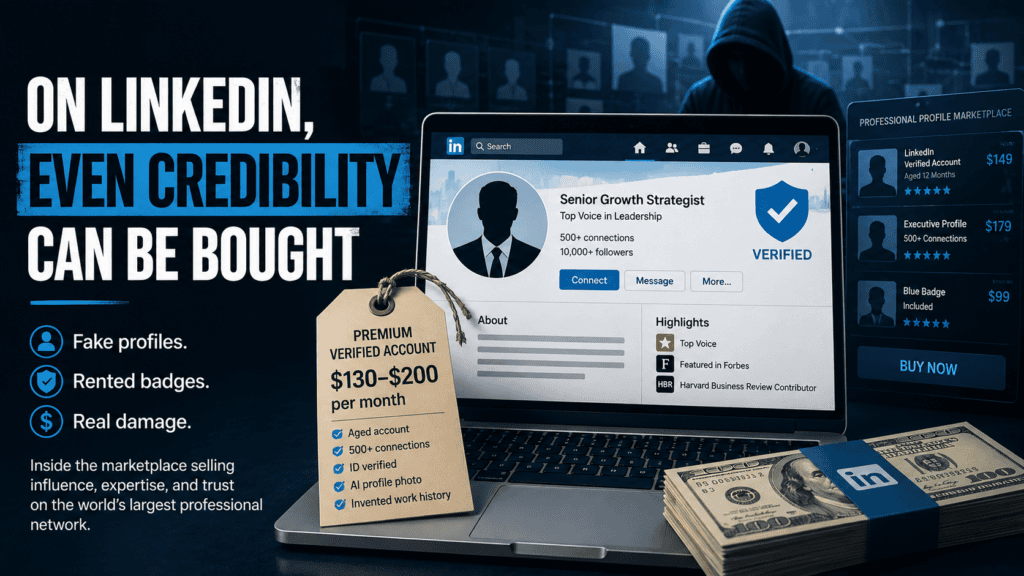
Companies openly sell LinkedIn accounts for rent or permanent use. MirrorProfiles, for one, states in its own terms of service that the profiles it rents out aren’t tied to real individuals, and come with AI-generated photos and invented work histories. That’s a vendor plainly advertising the manufacture of fake professionals as a product. Below that sits a graded marketplace:
- Bulk unverified accounts, $8 to $15 through peer-to-peer marketplaces, churned out by phone-verification farms. Cheap and fragile.
- Rented, “warmed” profiles, pre-aged for months with 500-plus connections, running $130 to $200 a month.
- Permanently ID-verified accounts, the premium tier, already past LinkedIn’s own government-ID checks, carrying a real blue badge, for a flat fee in the low hundreds.
None of the underlying tools are sinister by themselves; we use some version of automation ourselves for outreach. What’s new is that it can all be assembled into one package: a real-looking photo, a plausible career, and a verification badge. That’s a synthetic person convincing enough to stop looking like a bot.
Tooling this specialized only gets cheaper. If a fully verified profile is selling for under $100 within a year or two, we think the badge stops meaning anything, at any price.
The badge proves less than people assume
Verification is a point-in-time event, not an ongoing guarantee. It confirms an ID or workplace email checked out once; it can’t confirm the same person still controls that account today. LinkedIn bans account sharing, but a policy violation doesn’t make a badge disappear the moment control changes hands.
That gap is exactly what the premium end of the marketplace is selling.
When a fake recruiter meets a real candidate
The clearest example we’ve come across is a scam called “Fake Stacy,” which impersonated recruiting industry figure Stacy Zapar, founder of Tenfold and Fraud Squad.
The scammers bought legitimate LinkedIn Recruiter licenses, which let them target people who’d flipped on the public “#OpenToWork” signal. A paid Recruiter seat made the approach look credible from the start. They built look-alike domains and free Gmail accounts, copying the real recruiter’s name, photo, and signature, and used Gmail’s display-name trick to show a fake corporate address while routing mail through a personal one.
Once a candidate engaged, they asked for a resume and references under the guise of forwarding an application, exactly the data that could seed the next fake identity. Then came the money ask: several hundred dollars for a “leadership assessment,” with the amount misspelled (“$4O0”) to dodge spam filters.
If a candidate got suspicious, the scammer told them to go connect with the real recruiter’s actual, verified profile. That’s the whole trick. They were counting on a real badge and a real following to make the candidate let their guard back down long enough to pay.
We think that last move is the whole essay in miniature. The badge and the follower count did exactly what they’re built to do. They just weren’t attached to the person on the other end.
Recruiters eventually built their own defense, a public database called “The Catfish List,” because LinkedIn’s own verification wasn’t catching this.
When a fake candidate meets a real company
The same trust gets worked the other direction, and the most sophisticated version isn’t a freelancer. It’s state-sponsored.
Microsoft’s threat intelligence team tracks a group called “Jasper Sleet,” remote IT workers operating for the North Korean government out of Russia and China. They rent legitimate Western identities, then use AI face-swapping and voice-cloning tools during live interviews to match a fabricated profile. Once hired, they route their laptop traffic through a domestic “laptop farm” so the connection looks local, while the real work and data access flow back overseas.
There’s a darker version of this same funnel too. The Organization for Security and Co-operation in Europe has documented crime networks posting fake high-paying remote jobs on LinkedIn to recruit people internationally, then confiscating their documents and forcing them into scam compounds once they arrive. The OSCE estimates this now touches roughly 40 percent of its member states. At that point it’s not a hiring scam anymore, it’s a trafficking pipeline using a professional network’s credibility as bait.
The version we actually worry about day to day sits between those extremes: spending an InMail credit on a profile that turns out to represent nobody real, then losing hours to interviews before it becomes visible.
LinkedIn profits from every side of this
Everyone in this story pays LinkedIn somewhere along the way: candidates for Premium, recruiters for Recruiter seats, companies for promoted jobs. LinkedIn clearly knows how to gate access when it wants to; developer API access requires approval, and it keeps expanding how it monetizes credibility through creator sponsorships and “trusted creator” partnerships.
None of that’s wrong to sell. What bothers us is the asymmetry underneath it. When a recruiter messages a fake candidate, LinkedIn keeps the fee. When a stolen framework generates engagement, LinkedIn sells ads against the attention. LinkedIn monetizes the introduction, and the people on either end absorb the cost when it turns out to be fraudulent.
The fix is already being built, just not by LinkedIn
What we find most interesting isn’t the fraud side. It’s that a whole industry of outside vendors has already built the layered verification LinkedIn hasn’t, something security specialists describe like a water filter running coarse to fine:
- Gravel, screening applications for AI-generated text and metadata anomalies.
- Sand, biometric verification that checks a selfie and ID against government databases before a candidate speaks to a recruiter.
- Charcoal, live-interview tools that watch for face-swap artifacts and voice-cloning inconsistencies.
- Cotton, background checks that verify employment and education directly against the source, not the resume.
That an entire industry exists to do this work is itself the indictment. Outside vendors are building the trust infrastructure the platform hosting the interaction never built. LinkedIn takes down individual fake profiles as they’re reported, but pulling one down at a time does very little when the same vendor can generate a replacement tomorrow.
The strongest version of this doesn’t check once and move on. It looks for a footprint that’s been building independently for years, across places a vendor would have to fake all at once to pull off: a GitHub history, a personal site, a conference bio, all lining up without having been built for each other. That’s a much harder thing to buy than a single badge, or even a single aged account.
Where we land on this
Telling people to be more careful is good advice; we give versions of it ourselves. But it puts the whole burden on the people with the least visibility into how the fraud works.
LinkedIn’s business rests on people believing profiles, badges, and content mean something. It can’t keep expanding how it monetizes that trust while treating the counterfeiting of it as someone else’s problem.
Because right now: the person might be fake, the audience might be purchased, the idea might be stolen. The badge might be years out of date, and the credibility tying it all together might have been bought outright, for a few hundred dollars, from a company that will happily sell you another one tomorrow. We’d rather our clients and candidates hear that from us first.
Sources
- MirrorProfiles terms of service (profiles not tied to real individuals, AI-generated photos)
- Account marketplace pricing and tiers
- LinkedIn verification help (point-in-time nature of badges, engagement data)
- LinkedIn Professional Community Policies (account sharing, real-identity requirements)
- “Fake Stacy” recruiter impersonation scam, Tenfold
- The Catfish List
- “Jasper Sleet” DPRK remote-worker campaign, Microsoft Security Blog
- OSCE report on trafficking into cyber scam operations
- LinkedIn developer API access requirements, Microsoft Learn
- LinkedIn creator/advertiser partnerships announcement
- BrightHire live-interview deepfake detection (“water filter” model), Biometric Update
- Persona candidate identity verification
- Certn OneID identity verification