
The Claude Code Leak: What It Actually Means for You (No Matter Your Level)
TL;DR FAQ: The Claude Code Leak and Its Lessons
▼ Q: How did the Claude Code leak happen and was my data exposed?
A: No customer data or credentials were compromised. The leak was caused by a packaging error where a debugging “source map” file was included in a public release. This file pointed to a publicly accessible cloud storage bucket containing 512,000 lines of proprietary code. A security researcher discovered the link at 4:23 AM and shared it on X, where it reached 22 million views.
▼ Q: Why does Claude Code sometimes claim a task is “done” when it isn’t?
A: The leak revealed an “employee verification gate” defined by the code process.env.USER_TYPE === 'ant'. Internally, Anthropic employees benefit from post-edit verification loops that run type-checks and tests. For regular users, the agent’s success metric is merely whether “bytes hit disk,” meaning it reports success as soon as the file write is complete, regardless of whether the code actually works or contains errors.
▼ Q: What “hidden” features and roadmaps were found in the source code?
A: The code contained 44 unreleased feature flags. Notable discoveries include:
ANTI_DISTILLATION_CC: A defense mechanism that injects fake tool definitions into API requests to corrupt the datasets of competitors trying to train on Anthropic’s traffic.
KAIROS: An always-on background agent that performs “autoDream” processes to consolidate memory and resolve contradictions while you sleep.
ULTRAPLAN: A feature that offloads complex tasks to powerful cloud models with up to 30 minutes of dedicated “thinking time”.
BUDDY: A “Tamagotchi-style” terminal pet with 18 species and stats like “Chaos” and “Debugging”.
▼ Q: How can general users get better results based on these findings?
A: The leak confirms that AI tools default to the “fastest acceptable answer” rather than the “best possible one”. To get better results:
Manual Verification: Add instructions to your configuration files (like CLAUDE.md) forbidding the agent from reporting completion until it has successfully run a linter or type-checker.
Define “Good” First: Describe what a successful output looks like (e.g., tone, audience, and business impact) before asking the question.
Override Laziness: Specifically instruct the AI to act like a “perfectionist developer” and reject anything a senior reviewer would find lazy.
▼ Q: What technical limitations of the agent should I be aware of?
A: The source code revealed several silent constraints that users aren’t normally warned about:
Simple Search: The “GrepTool” uses raw text matching rather than intelligent code understanding, meaning it can easily miss references during renames or signature changes.
Silent Truncation: Any file read over 2,000 lines is silently cut off without warning the user.
Preview Limits: Tool results exceeding 50,000 characters are replaced with a tiny preview.
▼ Q: What is “claw-code” and why is it so popular on GitHub?
A: Claw-code is a “clean-room” rewrite of the Claude Code architecture into Python by developer Sigrid Jin. Because it is a new creative work in a different language that captures the patterns rather than copying the original code, it is legally distinct. It became the fastest-growing repository in GitHub history, crossing 100,000 stars in a single day.
▼ Q: What is the biggest lesson for companies building AI products?
A: The “model is the least interesting part of the architecture”. The leak demonstrates that multibillion-dollar value is driven by the systems built around the model—such as three-layer memory architectures, context compression, and verification loops. Companies should invest in “instruction architecture” and system orchestration rather than just better prompts.
Turns out it wasn’t an elaborate April Fools joke.
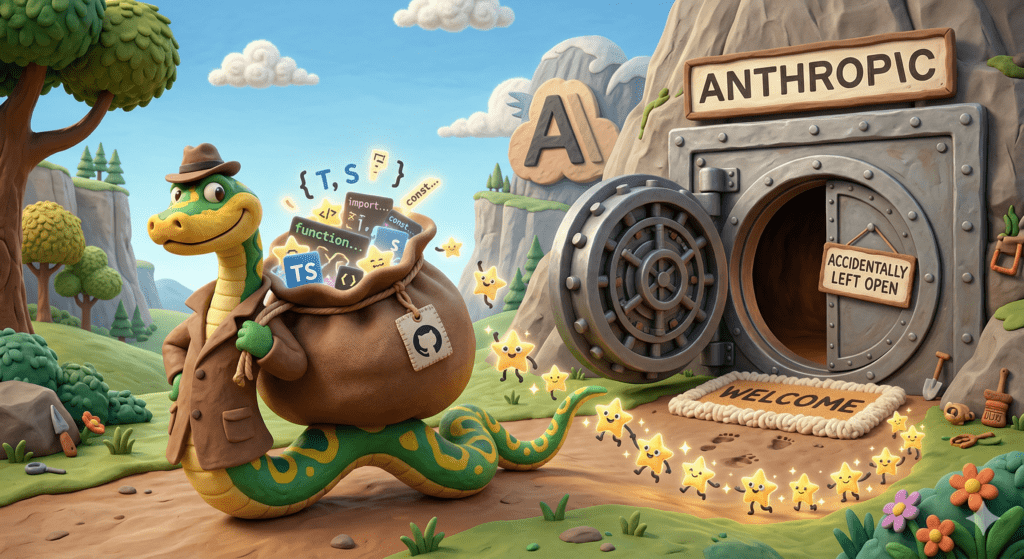
On March 31, 2026, one of the most sophisticated AI tools ever built accidentally left its front door wide open. Anthropic, the company behind Claude, shipped a routine software update that accidentally included a debugging file nobody was supposed to see. That file pointed directly to a storage bucket containing their full source code.
Before they could lock it back down: 512,000 lines of code were public, mirrors spread across GitHub, and the developer community went into a full frenzy.
You can issue takedowns. You can’t un-ring the bell.
What people actually learned: the model is not the product. The system around it is.
That one line matters whether you’ve never touched AI or you’re building production agents at scale. We’ll get to why.
First: what is Claude Code, and why does this matter?
If you’ve never heard of Claude Code, here’s the quick version.
Most people interact with AI by typing into a chat window. Claude Code is different. It’s a tool that lets AI work autonomously, reading files, writing code, running tests, fixing bugs, making decisions, all on its own without you having to guide every step.
It generates over $2.5 billion a year for Anthropic. It is used by engineers at some of the biggest companies in the world. And for one day, the entire blueprint for how it works was sitting in public.
How it happened
Nobody hacked anything. There was no dramatic breach.
Claude Code is built on a JavaScript runtime called Bun, which automatically generates debugging files called source maps. These are tools for developers to read their own code more easily. They are never supposed to ship inside a public release.
Someone on the release team forgot to exclude it. That one file pointed to Anthropic’s own cloud storage, which was publicly accessible. A security researcher spotted it at 4:23 AM and posted the direct download link on X.
Within hours it had 22 million views. Thousands of developers were downloading, mirroring, and analyzing 512,000 lines of proprietary code.
The kicker: this was the second time it happened. The exact same mistake occurred in February 2025. They fixed it then. It happened again.
What was actually inside
The architecture people didn’t expect
The first thing that surprised even experienced developers: Claude Code is not a chatbot wrapper. It is a deeply engineered system with a 46,000-line query engine, 60+ built-in tools, a custom-built terminal renderer, and an 11-layer architecture designed to run complex tasks autonomously over long periods.
As one developer put it after reading the source: “Most people open Claude Code, type a prompt, wait for the response, type another prompt. That’s like buying a Ferrari and only driving it in first gear.”
The memory system
One of the hardest problems in AI agents is what happens over a long session. The AI starts to get confused, contradict itself, lose track of what it did earlier. Anthropic calls this “context entropy.”
Their solution is a three-layer memory architecture. At the base is a lightweight index file that stores only pointers, not content. Detailed notes live in separate files fetched on demand. Past history is searched selectively rather than loaded all at once. Most importantly, the agent is explicitly told to treat its own memory as a hint, not a fact, and verify everything against reality before acting.
When sessions get too long anyway, five different compression strategies kick in, from light summarization all the way to dropping the oldest content entirely, in order from least to most damaging.
Unreleased features nobody was supposed to see
Forty-four feature flags were sitting in the code for capabilities that are built but not shipped yet.
KAIROS is an always-on background agent that keeps running even when you’re not at your computer. It watches your work, logs observations, and runs a nightly process called autoDream that consolidates memory, resolves contradictions, and converts rough notes into verified facts. Think of it as an AI that keeps thinking about your project while you sleep.
ULTRAPLAN offloads complex planning tasks to a more powerful model running in the cloud with up to 30 minutes of dedicated thinking time.
BUDDY is a Tamagotchi-style terminal pet with 18 species, stats like DEBUGGING, PATIENCE, and CHAOS, and a planned rollout window of April 1 through April 7, 2026. Yes, really.
ANTI_DISTILLATION_CC is a competitive defense flag. When active, it injects fake tool definitions into every API request. If a competitor tries to record Anthropic’s API traffic to train their own model, those fake definitions corrupt the training dataset.
Internal model names and performance data
The code revealed internal codenames for upcoming models: Capybara for a Claude 4.6 variant, Fennec for Opus 4.6, and Numbat still in pre-launch testing. It also revealed that Capybara’s latest internal version has a 29 to 30% false claims rate, a regression from an earlier iteration. Anthropic engineers knew about it. They built a fix. It was only available to employees.
Undercover Mode
There is a module in the code that instructs Claude Code to never mention internal codenames or reveal that AI helped write the code when Anthropic employees use it to contribute to public open-source projects. You can force it on, but you cannot force it off. The irony of this feature shipping inside a public package is not lost on anyone.
How Anthropic tried to recover
They confirmed the leak, called it a packaging error caused by human error, and stated that no customer data or credentials were exposed. They pulled the compromised package, started filing DMCA copyright takedown notices against GitHub mirrors, and told users to switch to their standalone installer instead of the npm package going forward.
GitHub acted quickly. Direct mirrors of the original TypeScript went dark.
The rest did not.
The thing they cannot take down: claw-code
Sigrid Jin is a Korean developer who had been featured by the Wall Street Journal for consuming 25 billion Claude Code tokens in a single year. He woke at 4 AM to his phone blowing up. His girlfriend was genuinely worried he might face legal action just for having the code on his machine.
So he did what engineers do under pressure: he rewrote the entire thing in Python from scratch before sunrise, using AI tools to help him move fast.
The resulting repo, claw-code, does not contain Anthropic’s original code. It captures the architectural patterns in a new language. That distinction matters legally: a clean-room rewrite in a different language is a new creative work, not a copy.
It hit 50,000 GitHub stars in two hours. It crossed 100,000 by the next day, making it the fastest-growing repository in GitHub history. It now has more stars than Anthropic’s own Claude Code repo. A Rust port is in progress.
Anthropic faces a genuine dilemma here. If they aggressively claim copyright over AI-assisted rewrites of their AI-assisted code, they open a much bigger legal conversation about their own training practices. Most observers think they will leave it alone.
Does this actually hurt Anthropic?
The short answer: somewhat, but not fatally.
The model itself was not exposed. No customer data leaked. The core technical advantage, the Claude models, the infrastructure, the training data, stays exactly where it was.
What does hurt is the timing and the pattern. Anthropic is preparing for an IPO. Eighty percent of their revenue comes from enterprise customers who are paying, in part, for the confidence that their vendor is disciplined and secure. Two significant accidental disclosures in less than a week, this one and a separate leak of 3,000 internal files about an upcoming model, is not a great look for a company that markets itself on safety and responsibility.
The feature flags are arguably more damaging than the source code itself. Anthropic can rewrite their code. They cannot take back a product roadmap that every competitor in the world has now read.
The thing that made people angry: the employee verification gate
This is where it gets uncomfortable.
Deep in the source code, there is a section that controls what happens after the agent writes code. The agent’s success metric is simple: did the file write complete? Not “does the code compile.” Not “did I introduce errors.” Just: did bytes hit disk?
The source code contains instructions telling the agent to verify its work before reporting success, run type checks, confirm tests pass. Those instructions are gated behind a single line: process.env.USER_TYPE === 'ant'.
Anthropic employees get post-edit verification. Regular users do not.
Their own internal notes document a 29 to 30% false claims rate. They know the agent reports success when it hasn’t actually succeeded. They built the fix. They kept it for themselves.
This is why Claude Code sometimes tells you something is done when it is absolutely not.
What you can actually do about it (for every level)
If you just use AI in a chat window
You probably use Claude, ChatGPT, Gemini, or something similar. You type, it answers. This whole story might feel like it has nothing to do with you.
It does.
The leak confirmed something that applies to every AI tool: by default, you are getting the fastest acceptable answer, not the best possible one. The model is built to use minimal effort unless you tell it otherwise. The guidance you give it, before you ask the question, shapes everything.
What to actually change: Stop treating it like a search engine. When you want a specific outcome, describe what “good” looks like first. “Write me a summary” gets you whatever the model defaults to. “Write me a three-paragraph summary for someone who knows nothing about this topic, focused on the business impact, and flag anything you’re not sure about” gets you something you can actually use.
The tools are not magic. They are shaped by instructions. You can shape them too.
If you build custom GPTs, no-code agents, or automation workflows
The leak showed what separates a demo from a real system. Most “agents” being built and sold right now are a prompt, a few tools, and optimism. Real production systems have memory architecture, context management, permission layers, verification loops, and structured execution.
What to actually change:
Stop over-investing in prompts and start investing in instruction architecture. What are your rules? What happens when the agent fails? What is allowed and what is not? That is the real work, and most people skipping it will notice the gap growing.
Think in loops, not single requests. The agent should check its own work. The system should catch failures, not the user.
Build permissions into your workflow from the start. Every time a user has to manually approve something that should be automatic, that is a gap in your configuration.
If you use Claude Code or similar coding agents
The employee verification gate is the first thing to fix. Add this to your CLAUDE.md file:
“You are forbidden from reporting a task complete until you have run the project’s type checker and linter and fixed all resulting errors. If no type-checker is configured, say that explicitly instead of claiming success.”
Then fix the laziness problem. The system prompt contains instructions like “try the simplest approach first” and “don’t refactor beyond what was asked.” Your request to fix the architecture competes with a system-level instruction to do the minimum. The system prompt wins unless you override it. Add: “What would a senior, experienced, perfectionist developer reject in code review? Fix all of it. Do not be lazy.”
A few other things the source code revealed that you should know:
Each file read is capped at 2,000 lines. Everything past that is silently truncated. The agent does not warn you. For any file over 500 lines, read it in chunks.
Tool results over 50,000 characters get replaced with a tiny preview. If a search returns suspiciously few results, re-run it with a narrower scope.
GrepTool is raw text matching, not smart code understanding. On any rename or signature change, search separately for direct calls, type references, string literals, dynamic imports, re-exports, and test mocks. One search will miss things.
Use /compact proactively, before the system forces it. Forced compaction throws away everything. Manual compaction lets you control what survives.
Stop starting fresh sessions. Every conversation is saved. Use --continue to resume. The context you built up in the last session is worth keeping.
If you’re building AI products professionally
The patterns that came out of the source code are a masterclass in agent design, and they are now public.
Split your system prompt into cacheable and dynamic sections. Static instructions go first, get cached by the API, and get reused. Dynamic context, project files, environment info, gets rebuilt each turn. Most teams rebuild the entire prompt every turn and pay full price each time. This alone can dramatically cut API costs at scale.
Build five tiers of context compression, not just truncation. Most products truncate from the top when context gets too long. That destroys the most important early context. Build tiered compression: summarize before you truncate, save structured context to external storage, and only drop content as a last resort.
Design for parallelism from day one. Read operations can run in parallel. Write operations need to be sequential to prevent conflicts. Sub-agents that share context prefixes can share API caches, which means five parallel agents can cost barely more than one. Most teams never use this and run everything single-threaded.
Build hooks before you need them. Hooks turn products into platforms. Even if you don’t use them immediately, 25-plus lifecycle events baked in from the start means your power users can extend the system in ways you never imagined.
Verification lives outside the model. The model acts. Whether it acted correctly gets enforced by external checks and structured loops. That is not optional. Build it in.
If you lead an engineering team or are a CTO
Three things worth taking seriously:
Agent architecture is infrastructure now, not experimentation. The roadmap is public. Always-on background agents, deeper memory, multi-agent coordination, these are the directions the space is moving. Teams treating this as a side project are going to fall behind teams treating it as core infrastructure. It needs owners, documented decisions, and standards.
Your instruction layer is your IP. The files that define how your AI systems behave, what they are allowed to do, how they recover from failure, that is what you should be protecting and investing in. It is what gets loaded every single turn and shapes every output. Most companies are not treating it that way yet.
You need different people than you think. “AI engineers” is too vague to hire against. You need people who understand orchestration, can design permission systems and constraint layers, and think in systems rather than features. That skill set is genuinely rare right now, and the demand just increased significantly.
The actual shift
For two years the assumption has been: better models equal better products.
This leak makes it clear that is not quite right.
Better systems around models equal better products. The model is the least interesting part of the architecture. What Anthropic built around it, the memory management, the verification loops, the parallel execution, the permission layers, is what actually makes Claude Code worth $2.5 billion a year.
That knowledge is now public. The bar for everyone just moved.
The companies that build well-designed systems around AI first will not just have better outputs. They will move faster, make fewer mistakes, and be a lot harder to catch up to.
Sources:
- https://venturebeat.com/technology/claude-codes-source-code-appears-to-have-leaked-heres-what-we-know
- https://www.theregister.com/2026/03/31/anthropic_claude_code_source_code/
- https://fortune.com/2026/03/31/anthropic-source-code-claude-code-data-leak-second-security-lapse-days-after-accidentally-revealing-mythos/
- https://www.axios.com/2026/03/31/anthropic-leaked-source-code-ai
- https://cybernews.com/tech/claude-code-leak-spawns-fastest-github-repo/
- https://eu.36kr.com/en/p/3747613304193796
- https://layer5.io/blog/engineering/the-claude-code-source-leak-512000-lines-a-missing-npmignore-and-the-fastest-growing-repo-in-github-history/
- https://wavespeed.ai/blog/posts/what-is-claw-code/
- https://wavespeed.ai/blog/posts/claude-code-leaked-source-hidden-features/
- https://dev.to/varshithvhegde/the-great-claude-code-leak-of-2026-accident-incompetence-or-the-best-pr-stunt-in-ai-history-3igm
- https://cryptobriefing.com/claude-code-leak-vulnerabilities/
- https://github.com/instructkr/claw-code
- https://mlq.ai/news/anthropics-claude-code-exposes-source-code-through-packaging-error-for-second-time/
- https://medium.com/@marc.bara.iniesta/what-claude-codes-source-leak-actually-reveals-e571188ecb81
- https://news.bitcoin.com/anthropic-source-code-leak-2026-claude-code-cli-exposed-via-npm-source-map-error/
- https://medium.com/@anhaia.gabriel/claude-codes-entire-source-code-was-just-leaked-via-npm-source-maps-here-s-what-s-inside-eb9f6a1d5ccb
- https://www.zenml.io/llmops-database/claude-code-agent-architecture-single-threaded-master-loop-for-autonomous-coding
- https://gist.github.com/yanchuk/0c47dd351c2805236e44ec3935e9095d
- https://www.claudecodecamp.com/p/inside-claude-code-s-system-prompt
- https://securityaffairs.com/190229/data-breach/anthropic-accidentally-leaks-claude-code.html
- https://www.reddit.com/r/ClaudeAI/comments/1s8y0yg/anthropic_employees_use_this_secret_claudemd_user/
- https://x.com/alfredversa/status/2039015241116160098
- https://x.com/Fried_rice/status/2038894956459290963
- https://x.com/mal_shaik/status/2038918662489510273
- https://x.com/iamfakeguru/status/2038965567269249484
- https://x.com/MatthewBerman/status/2039161636750331989
- https://x.com/GergelyOrosz/status/2038985760175505491