
The Unofficial STEM Search Group Holiday Hall of Fame
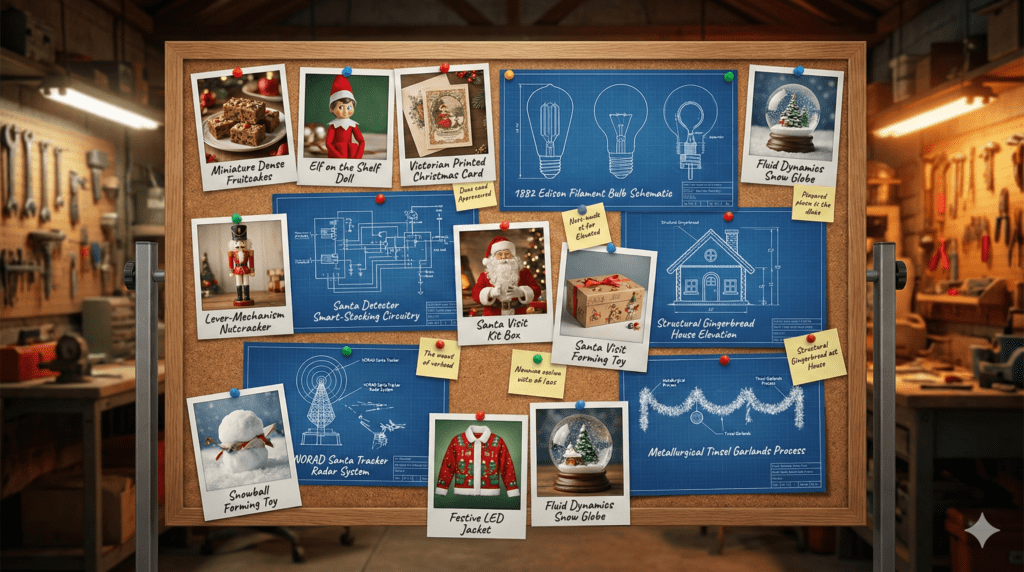
At STEM Search Group, we spend our days working with the people who quietly keep the world running in the background: technologists, engineers, manufacturing pros, life scientists, healthcare innovators, and niche startup builders who live to solve problems.
So for the holidays, we’re giving the spotlight to them… kind of.
Here’s a tour of the inventions, traditions, and accidental breakthroughs that make the holidays what they are, seen through the lens of engineering, chemistry, data, and “who thought this was a good idea, but also thank you.”
Fruitcake (Ancient Origins → Victorian Christmas)
Fruitcake is the original long-shelf-life energy block.
Ancient Romans made a dense mix of barley, nuts, dried fruit, and honey for soldiers. Centuries later, Europeans amped it up with sugar, candied fruit, and liquor until Victorian England crowned it a Christmas staple.
On the food science side:
- High sugar + low water activity = preservation
- Alcohol as a microbial buzzkill
- Dense structure that could probably survive reentry
It’s the only “dessert” that can outlast a lease agreement. Say what you will, but the formulation is solid.
Tinsel Garlands (1610)
In 1610, German silversmiths hammered pure silver into ultrathin strips, cut them into slivers, and hung them on trees to make candlelit branches sparkle.
That meant:
- Metallurgy
- Thin foil production
- Reflectivity versus brittleness trade-offs
Over time, silver gave way to cheaper metals, then to PVC. Now tinsel is a lightweight, mass-produced plastic that migrates into every corner of your house and refuses to leave. From elite luxury metallurgy to mass-market platstic polymer in just a few centuries. Impressive.
Nutcracker Dolls (Late 1600s)
Nutcracker figures began as functional tools in the German mountains: little wooden soldiers designed to crack actual nuts with simple lever mechanics.
Engineering notes:
- Hardwoods for durability
- Leverage ratios good enough to crack a shell without snapping the jaw
- Simple, repairable joints
Then Tchaikovsky came along, the ballet blew up, and now these guys just stand around in uniforms guarding bowls of nuts no one eats. Retirement in style.
Gingerbread Houses (1500s–1800s)
Gingerbread evolved from dense spiced bread to a canvas for edible sculpture. In Germany, bakers were making ornate pieces by the 1500s. After the Brothers Grimm published Hansel and Gretel, the idea of a gingerbread house took off as a Christmas tradition.
Structural highlights:
- Icing as mortar
- Flat walls under compression and toddler impact
- Gumdrops and candy as decorative dead load
It’s the only construction project where catastrophic collapse is considered a success if it happens while everyone’s laughing.
Candy Canes (1670)
Legend has it a choirmaster in Cologne bent sugar sticks into cane shapes to keep kids quiet during long Christmas services and tie it to the “shepherd” theme.
Behind the humble candy:
- Sugar cooked to a precise temperature
- Aeration and pulling for texture
- Hand-twisted striping, later replaced by mechanized forming
Today, candy cane output is the result of carefully tuned process lines, not individual grandmas with pots and prayers.
Eggnog (1700s → Present)
Eggnog is the most chaotic respectable beverage on the holiday table.
It grew from medieval milk-and-egg punches and became a colonial American hit once rum and other spirits joined the party.
Chemistry flex:
- Emulsion engineering: Eggs emulsify fat (cream) and water (milk).
- Protein denaturation: Whisking and gentle heat unwind egg proteins so they stabilize the mixture.
- Preservation: Sugar, alcohol, and refrigeration discourage microbial freeloaders.
- Flavor diffusion: Spices like nutmeg and cinnamon slowly release aromatic compounds into the fat and alcohol.
It’s the one time of year people run a full-blown food science experiment in a punch bowl and just call it “Grandma’s recipe.”
Centigrade Scale (1742)
In 1742, Anders Celsius introduced a temperature scale that finally put numbers to “wow, that’s cold.”
He originally set water’s boiling point to 0 and freezing to 100, before the scale was flipped to the version we use today.
This gave:
- Labs a standard reference
- Bakers reliable oven settings
- Everyone a way to argue about weather with data instead of vibes
Celsius is quietly working behind every successful batch of cookies and every “we’re not driving in this” decision.
Kissing Under the Mistletoe (Late 1700s Tradition)
Mistletoe had a long history in ritual and folk medicine, but by the late 1700s in England, it picked up a new job: forcing awkward romantic moments at parties and future HR nightmares.
Think of it as:
- Primitive social protocol
- A proximity-based trigger system
- An analog opt-in workflow that would never pass a compliance review today
The hardware is simple: a plant. The behavioral layer is… more complex.
Christmas Cards (1843)
Sir Henry Cole, drowning in December letter-writing, commissioned the first printed Christmas card so he could stop handwriting messages to everyone.
Scalable sentiment required:
- Advances in lithography and printing
- Affordable mass production of cardstock
- A postal system robust enough to handle seasonal spikes
He basically invented holiday batch processing for human feelings.
Christmas Crackers (1847)
Tom Smith in London merged candy, festive packaging, and a tiny controlled explosion to create the Christmas cracker.
Inside the tube:
- A friction-sensitive “popper” strip
- Force distribution so it breaks in a satisfying way
- Payload: paper crown, toy, and a joke that’s barely above dad-joke grade
It’s packaging engineering, chemistry, and theater all rolled into one disposable cylinder.
Electric Christmas Lights (1882)
Edward H. Johnson, an associate of Thomas Edison, strung 80 electric bulbs around his Christmas tree in 1882. Goodbye open flame, hello early electrical hazard.
This early prototype led to:
- Safer indoor lighting
- A holiday lighting industry
- The annual ritual of discovering one broken bulb tanked the whole strand
Today’s smart lights trace back to this single “what if we wired the tree” moment.
BB Gun (1886)
The Daisy BB gun started as a promotional item and became a staple under the tree.
Mechanical design:
- Spring-piston mechanism compressing air
- Smoothbore barrel shooting small steel BBs
- Simple, rugged construction
Cultural design:
- Immortalized in A Christmas Story
- Forever associated with: “You’ll shoot your eye out.”
It’s a clean example of how one product can live in the Venn diagram of clever engineering, nostalgia, and mild safety panic.
Snow Globes (c. 1900)
An Austrian mechanic, trying to improve surgical lamps, experimented with water-filled bulbs and reflective particles. He didn’t revolutionize surgical lighting, but he did stumble into the snow globe.
Inside each globe:
- Fluid dynamics keeping particles suspended
- Carefully chosen density so “snow” falls slowly
- Optics that magnify and soften the scene
It’s basically a controlled miniature environment, hand-sized, and sold as a souvenir.
Gift Wrapping (Modern Printed Wrap, 1917)
People have wrapped gifts in cloth and paper for centuries, but modern printed wrapping paper has a clear spark.
In 1917, the Hall brothers in Kansas City ran out of colored tissue paper in their shop. They started selling patterned French envelope liner paper instead. Customers loved it. They leaned in and began printing dedicated wrapping paper.
That one inventory problem birthed:
- A new print category
- Seasonal production planning
- A global population all discovering at once their roll is 3 inches too short
Supply chain pain, but festive.
Artificial Christmas Trees (1920s–1930s)
As cities grew and apartments shrank, real trees became less practical. Early artificial trees used feathers, then metal, then plastic.
Engineering considerations:
- Flame resistance
- Needle realism versus manufacturing cost
- Collapsibility and storage
Now we have pre-lit, color-themed, app-controlled artificial trees that go from closet to Instagram-ready in under an hour.
Cellophane Gift Tape (1930)
Clear tape turned gift wrapping from a wrestling match into a solvable problem.
Behind each little roll:
- Thin, flexible film that doesn’t tear too easily
- Pressure-sensitive adhesive with the right stickiness profile
- A dispenser that (in theory) cuts cleanly instead of shredding the tape and your patience
Simple, yes, but one of the quiet heroes of December.
Automated Candy Cane Machine (1950s)
Hand-bending thousands of hot sugar sticks is a great way to learn about occupational burnout.
In the 1950s, candy makers built automated systems:
- Heated kettles feeding candy ropes
- Cooling tables regulating texture
- Bending and cutting mechanisms synchronizing shape and size
It’s a specialized manufacturing line dedicated to one very specific striped product.
NORAD Santa Tracker (1955 → Digital Age)
In 1955, a department store ad misprinted Santa’s phone number and accidentally sent kids calling a Continental Air Defense Command hotline. The officer on duty rolled with it, and the tradition of “tracking Santa” was born. Later, NORAD took it on, and eventually it became a full-blown digital event.
Today, Santa tracking involves:
- Satellite data and radar feeds (for the “real” story)
- Web and mobile apps with interactive maps
- Streaming content, games, and live updates
- Infrastructure that survives a global traffic spike on one specific night
Somewhere, a team of developers, designers, SREs, and comms folks are running what is basically a seasonal, family-friendly observability platform for one fictional asset.
LED Christmas Lights (1962 → Modern)
Early red LEDs in the 1960s eventually evolved into the full-color, low-power holiday light sets we use now.
Modern strands combine:
- Semiconductor devices
- Current-limiting circuitry
- Weather-resistant encapsulation
- Sometimes Wi-Fi or app integration for sequences and patterns
Your neighbor’s sound-synced light show is part electrical engineering, part frontend UI, part someone getting way too into the “effects” menu.
Santa Phone Calls & Video Calls (Late 1900s → 2000s)
Santa hotlines popped up as phone systems got cheaper and easier to scale. Then came pre-recorded Santa calls, then live video chats with Santa, and now full apps that schedule personalized calls.
Under the red hat:
- Telephony routing and IVR systems
- VoIP services and WebRTC for live video
- Scheduling, CRM, and payment systems
- Content personalization driven by basic data (names, wish lists)
It’s a nice reminder that the same tech stack that powers business operations can also power a 5-year-old’s mind-blowing call with the North Pole.
Santa Claus Detector Stocking (1996)
This gadget stocking lit up and/or chimed when it detected weight inside — a Santa alert system running on basic electronics.
Inside:
- Simple sensors
- Timer or trigger circuit
- LED indicator or sound module
It’s a microcontroller-free device that still feels “smart” to a kid at 6 a.m.
Elf on the Shelf (2005)
A soft-bodied elf with a plastic head, designed to sit in odd places and silently judge everyone.
Design considerations:
- Stable sitting and perching
- Child-safe materials and construction
- Durable enough for daily repositioning all December
The real genius is the behavioral overlay: software-level “Santa surveillance” built on top of very simple hardware.
Automatic Tree Fire Extinguisher (2006 → 2010s)
Engineers looked at dry trees plus overloaded outlets and said: absolutely not.
These systems use:
- Heat-activated triggers or fusible links
- Pressurized suppressant agents
- Dispersal geometry to cover the tree
It’s a targeted fire protection system for one very specific, very festive hazard scenario.
Santa Visit Kit (2007)
The Santa Visit Kit is basically a box of props for one key illusion: “He was here.”
Inside:
- “Reindeer food” (engineered to be yard- and pet-safe)
- Hoofprint templates or stamps
- Bells, notes, and other artifacts
Think of it as a one-night-only immersive experience, with parents running ops.
Snowball Forming Toy (2008)
This tool lets you scoop and compress snow into uniform spheres without freezing your hands off.
Product design:
- Ergonomic handles usable with gloves
- Plastic that won’t shatter in the cold
- A mold that releases cleanly
It turns backyard chaos into something approaching a regulated winter sport.
Festive LED Jacket (2017)
Wearable holiday tech at full brightness. These jackets use:
- Flexible LED strips or fiber optics
- Conductive threads or lightweight wiring
- Battery packs and simple controllers
- Weather-resistant outer fabrics
Pair it with an app and your jacket becomes a walking holiday display with built-in visibility and zero subtlety.
The Bigger Picture (And A Big Thank You)
Behind every light, every gadget, every treat, and every small holiday miracle is someone who built it, engineered it, tested it, or kept it running. This season is a good reminder that none of it happens without talented people, dedicated teams, and companies full of folks who care about doing things well.
We take so much for granted in the rush of the year. So consider this a gentle nudge to step back for a moment, appreciate the people who make things work, and make room for a little joy too.
Take time for yourself. Take time for family and friends. Tis the season, you’ve earned it.