
The World Needs More Grok
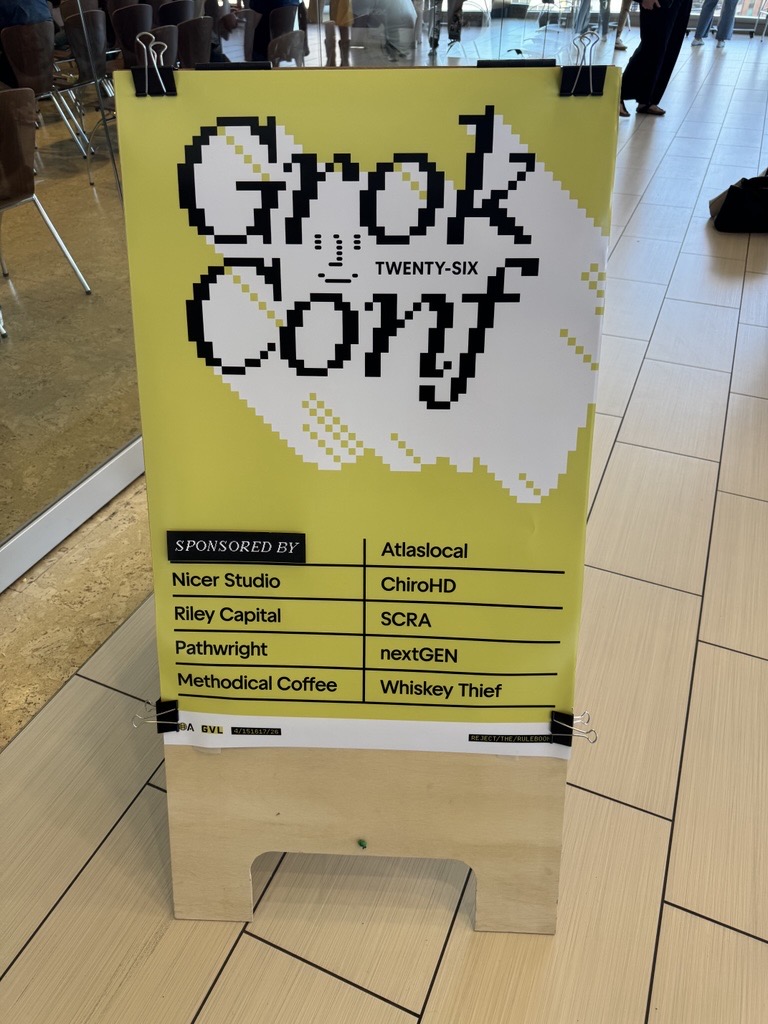
No, not that Grok. The one that’s been around long before that. The one right in our backyard that, somehow, Blake Coleman had never made it to.
That’s fixed now. We won’t be missing it again.
Most conferences follow the same script. You pay a few hundred dollars, fly somewhere convenient, and sit in a cold ballroom while someone clicks through slides for two days. You leave with a tote bag, some forgettable swag, and maybe one good conversation you had at the hotel bar.
Grok isn’t that.
It’s been running since 2011 out of Greenville, South Carolina. It’s built for people who work on the web, designers and developers mostly, but the real point is simple: you actually talk to each other. Not forced icebreakers. Real conversations. The kind where you realize the person across from you is dealing with the same problems you are.
The name comes from Stranger in a Strange Land. To “grok” something is to understand it so deeply that the line between you and it starts to blur. That’s the goal here. Not surface-level networking. Real understanding.
The 10/20 Format
This is what makes Grok different.
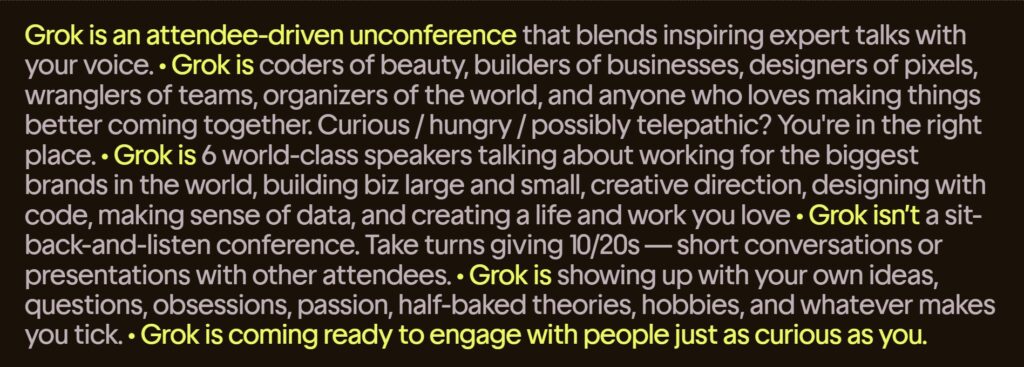
The room breaks into small, facilitated groups. You sign up to talk for 10 minutes. Some sessions run 20. That’s it.
Bring your side project. Bring your half-finished idea. Bring the thing you’ve been thinking about for six months but haven’t said out loud yet.
It sounds simple. It is. But it flips the whole dynamic.
You’re not there to consume content. You’re there to contribute it.
And the person next to you isn’t a name to collect. It’s someone you just heard talk about something they actually care about. Sometimes it’s work-related. Sometimes it’s not. Either way, those are usually the conversations you remember.
Most conferences are built for passive learning. The 10/20 format forces participation.
The People Behind It
Chris Merritt and Matt Cook have been running this for over a decade, which matters.
Events like this don’t stay good by accident. They stay good because someone protects what makes them work.
They’ve kept it small. They’ve kept it focused. And they’ve resisted the obvious temptation to scale it into something bigger and more profitable at the expense of what makes it different.
That restraint is the whole point.
What People Were Actually Talking About
The design chops of the speakers, world class. Kelli Anderson, Matt Lehman, Bryan Barger, Diana Mounter. People who’ve done literally the most amazing work for brands everyone would recognize.
Note: Do yourself a favor, buy Kelli Anderson’s Alphabet in Motion. It’s an interactive masterpiece every creative should own. Honestly, anyone with a coffee table should own it, so… basically everyone.
But the throughline this year wasn’t design trends. It was anxiety around AI.
Not the hype version. The practical version.
A lot of people in the room make a living doing work that AI is starting to replicate at a “good enough” level. That’s not theoretical. That’s people quietly wondering what their role looks like three years from now.
And instead of pretending that isn’t happening, people talked about it.
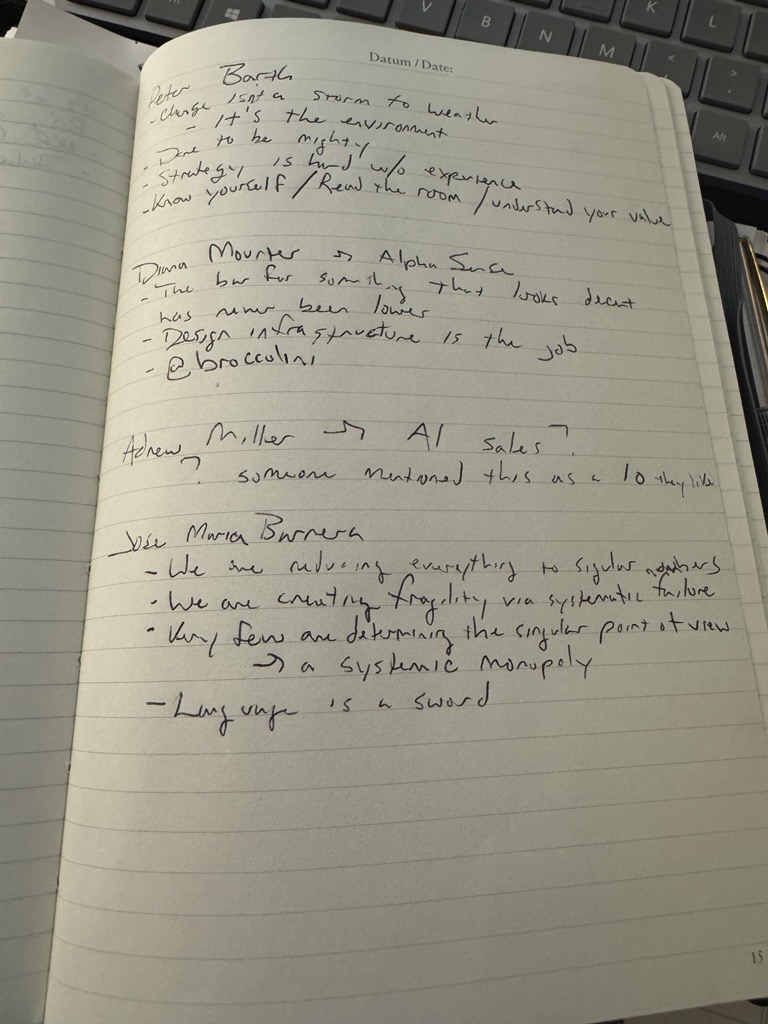
Peter Barth framed it plainly: change isn’t something you get through anymore. It’s the environment.
Diana Mounter made the point that when AI can produce decent design instantly, “decent” stops being valuable. The work shifts to systems, judgment, and context. The parts that don’t show up in a prompt.
José María Barrera talked about language as leverage. How the way you describe your work shapes how it’s valued.
There was also a broader concern that if a handful of companies control the most powerful AI systems, they also shape how everyone else learns, builds, and competes. That concentration of influence doesn’t just affect tools. It affects outcomes.
No one walked away with a neat solution. But the conversation was honest. That’s rare.
Why It Holds Up
Grok made it through the pandemic. That says a lot.
If your entire premise is real human connection, and you remove the ability to meet in person, you either prove your point or disappear. Grok proved it.
There’s a version of this industry where everything gets optimized, automated, and flattened. Where the human layer gets thinner every year.
Grok is a quiet argument against that.
It’s a room full of people who care about what they’re building and how they’re growing. You leave with a few new ideas, a few better questions, and a handful of conversations that actually stick.
That’s harder to find than it should be.
We’re glad it’s here in Greenville.
And if you’re thinking about next year, consider this your invite. We’ll be there.