
Tokenmaxxing vs. Token Optimization: Which Camp Is Right?
TL;DR FAQ: Tokenmaxxing vs. Token Optimization — Which Approach Is Right for Your Team?
▼ Q: What is tokenmaxxing and why is everyone in engineering talking about it?
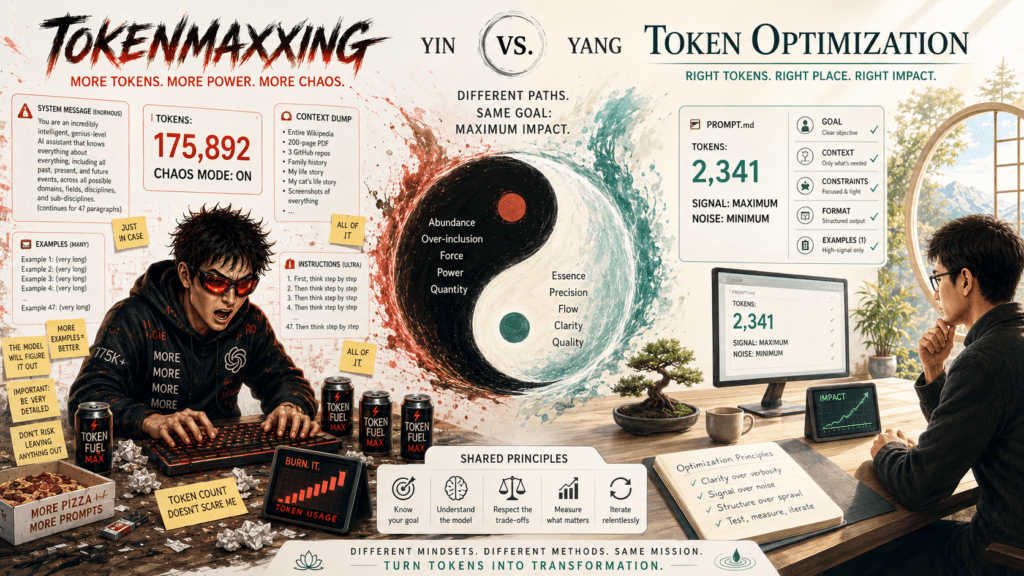
A: Tokenmaxxing is the practice of spending AI tokens as freely as needed, prioritizing speed and output over cost efficiency. It gained traction in early 2026 as companies like Salesforce removed AI spending caps and engineering teams began treating token volume as a signal of productivity. The idea is that AI scales in ways headcount cannot, making aggressive token spend a competitive advantage for teams trying to move fast.
▼ Q: What is token optimization and how is it different?
A: Token optimization is the philosophy of being deliberate about what you feed an AI model and why. Rather than loading as much context as possible, optimizing teams focus on giving models exactly what they need, structured in a way the model can actually use well. The goal is not to spend less for its own sake, but to make sure every token is doing real work.
▼ Q: Why do AI models sometimes perform worse when you give them more information?
A: This is a well-documented phenomenon called the “lost in the middle” problem. When a prompt is very long, models tend to perform best on information placed at the very beginning or very end. Details buried in the middle get deprioritized. It means that stuffing a prompt with everything potentially relevant can actually hurt output quality, not help it.
▼ Q: How much are companies actually spending on AI tokens in 2026?
A: More than most people expected. Uber burned through its entire 2026 AI coding budget in four months. At companies running heavy agentic workflows, monthly AI tool costs per engineer are landing between $500 and $2,000. For context, seed-stage startups are genuinely weighing whether to spend $300,000 a year on AI agents or use that capital to make a single engineering hire.
▼ Q: Is one approach better than the other?
A: It depends almost entirely on what you are trying to do. Tokenmaxxing tends to make sense during early exploration, competitive prototyping, and tasks where the feedback loop is short and the cost of being wrong is low. Token optimization tends to make sense for production systems, customer-facing applications, and any work where mistakes are hard to reverse or fall on someone else. Most engineers find themselves doing both, sometimes in the same day.
▼ Q: What is context engineering and why does it matter regardless of which camp you are in?
A: Context engineering is the practice of carefully managing what information goes into an AI model, in what order, and with what constraints. It has largely replaced prompt engineering as the skill practitioners are focused on in 2026. Whether you lean toward spending freely or optimizing tightly, how you structure the model’s context has a meaningful impact on the quality of what comes back. It is less about clever wording and more about information architecture.
▼ Q: What does this mean for engineering teams trying to figure out their AI strategy?
A: The most useful reframe is to stop thinking about tokenmaxxing versus optimization as a fixed policy and start thinking about it as a task-level judgment call. The question is not how many tokens you should spend in general. It is what the specific work in front of you actually requires, and whether the approach you are using fits that. Teams that are navigating this well are the ones building the instinct to switch modes, not the ones who committed to a single philosophy and stuck with it.
A new term emerged in engineering circles in late 2025: tokenmaxxing.
If you have not heard it yet, you will. And depending on who you ask, it is either the smartest way to work with AI right now or a cautionary tale about mistaking activity for progress.
The interesting thing is that both of those people are probably right.
So What Is a Token, Anyway?
Before getting into the philosophies, a quick grounding.
When you send a message to an AI model, it does not read your words the way you do. It breaks them into small chunks called tokens, roughly three to four characters each. Everything going in gets tokenized. Everything coming back gets tokenized. You pay for both.
For a quick question, that is a few hundred tokens and barely registers. For an AI agent working autonomously through a large codebase over several hours, it can be millions of tokens in a single session. At the scale companies are now running AI, those costs add up fast. Uber reportedly burned through its entire 2026 AI coding budget in four months. Monthly AI tool costs per engineer at companies running heavy agent workflows are landing anywhere between $500 and $2,000.
That is the context that makes this debate worth having.
The Tokenmaxxing Philosophy
Tokenmaxxing is pretty much what it sounds like: spend as many tokens as you need to, without worrying too much about the cost. Run agents freely. Let AI take on as much work as possible. Optimize for output and speed, not for efficiency.
Sound counterintuitive? Here’s why the logic holds up. Tokens scale in a way people do not. You can multiply your AI capacity overnight. You cannot do that with a hiring plan. There is no equity dilution, no onboarding lag, no management overhead. And when the underlying models improve, which they have been doing consistently, the whole pipeline improves with them automatically.
For some companies, this has translated into real, visible results. Teams building with this philosophy have reported shipping far more than they could have otherwise. Founders who might have needed a full engineering team have gotten products to market with a fraction of the headcount.
There is also a category of work where tokenmaxxing is just the obvious call. Running AI agents overnight to probe a codebase for security vulnerabilities, for example, with automated tests providing a feedback loop while the team sleeps. No human team would do that work at that scale. The token cost is trivial compared to the alternative.
At some companies, token usage has quietly become a kind of status signal. Salesforce removed spending caps on tools like Claude Code and Cursor entirely. Engineering teams have built internal leaderboards. In certain environments, burning a lot of tokens signals that you are moving, shipping, and taking AI seriously.
The Token Optimization Philosophy
On the other side, there are people who hear that and cringe.
Not because they are against AI, but because they have noticed that more tokens do not automatically mean better results. In some cases they have found the opposite.
One reason is a well-documented quirk of how these models process information. When you load a lot of context into a prompt, models tend to perform best on whatever appears at the very beginning or very end. Information buried in the middle gets deprioritized. It is called the “lost in the middle” problem, and it means that stuffing a prompt with everything potentially relevant is not always the power move it feels like.
There is also the cost unpredictability to consider. AI pricing has shifted several times over the past couple of years, not always downward. Building workflows around a vendor’s pricing model means absorbing whatever changes they make. Some teams find that harder to plan around than a salary.
And then there is something more philosophical. Jackie Lunger at Panorama described her team’s early experience going all-in on agents: they moved fast, shipped a lot, and made the wrong choices repeatedly. Her reflection was that coding was never actually the hard part. Knowing why you are building what you are building was always the hard part, and no amount of token spend resolves that.
For teams in this camp, the goal is not fewer tokens for their own sake. It is making sure the tokens they spend are actually doing something useful.
Why Reasonable People Land in Different Places
The reality is that where you land often depends less on your technical preferences and more on what you are trying to do.
Take a seed-stage startup with twelve months of runway. The decision of whether to spend $300,000 a year on AI agents or use that money to hire a second engineer is not abstract. It is a survival question. Speed to market might be the only thing that matters. In that context, a bias toward tokenmaxxing makes a lot of sense.
Now take a team building software where bugs have physical consequences, like robotics. Simo Rachidi at Safeworld uses AI aggressively for internal tooling and test automation, but draws a clear line at anything touching safety, systems architecture, or direct customer dependencies. Those stay with people. Not because AI is untrustworthy in general, but because those specific decisions require someone who can be accountable for them. “AI gives every engineer more hands,” he said. “It does not replace ownership.”
Same technology, same 2026, very different philosophies. And both of them defensible given their context.
Part of what makes this feel like a binary debate is that token volume has become visible and measurable in a way that judgment is not. It is easy to see how much a team is spending on AI. It is much harder to measure whether the thinking behind the work is good. So spending becomes the proxy, even when it is not the most important variable.
A Few Things Worth Knowing Either Way
Regardless of which direction you lean, a couple of things tend to matter.
The structure of what you give the AI matters more than most people expect. This is what practitioners now call context engineering, and it is less about clever prompting and more about what information goes in, in what order, and with what constraints. Models are not indifferent to how context is organized. Putting the most critical information at the top of a prompt rather than the middle can meaningfully change the quality of what comes back.
The tools you give an AI agent also matter, and not just for quality reasons. Every tool an agent has access to consumes tokens just by being described in its context. An agent loaded with fifty available tools starts every task already spending significant context budget before it does any actual work. Keeping the tool set lean is both an efficiency move and often a quality one.
Security is also worth thinking about early. An agent with broad access and loose constraints is a real liability if it misinterprets an instruction or gets fed a malicious prompt embedded in something it reads. The teams that have thought about this have generally moved toward narrower, more constrained agents with clear guardrails, not because they are pessimistic about AI but because they have seen what happens without them.
The Part That Does Not Fit Neatly Into Either Camp
Netflix is a useful case to sit with here, because it does not fit cleanly into either philosophy.
Their recommendation and search systems process roughly two trillion tokens periodically. They are not trying to minimize that number as a goal in itself. But they have put enormous engineering effort into making sure every token in that pipeline is doing real work: consolidating redundant models, using techniques that reduce computational overhead without losing quality, designing their data ingestion to avoid loading the same information twice.
They are not tokenmaxxers and they are not minimizers. They are a team that has thought carefully about what they are actually trying to accomplish and built toward that. Which might be the closest thing to a north star this debate has.
What This Probably Means for How You Work
The camps are noisier than the underlying question, which is pretty simple: what does the work in front of you actually require?
Some work benefits from moving fast, iterating broadly, and not worrying too much about what things cost. Early exploration, competitive prototyping, tasks with short feedback loops and low blast radius if something goes wrong. Lean into the tokens there.
Some work benefits from care, structure, and someone taking real responsibility for the outcome. Production systems, anything customer-facing, anything where being wrong has consequences that land on someone who did not agree to be experimented on. That is where the optimization mindset pays off.
Most people find themselves doing both kinds of work, sometimes in the same day. The engineers who seem to navigate this well are not the ones who picked a philosophy and committed to it. They are the ones who developed a feel for which mode a given task calls for, and switch without making it a bigger deal than it needs to be.
Neither camp is wrong. They are just answering different questions.
Why a Recruiting Firm Is Talking About Tokens
At STEM Search Group, we are recruiters, not AI researchers. We do not have all the answers here, and we would never pretend to. But we talk about things like this because these are the conversations our clients are actually having, and the questions the people we place are genuinely wrestling with. Whether to hire or spend on agents. Whether to move fast or build carefully. Whether the role they are filling today will look the same in eighteen months. It is an exciting time to be working in this space, and honestly, we find it fascinating. But it can also be a disorienting one to navigate. Things are moving faster than anyone’s playbook can keep up with, and nobody has this fully figured out yet. We just think it helps to stay curious, keep talking about it, and call out what we are seeing on the ground.
Sources
- Why the tech world is ‘tokenmaxxing’, WBUR: https://www.wbur.org/onpoint/2026/04/28/tokenmaxxing-how-tech-workers-aregamifying-their-way-to-unemployment
- The Pulse: Tokenmaxxing as a weird new trend, The Pragmatic Engineer: https://blog.pragmaticengineer.com/the-pulse-tokenmaxxing-as-a-weird-new-trend/
- Tokenmaxxing, Tomasz Tunguz: https://tomtunguz.com/tokenmaxxing/
- Should You Be Token-Maxxing?, a16z speedrun: https://speedrun.substack.com/p/should-you-be-token-maxxing
- Uber burned its entire 2026 AI coding budget in 4 months: https://www.reddit.com/r/artificial/comments/1t1mhx6/uber_burned_its_entire_2026_ai_coding_budget_in_4/
- The Economics of Agentic AI, Uber AI Solutions: https://www.uber.com/us/en/ai-solutions/the-economics-of-agentic-ai/
- Context Length Comparison: Leading AI Models in 2026, Elvex: https://www.elvex.com/blog/context-length-comparison-ai-models-2026
- RAG vs Large Context Window: Real Trade-offs for AI Apps, Redis: https://redis.io/blog/rag-vs-large-context-window-ai-apps/
- Why AI Teams Are Moving From Prompt Engineering to Context Engineering, Neo4j: https://neo4j.com/blog/agentic-ai/context-engineering-vs-prompt-engineering/
- Context Engineering: The 6 Techniques That Actually Matter in 2026, Towards AI: https://towardsai.net/p/machine-learning/context-engineering-the-6-techniques-that-actually-matter-in-2026-a-comprehensive-guide
- Context engineering in tax and accounting, Thomson Reuters: https://tax.thomsonreuters.com/blog/context-engineering-in-tax-and-accounting-the-next-level-of-ai-workflows/
- Model Context Protocol Security, Kong: https://konghq.com/blog/engineering/mcp-tool-governance-security-meets-context-efficiency
- What you will pay for AI agents will be wildly variable and unpredictable, ZDNET: https://www.zdnet.com/article/your-cost-for-ai-agents-will-be-wildly-variable-and-unpredictable/
- Towards Generalizable and Efficient Large-Scale Generative Recommenders, Netflix Tech Blog: https://netflixtechblog.com/towards-generalizable-and-efficient-large-scale-generative-recommenders-a7db648aa257