
What Talent Acquisition Teams Are Facing In 2026 & 2027
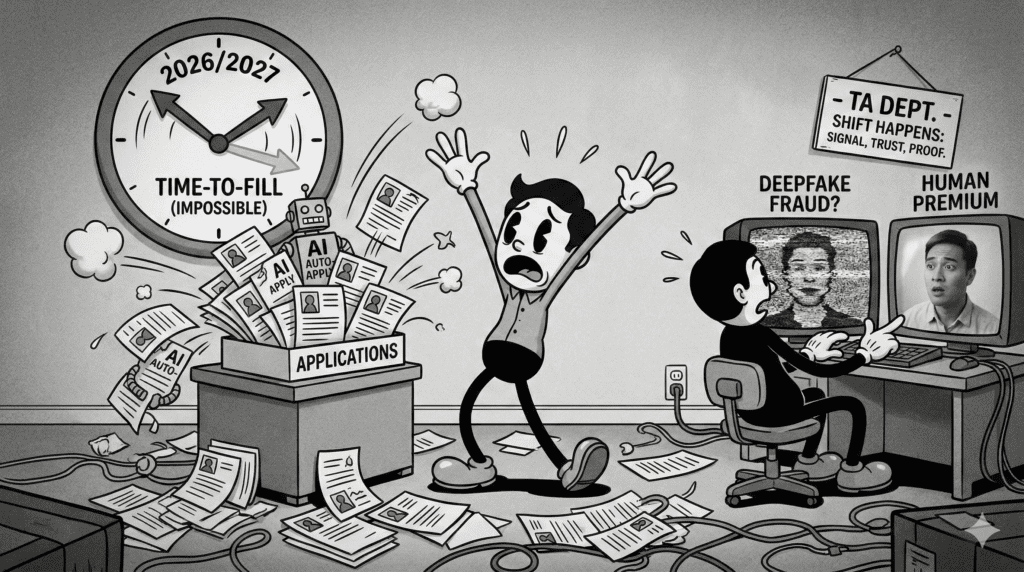
TL;DR FAQ: What Are The Current Challenges Facing Talent Acquisition Teams in 2026/27
▼ Q: Why are companies receiving more job applications but struggling to identify qualified candidates in 2026?
A: The surge in AI-generated resumes and auto-apply tools has created a volume problem, not a quality solution. Candidates can now apply to hundreds of roles in minutes, often with optimized but generic materials. That inflates applicant counts while reducing signal clarity. Talent acquisition teams are responding by adding structured screening questions, skills-based assessments, and proof-of-work exercises early in the hiring process to filter for real capability rather than keyword density.
▼ Q: How is artificial intelligence changing the hiring process for employers and recruiters?
A: AI is automating sourcing, resume review, interview scheduling, and even candidate communication. That shifts recruiter value away from list-building and toward evaluation, stakeholder alignment, and candidate trust. In 2026 and 2027, the competitive advantage is not who has AI tools, but who uses them to improve quality of hire, reduce time to productivity, and strengthen workforce planning.
▼ Q: Are AI deepfakes and remote identity fraud a real risk in hiring?
A: Yes. As remote hiring remains standard across technology, engineering, healthcare, and scientific roles, companies face increasing risk of impersonation, synthetic identities, and manipulated video interviews. Employers are adding digital identity verification, structured live assessments, and tighter background validation protocols. Hiring teams that ignore identity risk expose payroll, IP, and compliance vulnerabilities.
▼ Q: Is traditional candidate sourcing becoming obsolete?
A: Traditional sourcing as a manual search-and-message function is being commoditized. AI tools can generate long lists of potential candidates instantly. However, human judgment is becoming more valuable. Recruiters who can calibrate requirements with hiring managers, interpret complex skill sets, and build trust with high-demand talent are seeing a “human premium” emerge in 2026 and beyond.
▼ Q: What new jobs are emerging in the AI Operator era?
A: Organizations are hiring for roles such as AI Operator, AI Agent Manager, AI Workflow Analyst, and AI Governance Lead. These professionals manage, monitor, troubleshoot, and optimize AI systems embedded in business operations. Unlike traditional software engineering roles, these positions blend technical literacy with operational decision-making and risk oversight. Demand is rising in technology, manufacturing automation, healthcare systems, and high-growth startups.
▼ Q: How are talent acquisition teams being measured differently in 2026 and 2027?
A: TA is moving from a service model to a measurable business function. Instead of focusing only on time to fill, leadership is asking about cost of vacancy, quality of hire, retention impact, and revenue alignment. High-performing teams are quantifying how hiring affects production capacity, product delivery timelines, patient outcomes, or plant efficiency. In tight budget environments, recruiting leaders must demonstrate financial impact, not just process efficiency.
▼ Q: What should companies prioritize to stay competitive in hiring over the next two years?
A: Employers should focus on three fundamentals: improving candidate signal quality, strengthening identity verification in remote hiring, and aligning recruiting metrics to business outcomes. Companies that invest in skills-based hiring, structured evaluation frameworks, and workforce planning tied to growth strategy will outperform organizations still relying on resume volume and reactive hiring.
Talent acquisition is entering a phase shift. The last decade was about tooling up, scaling up, and speeding up. The next two years are about restoring trust, rebuilding signal, and proving business impact in dollars, not vibes.
Below are the five pressure points showing up again and again, plus what strong TA teams are doing about each one.
1) The Auto-Apply Conundrum and the “Noise” Crisis
The modern pipeline is getting louder, not better.
We now have two opposing forces hammering the same workflow:
- Candidates using AI to write resumes, cover letters, even interview responses
- Candidates using auto-apply tools to blast applications at scale
Employers are noticing that submissions increasingly look the same and are often mismatched to the role, which makes filtering harder and slower, not easier.
This is exactly why Gartner has been pushing the idea that high-volume recruiting will go “AI-first” in 2026: not because it is fun, but because the old manual triage model collapses under volume.
What to do about it
- Move from “application review” to “signal design.” If your only gate is “submit resume,” you are basically hosting an open mic night.
- Add lightweight proof-of-work early. Short skill checks, structured questions, portfolio prompts, or job-relevant mini-scenarios.
- Treat the ATS like a system of record, not the brain. More teams are layering assessment and screening intelligence outside the ATS, then syncing finalists back for compliance and workflow.
2) AI Deepfakes and Remote Identity Fraud
If you hire remotely, identity is now part of your hiring stack, whether TA owns it or not.
Deepfake fraud is accelerating, and it is no longer limited to “someone exaggerated their resume.” We are talking about impersonation, synthetic identities, and manipulated video and voice.
The World Economic Forum has specifically highlighted strengthening digital identity verification against deepfakes as a near-term priority.
Fraud-focused vendors are also documenting how AI-driven attacks are changing risk patterns in 2026.
What to do about it
- Add identity checks at the right moments, not everywhere. Risk-based verification beats blanket friction.
- Update your “remote hiring SOP.” If your process still assumes video equals truth, it is due for a renovation.
- Partner with Security and IT early. This is not just a TA ops problem anymore. It is access control, payroll, and data risk.
3) The Death of Sourcing (aka the “Human Premium”)
Sourcing is not literally dead. But the old version of it is getting commoditized fast.
AI can find profiles, draft outreach, and build lists at scale. That pushes recruiters up the value chain into work that is harder to automate: judgment, calibration with hiring managers, candidate trust, and assessment quality. Gartner explicitly calls out that recruiter skills are shifting toward more complex work as AI takes over the repetitive layers.
Deloitte’s view on “agentic AI” is basically the same story in different clothes: as AI handles more execution, humans move toward orchestration, governance, and exception handling.
What the “human premium” really means in 2026/27
- Better intake conversations (less “send me a unicorn,” more “what would success look like in 90 days?”)
- Better signal interpretation (not “who has the keywords,” but “who can do the work?”)
- Better trust-building (candidates are skeptical, and they have reason to be)
4) Never-Seen-Before Roles (The “AI Operator” Era)
New roles are popping up that feel unfamiliar because they are not classic software jobs, and they are not classic operations jobs either.
As companies deploy AI agents into workflows, they need people who can:
- run them
- monitor them
- QA them
- troubleshoot them
- govern them
Deloitte describes organizations “managing agents as workers” and building operating models around agentic systems.
OpenAI’s Operator launch is another public example of where the market is heading: AI that can execute tasks across digital systems, not just answer questions.
And yes, the job market is reflecting this. You can already find “AI Operator” and “AI agent operator” style roles posted publicly.
What TA should expect
- Job titles and requirements will be messy. Hiring managers will describe outcomes, not skills.
- Assessment will be the bottleneck. Resumes will not tell you who can safely run production AI workflows.
- Comp bands will be weird at first. These roles touch revenue, risk, and productivity, so they will not price like “generic ops.”
5) TA’s Value Prop: From “Service” to “Profit Center”
Cost pressure is not a footnote. It is the headline.
Gartner’s October 2025 TA trends message is blunt: AI and cost pressures are shaping 2026 talent acquisition strategy.
So the “TA as a service desk” model keeps losing budget battles. The teams that win are the ones that can connect hiring to business outcomes and defend spend with real numbers.
You are already seeing this in how TA leaders talk about budgeting and ROI: tighter spend, more precision, and more accountability.
What “profit center TA” looks like in practice
- Prioritizing roles by business impact (revenue, delivery capacity, patient outcomes, plant uptime, etc.)
- Quantifying cost of vacancy and time-to-productivity instead of only time-to-fill
- Improving quality of slate so hiring managers spend less time interviewing the wrong people
- Building internal mobility pipelines to reduce external spend and compress time-to-fill
SHRM’s 2025 benchmarking reports are also a useful reality check here: if leadership can benchmark recruiting performance, they will.
The throughline for 2026/27: Signal, Trust, and Proof
If you want the simplest way to explain the next two years:
- Signal: pipelines are noisy, so you need better filters than “resume attached”
- Trust: remote hiring requires verification, not assumptions
- Proof: TA needs to defend decisions and budgets like a business function, not a support queue
Or put differently: the easy part of recruiting is getting applications. Congrats, you have 3,000. Now for the hard part.
From recruiting shifts to advanced manufacturing challenges, startup news to enterprise hiring, industrial initiatives to deep tech innovation, we cover it all. At STEM Search Group, we’re a multidisciplinary recruiting firm specializing in technology, engineering, manufacturing, scientific, life sciences, healthcare, and startup talent. No niche is too narrow for us.
Source list (Q4 2025 and newer)
- Gartner press release on top TA trends for 2026 (Oct 7, 2025). (Gartner)
- Deloitte Tech Trends 2026 chapter on agentic AI operating models (Dec 10, 2025). (Deloitte)
- World Economic Forum report PDF on digital identity verification against deepfakes (2026). (World Economic Forum Reports)
- Veriff Identity Fraud Report 2026. (Veriff)
- Washington Post reporting on AI resumes and auto-apply creating application sameness (Feb 21, 2026). (The Washington Post)
- Financial Times reporting on extreme application volumes and tougher entry-level dynamics (published 2026). (Financial Times)
- OpenAI “Introducing Operator” (2025, still directly relevant to 2026’s agent execution trend). (OpenAI)
- Public job market evidence for “AI operator / AI agent operator” roles (Indeed, ZipRecruiter). (Indeed)
- Internal mobility ROI discussions (OneRange, iCIMS). (OneRange)
- Symphony Talent 2026 TA Outlook framing “precision” and full-funnel visibility. (Symphony Talent)