
When does replacing human labor with automation actually save money?
TL;DR FAQ
Q: When does automation save money?
A: Automation saves money when the work it saves is worth more than the equipment, upkeep, staff time, and mistakes it adds.
Q: Can self-checkout cost more than staffed checkout?
A: Yes, extra inventory losses and the staff time needed to run the lanes can eat up the payroll savings.
Q: Why did Kroger close some of its automated warehouses?
A: Kroger closed three facilities that fell short of its operating or financial expectations.
Q: What should companies measure in an automation pilot?
A: Compare cost per order, part, or call, and track output quality and how much work employees still do.
Q: How is AI affecting hiring for younger workers?
A: U.S. payroll data show weaker hiring for workers ages 22 to 25 in jobs exposed to AI, though the cause remains unclear.
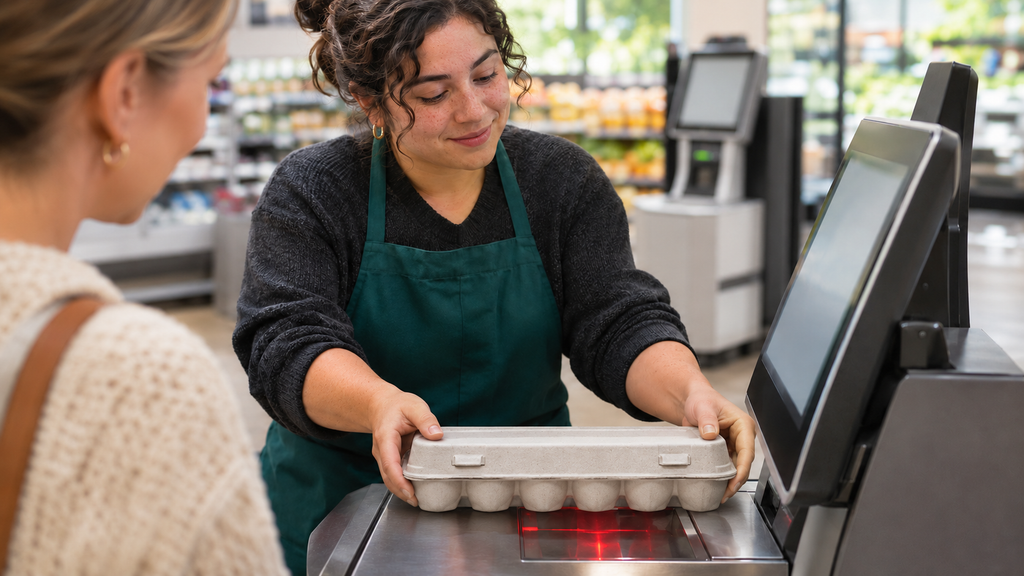
When Dollar General tried to bring down inventory losses in 2024, it put employees back at the checkout. By May, the chain had switched some or all of its self-checkout registers to assisted checkout in about 12,000 stores.
In the grocery store example below, an extra 19 cents of inventory loss for every $100 in sales is enough to wipe out projected self-checkout savings. Warehouse robots and AI tools have costs that can creep up the same way. A warehouse needs enough orders to keep its equipment busy. A coffee shop loses time when employees have to count the same shelf twice.
The self-checkout break-even point
Say a grocery store does $30 million in sales a year. With self-checkout, it needs four fewer full-time cashier positions. At $20 an hour, plus 30% for benefits and payroll taxes, that saves about $216,000 a year. The equipment, software, repairs, and attendants cost an assumed $160,000 a year. The store is ahead by about $56,000 before extra inventory losses.
Now suppose those losses rise by 25 cents per $100 in sales. Across a year, that adds up to $75,000. The store spends about $19,000 more than it did with staffed checkout. The example uses hypothetical costs, but the loss rate is close to what researchers found in stores. In a 2026 study covering 1,700 test stores at 11 grocers, ECR Retail Loss estimated that inventory losses rose by an average of 26 cents per $100 in sales in the first year after self-checkout went in.
Target approached the lanes differently from Dollar General. It kept self-checkout and capped it at 10 items at most stores. About a year later, Target reported that transactions across both self-checkout and staffed lanes were nearly 8% faster. Faster lines help shoppers get out the door. To know whether the change saved money, you’d also need the labor and inventory figures.
Amazon’s experience shows how much the setting can change the case for checkout technology. In January 2026, it said it would close its Amazon Go and Amazon Fresh physical stores. It said it hadn’t found the economics or customer experience to expand those formats. In the same announcement, Amazon said its checkout-free technology was in more than 360 third-party locations. At a BayCare hospital cafeteria, Amazon reported that waits dropped from 25 minutes to three. That’s a reason to look at the tool for a cafeteria. The operator would still need to price the system and figure out what shorter waits are worth.
A warehouse has to stay busy enough to pay for itself
Kroger built automated grocery fulfillment centers to assemble online orders. In January 2026, it closed three that fell short of its operating or financial expectations and dropped plans for a fourth. In fiscal 2025, Kroger recorded about $2.5 billion in charges tied to the network. The total reflects asset write-downs and related costs, including a roughly $350 million cash payment to Ocado, its automation partner.
Kroger kept automated facilities in its mix. It also fills orders from stores and works with third-party delivery companies. Each market has its own order volume and costs. A dedicated warehouse has a building, robots, and software to pay for even on a slow day. Filling orders from existing stores gives Kroger another way to serve markets where too few orders exist to keep a warehouse busy.
UPS was working on a different problem. It was redesigning its network to handle less volume from Amazon, its largest customer. UPS reported about $3.5 billion in savings from that overhaul in 2025. The company reduced its operational workforce by about 48,000 positions, including 15,000 fewer seasonal positions, and stopped daily operations at 93 buildings. It reported $544 million in program costs through year-end.
Automation was part of the UPS overhaul, along with facility closures and other changes. Kroger reported what it had to write down. UPS reported what the wider overhaul saved. To judge the equipment itself, you’d need to know which costs changed because the machines took over.
What happens when employees have to do the work twice?
Starbucks introduced an inventory tool from NomadGo that let workers point an iPad camera at shelves to count stock. The rollout reached about 11,300 company-operated cafés in 2025. Some workers told Fast Company the tool gave them wrong counts or lost their work when Wi-Fi dropped. Changes to product packaging could also throw it off. Starbucks retired the system in May 2026. People familiar with the project told Fast Company it may have cost more than $10 million to develop and deploy.
To judge a tool like that, time the whole count. Start when an employee picks up the iPad and stop when the store has a number it can use. If the worker has to restart the app or count some items by hand, include that time.
What a factory can learn from one production task
At BMW’s Spartanburg, South Carolina, plant, a Figure 02 humanoid robot positioned sheet metal for welding. BMW reported that it moved more than 90,000 parts and helped build more than 30,000 BMW X3s. Figure reported more than 1,250 hours of operation. Those numbers tell a plant manager what the robot handled on a live line. The companies did not release a payback figure or staffing changes.
An Ohio auto supplier put a price on the next step. AMG Industries borrowed a robot and tested it on one exhaust part for three months. Output went from 200 to 276 parts an hour, and AMG moved workers to other areas that needed them. Based on the trial, AMG cut its estimate of how long the equipment would take to pay for itself from 11.5 months to 6.5 months, according to the National Institute of Standards and Technology’s Manufacturing Extension Partnership. AMG then bought a $50,000 robot.
Leave room in the budget to get the new process working. A Census Bureau study of industrial AI found that U.S. factories could see productivity and profits fall in the short run before improving later. Separately, Stanford researchers found that 61% of 51 successful AI deployments had gone through at least one significant failure. That study looked at successful deployments, so it tells you what those teams had to work through. It can’t tell you how likely your own pilot is to succeed.
Before running a pilot, write down what the job costs today and decide what the new process needs to beat. Count paid hours, upkeep, downtime, and rework. Measure output and quality on busy shifts as well as quiet ones. Decide who takes over if the tool fails. If taking a busy line out of service is too expensive, look for a single task you can test during planned downtime.
When saved time changes the payroll
Bank of America said its EricaAssist tool shortened customer service calls by nearly a minute on average. In a separate study of more than 5,000 agents at a software company, researchers found that AI assistance helped agents resolve 15% more issues per hour on average. Less experienced workers gained the most. A manager can use those minutes to shorten wait times, cut overtime, or serve more customers before adding another shift. Each choice produces a different payroll result.
In a Census Bureau survey covering November 2025 to January 2026, about 2% of firms that used AI reported that it reduced employment. About 2% reported an increase. Challenger, Gray & Christmas counts announced job cuts. Employers cited AI in 121,401 cuts through October 2026, more than twice the total for all of 2025.
One source counts companies that reported a staffing change. The other counts positions employers said they planned to cut. Those figures make quieter changes hard to see. A manager can get by with the current team and drop a planned hire.
Who learns the work when software takes over the easy parts?
Indeed Hiring Lab found that U.S. software development postings were up 23.8% from a year earlier in October 2026, though still 19.2% below February 2020. An earlier analysis, covering May 2025 through May 2026, found that senior roles accounted for 71% of the net increase in postings over that period. A Stanford study of U.S. payroll records found weaker hiring among workers ages 22 to 25 in jobs with high AI exposure. The study couldn’t say how much of that gap AI caused.
A junior software engineer learns by fixing bugs, shipping small features, and watching a senior engineer work through a failure. If software starts doing more of those jobs, managers need to give junior engineers other ways to practice. Put a newer engineer on a real production fix with a senior reviewer. Have them write the test, explain what could break, and check what happens after the change goes live.
On a plant floor, newer operators need a way to learn what a normal cycle looks and sounds like when a machine does the routine work. Someone on the next shift still has to spot a bad part and work out why the machine stopped. The time it takes to train that person belongs in the automation budget.
Finding the people who change how work gets done
STEM Search Group is an executive search and niche role recruiting firm. We help manufacturers, retailers, and tech-forward companies make mission-critical hires. The right person can give a company a capability it never had, or even change how an entire industry operates. People who can do that are hard to find. One retailer may need a leader who can reduce inventory losses at self-checkout. A manufacturer may need someone who can bring robotics onto a production line or use a digital twin to see how a change would affect output before making it on the floor. Others are building custom AI tools that change how their teams work. These are the searches we built our firm for. If you have a project like this on the table, let’s talk about who you need to hire to get it done.
Sources
- Kroger, Fourth Quarter and Full-Year 2025 Results (March 5, 2026)
- Kroger, Form 10-K for fiscal year ended January 31, 2026
- Supply Chain Dive, Kroger cancels Charlotte fulfillment center; $350 million payment to Ocado
- UPS, Form 10-K for 2025, Transformation Strategy Costs
- UPS, Q4 2025 earnings call transcript (January 27, 2026)
- Dollar General, Q1 2024 earnings call transcript (May 30, 2024)
- Target, Express Self-Checkout results (May 5, 2025)
- ECR Retail Loss, Self-Checkout Loss Report 2026 (June 16, 2026)
- Amazon closes Amazon Go and Amazon Fresh stores, Associated Press (January 27, 2026)
- Amazon press release text, republished by Blue Book Services (January 27, 2026)
- Fast Company, Starbucks bet big on an AI tool; 9 months later, it pulled the plug (July 2026)
- Figure AI, F.02 Contributed to the Production of 30,000 Cars at BMW
- Bank of America, AI Adoption by BofA’s Global Workforce (April 8, 2025)
- Bank of America, EricaAssist generative AI expansion (July 21, 2026)
- U.S. Census Bureau, The Rise of Industrial AI in America: Microfoundations of the Productivity J-curve(s) (April 2025)
- Stanford Digital Economy Lab, The Enterprise AI Playbook: Lessons from 51 Successful Deployments (April 2026)
- U.S. Census Bureau, The Microstructure of AI Diffusion: Evidence from Firms, Business Functions, and Worker Tasks (2026)
- HR Executive (HCAMag), AI blamed for 121,401 job cuts, citing Challenger, Gray & Christmas (November 2026)
- U.S. Bureau of Labor Statistics, Job Openings and Labor Turnover, September 2026
- Indeed Hiring Lab, 2026 Q3 US Tech Labor Market Update (November 12, 2026)
- Indeed Hiring Lab, AI and Job Postings: From Destruction to Creation? (July 8, 2026)
- Stanford Digital Economy Lab, Canaries in the Coal Mine? revised August 12, 2026
- Hidden Labor Market Signals: More Than JOLTS and Unemployment Data (November 12, 2026)
- AI layoffs doubled this year, but there’s a lot more to the story (November 3, 2026)
- Software Engineering Teams in an AI-Native World (October 21, 2026)