
Built to Bend: Southern Auto Alley After the EV Boom (Part IV)
Part IV: The technology kept moving. The industry had to pivot.
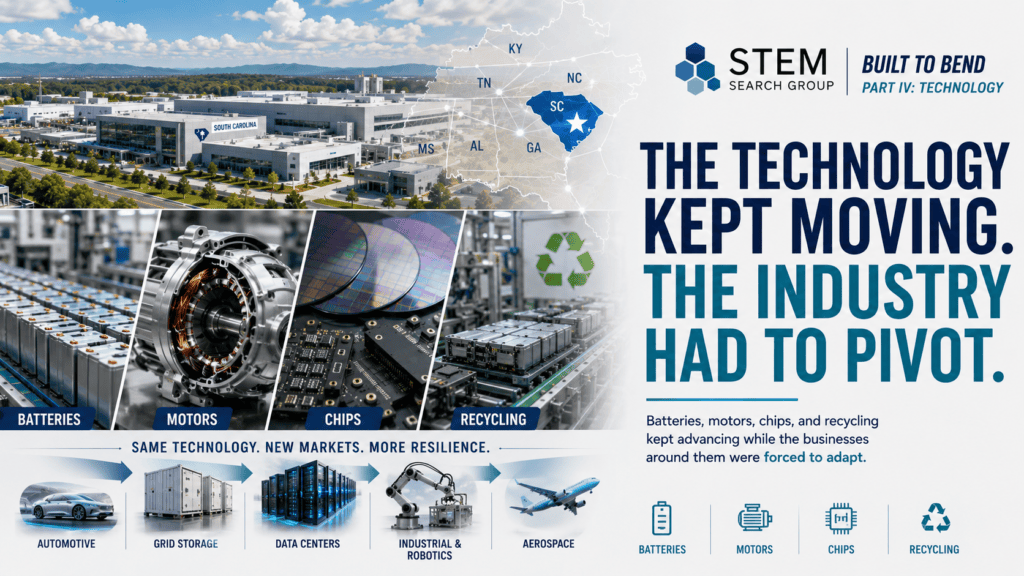
Built to Bend is a five-part STEM Search Group research series examining how Southern Auto Alley is adapting after the EV boom. Each installment explores a different part of the story, from manufacturing strategy and technology to hiring and long-term competitiveness.
Missed one of the other parts of our Southern Auto Alley After the EV Boom series? Want to share the full series with someone? Here are links to all five parts for your convenience:
- Part I: The EV pullback is revealing something bigger about Southern Auto Alley
- Part II: Why flexible manufacturing is quietly winning
- Part III: What the EV slowdown means for manufacturing hiring
- Part IV: The technology kept moving. The industry had to pivot.
- Part V: What will Southern Auto Alley look like in 2030?
TL;DR
Is this installment about batteries? Not really. It is about the gap between technological progress and business adaptation, and why the two moved on completely different timelines.
Did battery technology actually slow down along with sales? No. Silicon carbon anodes, solid-state batteries, and sodium-ion chemistries all kept advancing straight through the slowdown, because none of that progress depended on a tax credit.
What is the pattern across motors, chips, and recycling? The corporate structure absorbed real damage. The underlying technology and the physical plants mostly kept moving.
Here is the part of this story that does not show up in a quarterly sales report. EV sales fell 36% year over year in one quarter, then another 27% the next. The underlying technology behind those vehicles kept getting better the whole time, on a timeline that has almost nothing to do with tax credits or which administration happens to be in office.
Three battery chemistries are worth tracking closely. Each one is aimed at a different part of the market. None of them needed a policy tailwind to keep moving forward.
Silicon carbon anodes: the near-term upgrade
Why it matters: this is the one most likely to quietly show up in your next car, boosting range without anyone announcing a new architecture.
Silicon carbon anodes are the most practical near-term upgrade path for the batteries already rolling off production lines today. Swapping silicon in for some of the graphite in a battery’s anode can materially increase anode capacity. The exact gain in complete cell energy density depends heavily on how much silicon is used and how the individual cell is engineered.
Mercedes has already announced Sila’s silicon anode material for an electric G-Class application. Worth noting: this is still a relatively early, targeted use. These materials are not broadly on the road in volume yet.
The tradeoff holding this technology back:
- Silicon swells while charging, which used to crack these battery cells apart entirely
- The engineered scaffolds that fix that problem add a real price premium
- There is still a cycle life gap that is closing but is not closed yet
Silicon carbon has one real advantage over the other two chemistries below. It runs on the same factory lines as today’s batteries. That is exactly why it is the one most likely to show up in ordinary cars first, well before the other two reach the mass market.
Solid state batteries: the premium bet
Why it matters: do not expect this in a mainstream car soon. It is funded by premium vehicles and robotics first, mass market cars later.
Solid state batteries are the higher-density, further-out bet, and it is worth being clear-eyed about the timeline. Samsung SDI, Toyota, and Nissan are all working on replacing the flammable liquid electrolyte inside a battery with a solid one. That could open up meaningfully higher energy density and reduce some of the fire risks tied to liquid electrolytes.
Mass production remains difficult and expensive. Solid-state designs introduce their own problems around dendrites, interfaces, and pressure management that liquid-electrolyte batteries do not have to deal with in the same way.
Initial costs are steep enough that the realistic early path runs through premium vehicles, humanoid robotics, and aerospace applications first. Through 2030, this stays largely a premium and adjacent market story rather than something that shows up in an average buyer’s driveway. If you are trying to time when this technology actually affects mainstream vehicle pricing: not soon.
Sodium ion: the low-cost, materials-independence play
Why it matters: this is the chemistry that could make entry-level EVs and grid storage genuinely cheap, by cutting the industry’s dependence on lithium and cobalt.
Sodium ion batteries trade some energy density for a sharp reduction in dependence on lithium, nickel, and cobalt. All three have been sources of real supply chain anxiety for automakers over the past several years.
CATL and BYD are aiming sodium ion chemistries squarely at entry-level EVs and grid-scale storage, not range-obsessed passenger vehicles where energy density matters most. If sodium ion hits its projected cost targets, it is the chemistry that makes genuinely cheap EVs and genuinely cheap grid storage possible. That matters as much for utilities managing grid demand as it does for car buyers looking at a sticker price.
The throughline across all three chemistries: the write-downs automakers took over the past year hit sales assumptions and plant utilization rates. They did not touch the underlying physics or the manufacturing learning curve behind any of these three technologies. The pause in US EV sales growth does not mean a pause in how good these batteries are getting.
The motor side of the materials story
Why it matters: the same rare earth exposure that makes headlines about batteries also applies to the motor, and automakers are already engineering their way around it.
Batteries are not the only place automakers are trying to cut dependence on a small number of overseas suppliers. Most EV motors today are permanent magnet synchronous motors, which rely on neodymium magnets. China dominates much of the mining, refining, and processing behind the rare earths that go into them.
China’s tighter export controls on rare earths through 2025 created real supply disruptions and forced some manufacturers to reduce or pause production entirely. The motor magnet became the same kind of strategic pressure point that graphite has been for battery anodes for years.
The response looks a lot like the response on the battery side. Diversify:
- GM and Stellantis are backing a Minneapolis startup called Niron Magnetics to develop an iron nitrogen magnet with zero rare earth content
- Renault and Valeo are jointly targeting a fully rare-earth-free motor for 2027
- Nissan’s Ariya already uses a magnet-free externally excited synchronous motor instead of a permanent magnet design
- Oak Ridge National Laboratory in Tennessee, sitting right inside Southern Auto Alley itself, has conducted substantial research into rare-earth-free traction motor design
The same lesson shows up twice in two different parts of the vehicle. Whether it is graphite, lithium, or neodymium, the automakers still funding supply chain diversification, including the same ones that just wrote down billions of dollars in EV sales bets, are treating materials independence as a permanent engineering problem. Not something that resolves itself once the next election happens.
The chip layer nobody talks about
Why it matters: the semiconductor that makes an EV efficient also serves industrial and data center markets, which is exactly why the technology survived a bankruptcy that made headlines as an EV story.
Silicon carbide semiconductors are probably the least visible piece of this entire story, and maybe the most instructive one. These chips replace standard silicon inside an EV’s power inverter and cut energy loss between the battery and the motor. That is a real, measurable gain in range and efficiency, not a marketing claim dressed up as an engineering one.
Wolfspeed’s $5 billion materials facility in Siler City, North Carolina was supposed to anchor that part of the supply chain. Instead, the company cut headcount by roughly 28%, closed an older wafer fab in Durham, and filed for Chapter 11 in mid 2025.
That restructuring reflected several things at once: the cost of building capacity ahead of actual demand, a silicon carbide market that grew more slowly than planned, heavy existing debt, and the general difficulty of ramping major new facilities on schedule. Softer EV demand was a real factor. It was not the only one, and it is worth resisting the urge to blame the whole restructuring on EV sales alone.
The company emerged from Chapter 11 after materially reducing its debt load. The Siler City facility remains central to its manufacturing strategy going forward. The same pattern from the battery and motor stories shows up again here, one layer further down the supply chain. The corporate structure absorbed real, serious damage. The underlying technology and the physical plant itself kept moving, because silicon carbide also serves industrial, energy, data center, aerospace, and other power electronics markets well beyond passenger EVs.
Recycling: same corridor, genuinely different outcomes
Why it matters: two nearly identical businesses in this same corridor ended up in very different places, and the difference was largely whether they had more than one source of demand.
Battery recycling is where the divide between flexible and single-bet businesses shows up most starkly. Worth being careful here not to overstate how similar these two companies actually are underneath the surface comparison.
Ascend Elements has been operating a battery disassembly and lithium recovery plant in Covington, Georgia since 2023, feeding partly off scrap from the nearby SK Battery America plant. That Georgia facility hit commercial scale in 2025 and became the first US plant producing lithium carbonate at over 99% purity from recycled batteries. A genuinely impressive technical milestone on its own.
Ascend’s second facility, a cathode material plant in Hopkinsville, Kentucky, was built around federal Department of Energy grants originally valued at up to $316 million. When the federal government canceled support connected to that grant package, construction on the Kentucky site stalled. Ascend filed Chapter 11 in April 2026, with the loss of federal support standing as one factor alongside broadly difficult battery market conditions.
The Kentucky site was not just delayed. It was sold off entirely in the bankruptcy auction to a contractor, Turner-Kokosing, in the months that followed. Ascend no longer owns it.
Its Georgia plant, the diversified, revenue-generating one, kept running through all of it.
Redwood Materials chose a different state and a somewhat different strategy. It picked South Carolina for a separate recycling facility and has been expanding it, not retrenching. Alongside recycling, Redwood has been repurposing lightly used EV battery packs directly into grid storage and data center power. That gives it another potential source of demand beyond new vehicle recycling volume alone.
It is genuinely too early to say how much that diversification by itself explains the different trajectories of these two companies. They also differ in capital structure, technology, customers, and funding arrangements well beyond this one factor. But the pattern rhymes with everything else in this piece: businesses with more than one way to generate demand are having an easier time of it right now than businesses tied to a single customer or a single funding source.
The big picture across every layer
Look across batteries, motors, chips, and recycling, and the same story keeps repeating with different specifics attached. The technology at every layer kept advancing through a genuinely turbulent stretch of policy whiplash and gas price shocks. What varied was whether the business built around that technology had more than one way to generate revenue when the original demand assumption did not hold up.
Worth remembering the next time a headline makes it sound like the entire EV supply chain is in retreat. In most cases, the technology is not retreating at all.
For hiring, that points toward the same market flexibility we flagged in Part I. Skills built around silicon carbide, battery chemistry, or motor design travel well precisely because the underlying technology serves markets well beyond passenger EVs. A power electronics engineer at Wolfspeed or a battery chemist working on sodium ion is not betting a career on EV sales alone. They are betting on materials and processes that data centers, grid storage, and heavy industry all need too.
In the final installment, we will bring these signals together and look at what Southern Auto Alley could become by 2030.
Sources
- Sila Nanotechnologies press releases
- U.S. Department of Energy Awards Sila $100 Million to Scale
- Mercedes-Benz backed Sila to build silicon anode plant in Washington State
- Group14 Technologies
- Samsung SDI newsroom
- Exclusive: Global clients give early nod to Samsung SDI’s solid-state batteries
- Nissan unveils prototype production facility for all-solid-state batteries
- Sodium-ion batteries: A technology brief, IRENA
- BYD to manufacture sodium-ion batteries
- Sodium-ion batteries are happening, faster than you think
- Oak Ridge National Laboratory
- Wolfspeed Siler City facility
- Ascend Elements
- Redwood Materials
- Fortescue Zero Roadrunner program, MIGSO-PCUBED