
Built to Bend: Southern Auto Alley After the EV Boom (Part II)
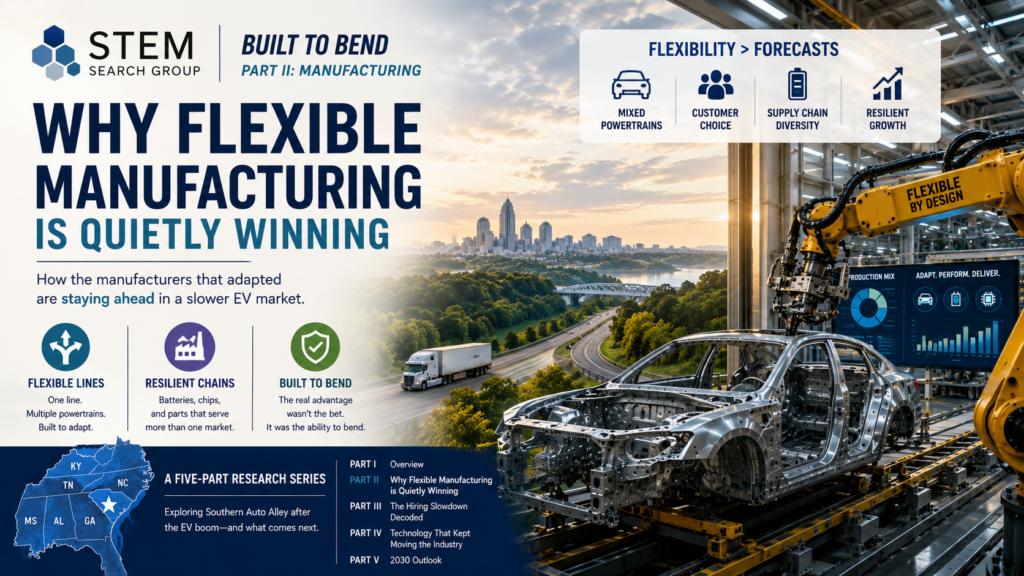
Part II: Why flexible manufacturing is quietly winning
Built to Bend is a five-part STEM Search Group research series examining how Southern Auto Alley is adapting after the EV boom. Each installment explores a different part of the story, from manufacturing strategy and technology to hiring and long-term competitiveness.
Missed one of the other parts of our Southern Auto Alley After the EV Boom series? Want to share the full series with someone? Here are links to all five parts for your convenience:
- Part I: The EV pullback is revealing something bigger about Southern Auto Alley
- Part II: Why flexible manufacturing is quietly winning
- Part III: What the EV slowdown means for manufacturing hiring
- Part IV: The technology kept moving. The industry had to pivot.
- Part V: What will Southern Auto Alley look like in 2030?
TL;DR
What actually separated the winners from the losers in the EV slowdown?
Flexibility, not a bet on EVs or gas.
What does that flexibility look like in practice?
Mixed powertrains on one line, product choice at the dealership, or a battery and chip supply that serves more than passenger EVs.
Who are the examples?
Hyundai, Toyota, Mercedes, BMW, Scout, and Rivian on one side. GM’s Ultium plants and Nissan’s Canton program on the other.
If you only read the headlines about the EV slowdown, the story sounds simple. Automakers overbuilt for electric vehicles, demand didn’t show up, and now everyone is paying for it. That’s true in some places.
But there is a more interesting pattern underneath the write-downs. Flexibility is what separated the winners from the losers over the past eighteen months, not any specific bet on EVs or gas.
Worth saying up front: these aren’t all the same kind of hedge.
- Some plants hedge by building more than one powertrain on a single line.
- Some hedge by giving customers a choice at the dealership.
- Some hedge by diversifying what a battery or a chip can be used for beyond passenger vehicles entirely.
They’re different mechanisms. But they all point toward the same conclusion, so it’s worth walking through each one.
The clearest case: more than one powertrain on the same line
Hyundai’s Metaplant near Savannah, Georgia is the clearest evidence that mixed powertrain flexibility works in practice, not just on paper. Hyundai describes it as producing the electric Ioniq 5 and Ioniq 9 alongside the Kia Sportage Hybrid on a single production line. That capability was built into the plant’s original design, not added later as a patch.
The Metaplant was roughly a $7.6 billion investment with 8,500 direct jobs. When demand shifts toward hybrids or back toward EVs, the plant adjusts its production mix. It doesn’t shut down a dedicated line.
Toyota’s battery plant in North Carolina tells a similar story one layer down the supply chain. It began shipping batteries in June 2025 and marked its formal production launch that November, Toyota’s first battery facility outside Japan. It’s built to supply batteries for hybrid, plug in hybrid, and fully electric vehicles from the same production lines.
A slowdown in one segment doesn’t strand the whole facility.
Mercedes Benz’s battery plant in Bibb County, Alabama feeds its Tuscaloosa assembly plant. It was built from day one with a highly flexible, digitized production system that lets Mercedes build electric and conventional vehicles on the same line. Hyundai’s separate EV production out of Montgomery adds to that same footprint.
Alabama has been marketing itself as part of the Southeastern Battery Belt. The flexibility built into its two biggest plants is a meaningful part of why that pitch holds up.
BMW’s case looks different again. Its $1.7 billion South Carolina investment covers electric vehicle production at Spartanburg and high-voltage battery assembly in Woodruff. This isn’t one dramatic bet. It’s four decades of steady reinvestment across whatever powertrains the market wants at a given moment. Flexibility, just spread out over time instead of built into one line.
The customer choice hedge
Scout Motors, building in Blythewood, South Carolina, put its hedge directly into the product rather than the factory floor.
- Scout plans to offer both the Traveler and Terra as a battery electric version with up to roughly 350 miles of range.
- Or a gas-extended Harvester version targeting more than 500 miles.
Scout says more than 85% of its reservations favored the Harvester as of March 2026. Worth noting: those reservations are refundable, not the same as completed sales, and production hasn’t started yet. Still, it’s an early signal. Scout is building both options from day one rather than retrofitting a hedge once demand data comes in.
Rivian is a different case, and it’s worth being precise about why. Rivian is an EV-only company, so it isn’t hedging on powertrain at all. It’s diversifying by vehicle size and price.
Rivian increased the planned initial capacity of its future Georgia plant from 200,000 to 300,000 vehicles a year ahead of construction, betting on the more affordable R2 and R3 rather than doubling down on premium-only volume. Construction is expected to begin in 2026, with customer production anticipated in 2028. This is a bet on a future segment, not proof of mixed powertrain flexibility the way Hyundai’s plant already is.
What happens without a hedge
The contrast sharpens when you look at plants that went all in on one demand assumption.
GM’s Ultium plants in Ohio and Tennessee were built around dedicated automotive EV cell demand. When that demand came in below plan, the plants had no immediate way to redirect output toward conventional vehicle production. That’s exactly why they were the ones temporarily idled, alongside a paused $3.5 billion Samsung SDI joint venture in Indiana. GM disclosed roughly $7.6 billion in charges tied to Ultium overall.
Ford’s Kentucky story, covered in Part I, is more nuanced. The Glendale plant survived, but only through an expensive strategic pivot into battery energy storage under the new Ford Energy subsidiary. That’s not the same as flexibility built in from the start. It’s a meaningfully different outcome than what Hyundai or Mercedes are dealing with.
Mississippi’s Nissan Canton plant, also touched on in Part I, is maybe the cleanest example of how granular this distinction can get. The plant itself kept its flexibility to produce conventional Frontier and Altima models. The specific EV investment inside it was canceled outright rather than redirected into some other electrified product.
That’s a sharper lesson than “always build a fallback.” Sometimes the fallback is fine, and the specific bet still fails.
Flexibility isn’t free
It would be dishonest to present flexible plants as simply better in every respect. They’re not.
A line built to switch between electric, hybrid, and combustion vehicles carries real costs a dedicated single architecture line doesn’t have to deal with:
- More complex changeovers.
- More constrained line balancing.
- Generally lower throughput per worker hour than a plant built to do exactly one thing at full tilt.
Tesla’s Giga Texas is the clean counterexample. It’s a single-architecture plant that keeps operating at enormous scale because vertical integration and volume allow efficiencies a mixed-model Southern plant isn’t designed to match. The bet on flexibility across this corridor is a bet that resilience is worth more than peak efficiency in a market this unpredictable. It’s not a claim that flexible plants win on every axis.
Where this flexibility actually came from
Here’s the part that might matter most going forward. The region likely didn’t build this flexibility specifically to survive the 2025 policy reversal. Much of it was deliberate for other reasons that had nothing to do with electrification policy.
Hyundai says its production flexibility was designed into the Metaplant from the beginning. Foreign OEMs like Toyota, BMW, Hyundai, and Mercedes came into this region already running mixed global portfolios, with combustion, hybrid, and EV vehicles all sold somewhere in the world at once. A flexible line was often just how they’d always built plants, not a specific hedge against an American policy swing.
The supplier base that grew up around them had to serve multiple OEMs with different needs at once. That likely pushed versatility down into the Tier 1 and Tier 2 layer early on.
Many of these facilities were also built recently enough that newer automation made adapting production easier than it would have been at older legacy plants. Persistent labor shortages across the region probably made that kind of flexible, automated production even more valuable, since manufacturers couldn’t always count on hiring enough people for one narrow, rigid task.
Put together: the South likely wasn’t positioned to win this specific EV whiplash by design. It happened to already have the right habits in place. We’ll come back to this in Part V, when we look at where this corridor is heading by 2030.
Why this matters more than the sales numbers do
It’s tempting to read all of this as a story about EVs specifically. That undersells what’s going on.
The pattern showing up across Hyundai, Toyota, Mercedes, BMW, Scout, and Rivian is about what happens to a manufacturing footprint when a single, confident demand assumption turns out to be wrong. That happens in every industry eventually, not just this one.
The plants that built in optionality, whether a second powertrain on the line, a second product option at the dealership, or a second customer base for the underlying chemistry, absorbed the shock and kept moving. The plants that bet everything on one assumption took the write-down.
That’s a lesson about how to build a factory in a market where the next five years are genuinely hard to predict. It will likely outlast the current EV story by a long stretch.
This is also worth watching if you’re not directly in the automotive industry. The same corridor building flexibility into battery plants and assembly lines is also home to a growing base of adjacent power electronics, energy storage, and materials work. A plant that can build electric vehicles and grid storage batteries under one roof is positioning itself to catch whichever part of the broader electrification economy grows fastest next: passenger vehicles, data centers, or something nobody’s built a business case around yet.
That’s the real reason flexible manufacturing is winning quietly rather than loudly. It doesn’t show up as a headline the way a plant cancellation does. It shows up gradually, as one plant after another keeps hiring, keeps shipping, and keeps expanding while its single-purpose neighbors get idled or converted.
By the time anyone writes the retrospective on this period, the flexible plants probably won’t look like they did anything dramatic. They’ll just look like they kept doing what they were already doing. In a market this unpredictable, that turns out to be the harder and more valuable thing to pull off.
In Part III, we move from the factory floor to the labor market and look at what this shift means for hiring managers, engineers, technicians, and workers coming out of canceled or idled programs.
Sources
- Hyundai Motor Group Metaplant America
- Toyota Battery Manufacturing North Carolina
- Mercedes-Benz U.S. International (Tuscaloosa)
- BMW Manufacturing Co., Spartanburg Plant
- Scout Motors Manufacturing Center
- Georgia Department of Economic Development, Automotive
- Alabama Department of Commerce, Automotive Manufacturing
- South Carolina Department of Commerce, Automotive Industry