
Built to Bend: Southern Auto Alley After the EV Boom (Part III)
Part III: What the EV slowdown means for manufacturing hiring
Built to Bend is a five-part STEM Search Group research series examining how Southern Auto Alley is adapting after the EV boom. Each installment explores a different part of the story, from manufacturing strategy and technology to hiring and long-term competitiveness.
Missed one of the other parts of our Southern Auto Alley After the EV Boom series? Want to share the full series with someone? Here are links to all five parts for your convenience:
- Part I: The EV pullback is revealing something bigger about Southern Auto Alley
- Part II: Why flexible manufacturing is quietly winning
- Part III: What the EV slowdown means for manufacturing hiring
- Part IV: The technology kept moving. The industry had to pivot.
- Part V: What will Southern Auto Alley look like in 2030?
TL;DR
What skills are holding up best in this market? Battery manufacturing, power electronics, and flexible line experience. Skills tied to more than one powertrain or program, not skills tied to just one.
Is a canceled or idled plant a red flag on a resume? No. It usually signals exactly the kind of hard-to-find experience flexible plants in this corridor need.
What’s actually slowing hiring down? A shortage of cross-trained workers who can run a line that switches between electric, hybrid, and combustion.
What the EV slowdown actually means for hiring
For most of the plants and clients we work with, the EV slowdown is not an abstract policy story. It shows up as a hiring plan. A layoff notice. A plant conversion announcement. Sometimes all three land in the same quarter.
The technology and policy details matter. But what clients actually want to know is more practical: what does this mean for the people they are trying to hire, and for candidates coming out of plants that got hit by the write-downs?
The skills proving durable right now
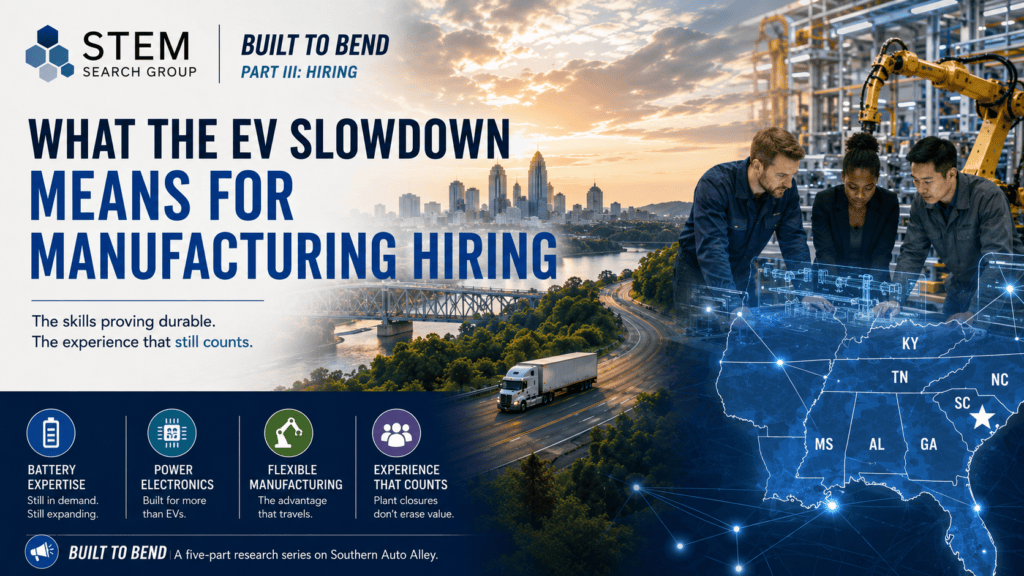
The skills holding up best through this cycle are not tied to a single powertrain or a single funding source. They are tied to three things: building batteries, moving power efficiently, and running flexible manufacturing systems.
In the searches and candidate conversations we’re seeing, experience across more than one production environment travels better than experience limited to a single architecture or a single customer relationship. Someone who has worked a line that switches between electric and hybrid models, or a battery plant that supplies more than one vehicle type, is walking into interviews with something a lot of hiring managers are actively looking for. That maps directly onto the line flexibility and market flexibility we named in Part I: skills that travel across powertrains, and skills built on technology that serves markets beyond automotive.
Two shifts we have watched directly in our own searches over the past eighteen months are worth naming plainly.
- Battery experience is easier to place when a candidate also has an automation or controls background, rather than battery experience alone.
- More than one client has quietly dropped “EV experience required” from a job req and replaced it with a broader manufacturing automation requirement, once they realized how much it was narrowing their pipeline for no real reason.
Silicon carbide power electronics is a good example of a skill set that stayed durable even as the corporate story around it got messy. Wolfspeed’s restructuring in North Carolina included a roughly 28% headcount cut, the closure of an older wafer fab in Durham, and a Chapter 11 filing in 2025. All of that read as an EV story in the headlines. But the underlying work, building semiconductors that cut energy loss between a battery and a motor, is used across industrial, energy, data center, and aerospace markets well beyond passenger EVs.
Wolfspeed emerged from Chapter 11 with materially reduced debt, and Siler City remains central to its plans. The skill set never stopped being valuable. The company just had to survive a rough stretch to keep using it.
Why a canceled plant is not a red flag on a resume
This is maybe the most important message for candidates specifically. Experience at a canceled or idled plant, or even a bankrupt recycler, is not a red flag. The experience itself is transferable. Hiring managers who treat it as a strike against a candidate are working off an outdated read of the market.
Think about what actually happened at places like SK Battery America in Georgia, GM’s Ultium plants, or Ascend Elements’ Kentucky facility. In every case, the underlying skills- battery manufacturing, power electronics, automation, and quality- stayed relevant. What changed was the business built around those skills, not the value of the skills themselves.
A technician who ran quality control on a battery line that later got idled still knows how to run quality control on a battery line. That knowledge moved to wherever the business was actually built to bend.
We would tell any candidate coming out of one of these situations the same thing: don’t undersell that experience in an interview, and don’t let a hiring manager treat a plant closure as evidence of a personal shortcoming. It almost never is.
We have seen this play out directly in our own searches. Candidates from idled battery lines in Georgia have landed quickly at flexible plants in Alabama and the Carolinas, because the underlying quality and automation skills mapped cleanly, even though the specific program they came from had been written off.
If you’re a hiring manager evaluating a candidate from a canceled or idled program, look for:
- Direct experience with the underlying process: battery assembly, power electronics, automation, quality control. Not just experience limited to one specific vehicle program.
- A track record of adapting to changeovers or process changes, even outside a formally “flexible” line.
- Clear articulation of what they actually did day to day, not just the name of the plant or program on their resume.
If you’re a candidate explaining experience from an idled plant, lead with:
- The specific systems and processes you worked with, not the fact that the program got canceled.
- Any exposure to more than one product or line, even informal cross-training.
- What you’d bring to a flexible operation specifically, since that’s where the hiring is concentrated right now.
The real bottleneck: cross-trained talent
Here’s where we’d push back a little on the idea that this is all good news for hiring. A technician who spent a career on a dedicated combustion line, or a dedicated EV line, doesn’t automatically know how to run a shift where the vehicle rolling off the line changes model to model.
Working a flexible line takes real cross-training. It means being comfortable with high voltage systems and traditional powertrains at the same time, plus having the judgment to handle a changeover without slowing the whole line down.
That talent pool is still pretty shallow. Cross-trained talent is one of the real constraints standing between these flexible facilities and the headcount they’re advertising for, though it’s not the only one. Plants like Hyundai’s Metaplant, Toyota’s North Carolina lines, and Mercedes’ Bibb County facility were all built with the flexibility already designed in.
The people who can actually run that flexibility at full productivity are in shorter supply than the equipment is.
If you’re hiring for one of these lines, budget for training time. Don’t assume a candidate with solid combustion or solid EV experience can step in and immediately run a mixed line at full speed. If you’re a candidate, cross training on both sides of the powertrain divide, high voltage systems and traditional combustion or hybrid systems, is one of the clearest ways to make yourself the person these plants are actually short on.
That’s not a small thing to ask of someone. It’s a real investment of time and effort. But it’s also one of the more reliable ways to make yourself durable against whatever policy swing comes next.
Reading the signals that don’t show up in a job posting
A few patterns are worth watching if you’re trying to figure out where the next round of hiring demand is going to land. They’re less exposed to policy swings than new vehicle sales figures.
The extended range EV signal is one of them. Scout’s early reservation data shows real demand for a configuration where electric motors drive the wheels while a small combustion engine mainly generates electricity rather than powering the wheels directly. Stellantis delayed its all-electric Ram 1500 REV specifically to prioritize the Ramcharger EREV instead.
In China, EREVs from Li Auto and the Huawei-backed Aito M9 are already a mainstream success, not a hedge. That pattern rejects oversized, expensive battery packs in favor of smaller ones that stretch scarce lithium and nickel further while eliminating range anxiety outright. Plants and suppliers building toward that configuration will need people who understand both a combustion generator and an electric drivetrain, which loops right back to the cross-training point above.
The heavy industrial signal is another one worth watching. Ultra-class mining haul trucks are getting electrified fast, not because of any EV mandate, but because diesel logistics at remote mine sites are expensive and a truck that recharges itself on the descent is simply a better bet economically. Fortescue Zero’s Roadrunner program went from prototype to a functional 3.2 megawatt-hour truck in 22 months, pairing megawatt static charging with overhead trolley assist and regenerative braking.
Programs like that create real-world data on high loads, charging, vibration, thermal performance, and battery degradation that moves at the pace of mining and industrial markets rather than vehicle sales or tax policy. That’s a hiring pipeline that doesn’t rise and fall with passenger EV sentiment. It’s worth candidates and hiring managers alike keeping an eye on it.
What this means if you’re building a team right now
If you’re a hiring manager in this corridor, the practical takeaway is to stop screening candidates based on which specific plant or program they came from and start screening based on the actual skills underneath that experience. Battery manufacturing, power electronics, energy storage, automation, quality, and mixed model assembly are the things that travel. The name of the program that got canceled around them doesn’t tell you much about the person.
If you’re a candidate, the takeaway is almost the mirror image. Don’t treat a canceled program or an idled plant on your resume as something to explain away. Treat it as evidence you have real experience in exactly the kind of environment these employers are trying to build more of.
And if you have the opportunity to cross-train across the powertrain divide, on either the technician or engineering side, that’s probably the single highest leverage move available to you in this market right now. The plants that are actually adding headcount are the flexible ones, and the flexible ones are short on people who can run flexibility well.
Why this region specifically has an edge in the hiring conversation
There’s one more piece of this worth spelling out, because it changes how a candidate or a hiring manager should think about the region itself, not just any single plant inside it. Southern Auto Alley now has meaningful depth across several layers of the supply chain at once: assembly plants, dedicated battery facilities, motor and magnet research, silicon carbide chip production, and battery recycling, all inside a fairly compact geographic footprint stretching from Georgia through Kentucky.
A worker laid off from a battery plant in Georgia isn’t necessarily looking at a long commute or a relocation to find the next opportunity. That density is part of why we’d tell a hiring manager not to be surprised if a strong candidate has bounced between two or three companies inside this corridor over the past few years. It’s often a sign of someone chasing where the work actually was, not a sign of instability.
It also means a hiring manager building a team here has more to work with than the job posting alone would suggest. Someone with recycling experience at Ascend Elements’ Georgia plant has skills that translate directly to a battery assembly role at Hyundai’s Metaplant, even though those are technically different industries on paper. Recognizing those adjacencies, rather than screening narrowly for exact title matches, is probably the fastest way to fill some of these harder-to-staff roles.
What we’re telling clients right now
When clients ask us directly whether they should be worried about hiring into a sector that’s absorbed tens of billions of dollars in write-downs over the past year, our honest answer is that the write-downs tell you less than the headlines suggest. They tell you which specific bets didn’t pay off. They don’t tell you whether the underlying work is going away, and in almost every case we’ve looked at across this corridor, it isn’t.
The plants hiring right now are overwhelmingly the flexible ones, and the people they’re struggling to find are overwhelmingly the cross-trained ones. That’s a solvable problem, but it takes both sides taking it seriously. Employers need to budget real time and real money for training rather than expecting a fully formed candidate to walk in the door.
Candidates need to treat cross-training as an investment worth making even when it isn’t strictly required for their current role. Do both, and this corridor’s hiring picture looks a lot healthier than the write-down headlines make it sound.
In Part IV, we’ll look underneath the vehicle itself at the battery, motor, semiconductor, and recycling technologies that continued advancing even while US EV sales weakened.
Sources
- Wolfspeed Chapter 11 bankruptcy filing and restructuring: https://www.manufacturingdive.com/news/us-chipmaker-wolfspeed-file-bankruptcy-chapter-11-restructuring-renesas/751475/
- Wolfspeed Chapter 11 debt reduction and Siler City plans: https://www.romesentinel.com/news/wolfspeed-chapter-11-bankruptcy-filing-marcy-ny/article_1c273574-b776-4da4-9d8f-721dd93ea33f.html