
Built to Bend: Southern Auto Alley After the EV Boom (Part I)
Part I: The EV pullback is revealing something bigger about Southern Auto Alley
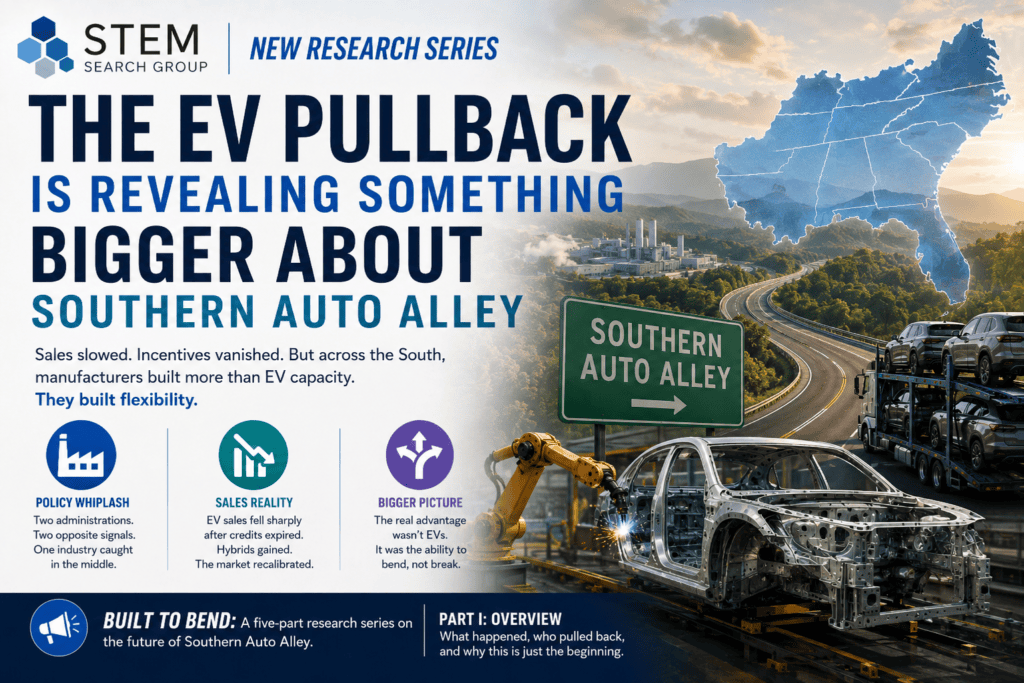
Built to Bend is a five-part STEM Search Group research series examining how Southern Auto Alley is adapting after the EV boom. Each installment explores a different part of the story, from manufacturing strategy and technology to hiring and long-term competitiveness.
Missed one of the other parts of our Southern Auto Alley After the EV Boom series? Want to share the full series with someone? Here are links to all five parts for your convenience:
- Part I: The EV pullback is revealing something bigger about Southern Auto Alley
- Part II: Why flexible manufacturing is quietly winning
- Part III: What the EV slowdown means for manufacturing hiring
- Part IV: The technology kept moving. The industry had to pivot.
- Part V: What will Southern Auto Alley look like in 2030?
TL;DR
Did Southern Auto Alley bet wrong on EVs?
Not really. Sales did slow sharply after federal tax credits expired, but the region’s advantage was never tied to EVs specifically.
So what actually protected it?
Flexible plants and supply chains built to serve more than one product, customer, or market.
What does this installment cover?
The policy whiplash, the sales numbers, and which manufacturers pulled back hardest, setting up the rest of the series.
Who should care?
Plant leaders, HR, and suppliers across Georgia, South Carolina, North Carolina, Tennessee, Kentucky, and Alabama making five- to seven-year bets right now.
We are starting with the broader question: did the South make a bad bet on EVs, or did the investments leave the region better positioned than the headlines suggest? Our answer, based on the searches we’ve run and the plants we’re staffing today, is that the South mostly bet on flexibility dressed up as an EV boom.
STEM Search Group works with a lot of clients tied to automotive manufacturing, and most of them sit somewhere along the Southern Auto Alley corridor: Georgia, the Carolinas, Tennessee, Kentucky, Alabama, and Mississippi. That means we don’t watch the EV story from a distance. We watch it through hiring plans, plant announcements, and the occasional layoff notice that lands the same week as a groundbreaking two states over.
Over the past two years, that story has whipsawed hard:
- One administration pushed the industry toward EVs with tax credits and emissions targets.
- The next one pulled almost all of that support back.
- Gas prices spiked on their own timeline too, driven by a Middle East conflict that had nothing to do with domestic auto policy.
Our clients keep asking some version of the same question: did the billions of dollars automakers and suppliers invested in batteries, motors, chips, and plants actually pay off, given that sales never matched expectations? Is the South positioned to keep growing on the back of that investment, or did this region just get lucky on timing?
The short answer is that the region is genuinely well positioned, but not because it bet on EVs specifically. Many of the plants and supply chain investments here were designed to serve more than one product, customer, or market. That’s a different and more interesting story than “the South bet on electric cars and won.”
That flexibility shows up in three distinct forms across this series, and it’s worth naming them up front because we’ll keep coming back to them:
- Line flexibility: a plant built to run more than one powertrain on the same production line.
- Product flexibility: a company giving the customer the choice, a hybrid, an EREV, or a full EV, rather than betting on one configuration.
- Market flexibility: a battery, chip, or material that serves more than the automotive industry alone, so a slowdown in one segment doesn’t strand the whole business.
Keep those three in mind. They’re the throughline for everything that follows.
A quick note on scope before we go further:
- Texas isn’t part of this picture. Tesla’s Giga Texas is massive, but it grew up as one company’s vertically integrated operation, not the multi-OEM, shared supplier cluster that defines the traditional Southern Auto Alley footprint. It’s also a single-architecture EV bet that happens to still be working, which is a different story than the one we’re telling here.
- Florida doesn’t have a comparable story yet either. No OEM assembly plant, no automotive battery gigafactory, just scattered defense and industrial-scale battery work.
Two administrations, two opposite signals
The Biden administration’s push was real and specific. The Inflation Reduction Act backed a $7,500 federal tax credit for new EVs and tightened fuel economy targets, helping accelerate tens of billions of dollars in battery and EV supply chain commitments across North America.
Then came the reversal:
- The 2025 legislation ended federal clean vehicle purchase credits for vehicles acquired after September 30, 2025.
- It weakened the financial consequences tied to missing federal fuel economy requirements.
- The administration also moved separately to scale back emissions rules that had supported faster electrification.
These are related policy moves, but not the same regulatory mechanism, and they didn’t all happen through one law. Even so, the combined effect for plant leaders felt like a single, sharp reversal. That meant capex commitments built around one demand curve and an operating reality built around another, almost overnight.
That’s two administrations, two opposite signals, inside of three years. Automakers built five- to seven-year manufacturing plans around the first signal and are now living with the second one. If you want to understand why some plants are thriving, and others are being idled or converted, that timeline is the place to start.
What the sales numbers actually show
According to Cox Automotive’s quarterly sales reporting:
- EV sales fell 36% year over year in Q4 2025, then another 27% in Q1 2026.
- EV share of new vehicle sales fell from around 10.5% in Q3 2025 (when buyers rushed to beat the credit deadline) down to 5.8% in Q4, and stayed at 5.8% through Q1 2026.
- Q2 2026 showed the first signs of stabilizing, with EV volume up 14.7% from the prior quarter, though still down 20.5% year over year.
- Several major automakers saw individual EV nameplates decline sharply over the same period.
Meanwhile, hybrids are having a moment nobody scripted. Hybrids kept gaining share through 2025 and into 2026, while battery electric and plug-in hybrid sales weakened. Gas prices have been genuinely volatile through this stretch rather than climbing in a straight line:
- National averages peaked near $4.56 in May 2026 after the Iran conflict broke out.
- Prices fell back below $4 by mid-June once a ceasefire took hold.
- They climbed again toward the $3.80 to $4.40 range after that ceasefire broke down in early July.
That volatility, more than any single price point, is what’s giving buyers another reason to look at a hybrid. But the shift also reflects broader model availability, lower range anxiety, and the simple fact that hybrids require fewer changes in driving and charging behavior than a full EV does.
Rising gas prices are pushing more shopping traffic toward EVs too, but that interest hasn’t turned into a sales recovery yet. Analysts at Cox Automotive have made the point directly: search traffic isn’t the same thing as a signed deal.
Globally, the picture looks a lot healthier. Electric car sales grew 20% worldwide in 2025, and BloombergNEF expects global passenger EV sales to rise another 11% in 2026, led by China and stronger growth in Europe and several emerging markets. The US is the outlier here, not the leading indicator, and that gap traces largely to the loss of federal incentives combined with steep tariffs that keep affordable Chinese EVs out of the market entirely.
Who pulled back, and how far
Trade publications have called this one of the industry’s most significant strategic reversals in years, and the numbers back that up. Combined charges across Ford, GM, and Stellantis are analyst estimates of roughly $53 billion to $55 billion, depending on what’s included.
- Ford dissolved its BlueOval SK battery joint venture in Kentucky, laying off roughly 1,600 employees at the Glendale plant. That Kentucky operation was built around a future lineup of Ford and Lincoln EVs, not one named vehicle, so when Ford’s EV plans and demand expectations changed, it couldn’t just switch into hybrid or combustion production. Ford took sole ownership of the site and is now converting it, under a new subsidiary called Ford Energy, to build battery energy storage systems instead, a roughly $2 billion investment with first customer deliveries targeted for late 2027. A separate Tennessee plant, originally built for a next-generation electric truck rather than the Lightning, is being repurposed toward gas-powered “Built Ford Tough” production instead. The Lightning itself hasn’t been discontinued: it shifted to a plug-in hybrid version built in Dearborn, while Super Duty production stays assigned to Ford’s Ohio plant. The Kentucky plant survived, but only through an expensive change in strategy, not through the kind of built-in flexibility that let other Southern plants shift weight without shutting down.
- GM disclosed roughly $7.6 billion in charges tied to its Ultium EV platform, temporarily idled Ultium battery plants in Warren, Ohio, and Spring Hill, Tennessee, and paused construction on a $3.5 billion battery plant it was building with Samsung SDI in Indiana.
- Honda shelved an $11 billion EV and battery plant planned for Ontario after already delaying it once in 2025, and scrapped three planned Honda and Acura EVs for North America.
- SK Battery America laid off 958 workers, about 37% of its Commerce, Georgia workforce, tied directly to Ford’s decision to cancel the electric Lightning.
A running tracker from Automotive News lists cancellations or delays from Ford, GM, Stellantis, Honda, Hyundai, Kia, Lamborghini, Nissan, BMW, and Sony Honda Mobility. Nissan’s Ariya was pulled from the US market entirely. The World Resources Institute puts total canceled EV manufacturing investment at roughly $19.9 billion since 2025.
The bigger question underneath the headlines
Here’s where it gets useful for anyone actually running a plant or hiring for one in this corridor. The real question was never “EV or gas.” It’s how you hire and build against a demand curve that keeps bending, and which bets across the whole supply chain are actually holding up underneath the write-down headlines.
Many of the projects still operating, expanding, or moving toward production had more than one way to absorb a change in demand:
- Hyundai’s Metaplant near Savannah builds the electric Ioniq 5 and Ioniq 9 alongside the Kia Sportage Hybrid on a single line, a capability built into the plant’s original design.
- Toyota’s battery plant in North Carolina supplies hybrid, plug-in hybrid, and fully electric vehicles from the same production lines.
- Mercedes-Benz’s plant in Bibb County, Alabama was built from day one with a flexible, digitized system that lets it build electric and conventional vehicles side by side.
Contrast that with the plants that had no fallback:
- GM’s Ultium plants in Ohio and Tennessee depended entirely on automotive EV cell demand and couldn’t redirect their output when that demand didn’t materialize, which is exactly why they were the ones idled.
- Mississippi’s Nissan Canton plant had a planned $500 million EV program canceled in April 2026. The plant itself can keep producing conventional Frontier and Altima vehicles, but the specific investment tied to EVs wasn’t redirected into anything else. It was just canceled.
That’s arguably a sharper lesson than “no fallback”: the plant survived, but the bet on it didn’t.
None of this means the underlying technology stalled. Silicon carbon anodes, solid-state batteries, and sodium-ion chemistries all kept advancing on their own timeline through the entire policy whiplash, because none of that progress depended on a tax credit. What changed wasn’t the physics; it was how confident automakers were in the demand curve they’d built their plants around.
That distinction, between technology that kept improving and demand assumptions that got proven wrong, is really the throughline for this whole corridor right now:
- The plants that assumed a straight line up and to the right are the ones absorbing nine- and ten-figure write-downs.
- The plants built to flex between powertrains, or between products, or between customers, are mostly still standing, still hiring, and in some cases still expanding.
Georgia, South Carolina, North Carolina, Tennessee, Kentucky, and Alabama now have meaningful assets across multiple layers of the EV supply chain: batteries, motors, chips, and recycling. That breadth is showing up directly in which projects are still standing after two administrations and a war-driven gas price spike hit the industry from opposite directions. Mississippi’s Canton plant is a reminder of what happens when a specific investment doesn’t build in that same flexibility, even when the plant around it does.
For hiring managers and candidates alike, that split is worth paying attention to, and it’s the subject of the rest of this series. But the headline point stands on its own: the region wasn’t lucky. It was built, in large part by accident and for reasons that had nothing to do with EV policy specifically, to survive exactly this kind of shock.
Whatever the industry’s next swing turns out to be, that’s the trait worth watching for.
In Part II, we’ll look more closely at the plants and manufacturers that have absorbed the EV slowdown without shutting down, and why flexibility is proving more valuable than getting one demand forecast exactly right.
Sources
- Cox Automotive, Q1 2026 and Q2 2026 EV sales reports — coxautoinc.com
- BloombergNEF, Electric Vehicle Outlook 2026 — about.bnef.com
- Atlas Public Policy, US EV and battery supply chain investment tracking — atlaspolicy.com
- Automotive News, EV cancellations and delays tracker — autonews.com
- InsideEVs, “All The EVs That Got Canceled Or Delayed In 2025 And 2026” — insideevs.com
- World Resources Institute, canceled EV manufacturing investment tracker — wri.org
- AAA and CBS News, 2026 national gas price data — gasprices.aaa.com, cbsnews.com
- Detroit News / CBT News, GM Indiana battery plant pause — detroitnews.com, cbtnews.com
- Carscoops, Honda Alliston, Ontario EV plant shelved — carscoops.com
- Yahoo Finance / Autoblog, SK Battery America layoffs — finance.yahoo.com
- WDRB, Ford Kentucky battery plant layoffs — wdrb.com
- ESG Dive, GM Ultium Cells production pause — esgdive.com
- Wikipedia and Automotive Manufacturing Solutions, Hyundai Metaplant America — en.wikipedia.org, automotivemanufacturingsolutions.com
- Mercedes-Benz Group and InsideEVs, Bibb County, Alabama battery plant — media.mbusa.com, insideevs.com
- Automotive News, Carscoops, and CBT News, Nissan Canton, Mississippi EV cancellation — autonews.com, carscoops.com, cbtnews.com