
Built to Bend: Southern Auto Alley After the EV Boom (Part V)
Part V: What will Southern Auto Alley look like in 2030?
Built to Bend is a five-part STEM Search Group research series examining how Southern Auto Alley is adapting after the EV boom. Each installment explores a different part of the story, from manufacturing strategy and technology to hiring and long-term competitiveness.
Missed one of the other parts of our Southern Auto Alley After the EV Boom series? Want to share the full series with someone? Here are links to all five parts for your convenience:
- Part I: The EV pullback is revealing something bigger about Southern Auto Alley
- Part II: Why flexible manufacturing is quietly winning
- Part III: What the EV slowdown means for manufacturing hiring
- Part IV: The technology kept moving. The industry had to pivot.
- Part V: What will Southern Auto Alley look like in 2030?
TL;DR
What does Southern Auto Alley look like by 2030? Silicon carbon anodes go mainstream. Solid state stays a premium and adjacent-market story. Sodium ion could make entry-level EVs and grid storage genuinely cheap.
Was this region’s flexibility built specifically to survive the 2025 policy reversal? No. It came from global OEM habits, newer automation, and labor shortages that predate this specific EV cycle.
Why does that matter going forward? Because those same traits are a reasonable bet to hold up again next time, whatever the next industry swing turns out to be.
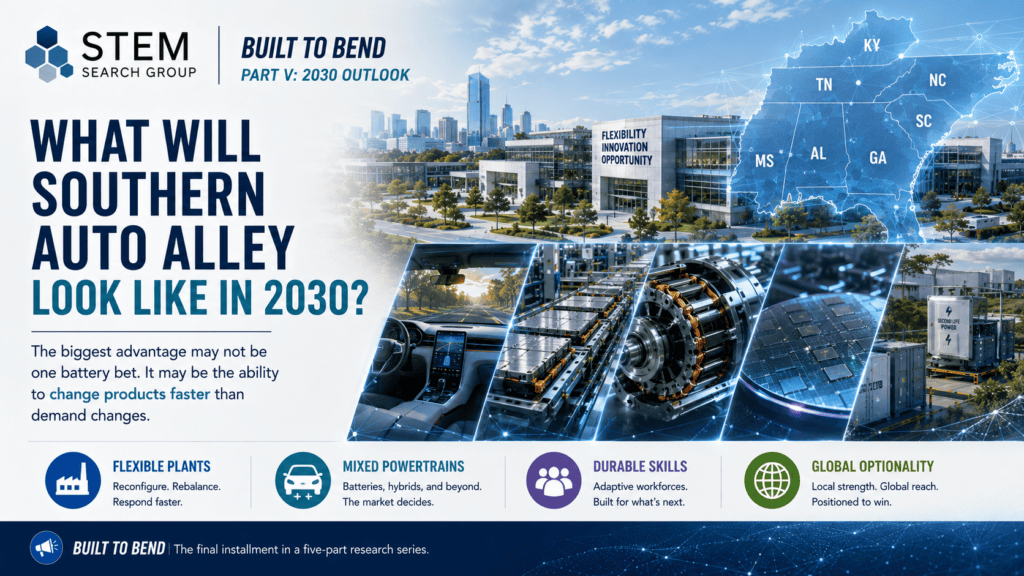
Step back from the headlines for a minute and a clear picture starts to form about where this corridor is heading over the next several years. Here’s the clearest prediction we can offer: the biggest manufacturing advantage by 2030 won’t be the plant with the newest battery chemistry. It will be the plant that can change products faster than demand changes.
The three chemistries, by 2030
By 2030, silicon carbon anode technology should look like the most practical near-term upgrade path for mainstream EVs. It quietly boosts range and charge speed on existing production lines, no new vehicle architecture required.
Solid state batteries will likely still be largely a premium and adjacent market story. Humanoid robotics, aerospace, and luxury vehicles fund the early volumes, with mass market cars coming sometime after 2030.
Sodium ion could become a genuinely meaningful option for entry-level EVs and stationary grid storage. It’s decoupled from lithium price swings in a way that matters as much for utilities as it does for everyday car buyers.
Exact timing will vary by OEM and by chemistry. Directionally, this is the most likely path.
On the vehicle side, expect extended range EVs and flexible powertrain plants to keep gaining ground relative to single architecture EV bets. Several automakers learned the expensive way that a plant tied to one battery chemistry and one buyer assumption is a fragile plant, no matter how much money gets poured into it up front.
Hyundai’s Metaplant, Toyota’s North Carolina lines, and Scout’s dual powertrain product are a plausible template for whatever gets announced next in this corridor, whether that’s a new plant in Georgia or a retooled facility somewhere else in the region.
Heavy industry stays ahead of passenger vehicles
Heavy industry will likely keep running ahead of passenger vehicles as a proving ground for battery and power electronics technology. Mining, aerospace, and robotics don’t wait around on tax credits. The safety data, degradation models, and manufacturing methods coming out of those sectors could reach consumer EVs faster than any new piece of federal policy.
Fortescue Zero’s Roadrunner program is a good example of the pace this kind of industrial development can move at when it isn’t tied to consumer sales cycles or election timelines. It went from prototype to a functional 3.2 megawatt-hour mining truck in just 22 months.
That matters for this corridor specifically:
- A lot of the underlying research infrastructure sits right here in Tennessee, including Oak Ridge National Laboratory’s work on rare-earth-free traction motors.
- Knowledge generated by heavy industrial applications doesn’t stay siloed. It feeds back into passenger vehicle engineering over time.
Southern Auto Alley’s exposure to heavy industrial and defense-adjacent work isn’t a distraction from its automotive story. It’s an extension of it.
The US stays the outlier, not the leader
Heading toward 2030, the US is currently the outlier in this story, not the model everyone else is following. Global EV sales grew 20% in 2025 and are projected to rise another 11% in 2026, led by China and stronger growth in Europe and several emerging markets.
Plants built with flexible capacity in this corridor aren’t just hedging against US policy swings from one election to the next. They’re positioning themselves to supply whichever market actually accelerates first, and increasingly, that market isn’t going to be ours.
The flexible plants in Georgia, South Carolina, North Carolina, Tennessee, Kentucky, and Alabama aren’t just insurance against another domestic policy reversal. They’re optionality against a genuinely global demand picture that could shift direction again in ways that have nothing to do with who wins the next American election.
None of this guarantees EV sales in the US snap back to a straight-line growth curve by 2030. Gas prices, tariffs, model availability, and the next election could all still bend that number in either direction. What looks durable, regardless of who’s in office at any given point, is the underlying chemistry curve and the manufacturing flexibility that several of the smartest bets in this region built in from day one, often for reasons that had nothing to do with electrification policy at all.
The signal worth watching going forward
If you’re trying to read where this corridor goes next, the advice stays the same: forget the headlines for a second and watch the plants instead.
A single architecture EV plant, or a single customer recycling business, is fundamentally a bet on a straight line. A flexible one, a plant or a company that can shift its mix between electric, hybrid, and combustion, or between new vehicle recycling and grid storage, is a bet on a market that keeps bending. Given how the last two years have played out, that second bet has been the better one so far, and there’s no obvious reason to expect that changes before 2030.
Georgia, South Carolina, North Carolina, Tennessee, Kentucky, and Alabama now have meaningful assets across multiple layers of the EV supply chain:
- Batteries
- Motors
- Chips
- Recycling
That breadth shows up clearly in which projects are still standing after two administrations and a war-driven gas price spike hit the industry from completely opposite directions. Mississippi’s Canton plant remains a useful reminder of what happens when a specific investment doesn’t build in that same flexibility, even when the surrounding plant does.
That’s not a story unique to Mississippi. It’s a pattern that will likely repeat wherever the next specific, single-purpose bet gets made without a fallback built in.
What this means for hiring through the rest of the decade
For hiring managers, the skills proving most durable right now aren’t tied to a single powertrain or any one funding source. They’re tied to building batteries, moving power efficiently, and running flexible manufacturing systems. There’s no strong reason to expect that changes between now and 2030.
Experience across more than one production environment will likely keep traveling better than experience limited to a single dedicated architecture or a single customer relationship, because the plants doing the best right now are exactly the ones built around more than one production path.
For candidates, experience at a canceled or idled plant, or even a bankrupt recycler, shouldn’t be treated as a red flag heading into any interview between now and the end of the decade. The underlying skills remain relevant regardless of what happened to the specific business they were developed at:
- Battery manufacturing
- Power electronics
- Energy storage
- Automation
- Quality
- Mixed model assembly
The skill set doesn’t stop being valuable just because the company built around it hit a rough patch. It moves to wherever the next business is actually built to bend.
That said, it would be underselling the real challenge here to make it all sound easy. A technician who spent a career on a dedicated combustion line, or a dedicated EV line, doesn’t automatically know how to run a shift where the vehicle rolling off the line changes model to model. Working a flexible line takes real cross-training: comfort with high voltage systems and traditional powertrains at the same time, plus the judgment to handle a changeover without slowing the whole line down.
That talent pool looks likely to stay fairly shallow through the rest of the decade. Cross-trained talent will probably remain one of the real constraints standing between these flexible facilities and the headcount they’re trying to hire for.
The bigger point, past the EV story itself
This was never really a story about whether EV sales recover next quarter, or even by 2030. It’s a story about which regions can absorb an industry shock without starting over from scratch. So far, Southern Auto Alley looks better equipped than most regions to do exactly that, and the reasons why have very little to do with anyone in this corridor specifically planning for an EV policy reversal back when these plants were first designed.
Foreign OEMs like Toyota, BMW, Hyundai, and Mercedes came into this region already running mixed global portfolios, with combustion, hybrid, and EV vehicles all sold somewhere in the world at the same time. A flexible line was often just how they’d always built plants, not a specific hedge against an American policy swing. The supplier base that grew up around them had to serve multiple OEMs with different needs at once, which likely pushed versatility down into the Tier 1 and Tier 2 layer from early on.
Many of these facilities were also built recently enough that newer automation made adapting production easier than it would have been at older legacy plants. Persistent labor shortages across the region probably made flexible, more automated production even more valuable, since manufacturers couldn’t always count on hiring enough people for one narrow, rigid task.
The South likely wasn’t positioned to win this specific EV whiplash by design. It was, in a lot of ways, structurally built for exactly this kind of uncertainty well before flexibility became the winning strategy anyone could point to in hindsight.
Mixed portfolios, versatile suppliers, adaptable plants, and a workforce that can retrain: those traits are a reasonable bet to matter again the next time the industry’s direction shifts, whatever that next shift turns out to be.
The region did not avoid the industry’s mistakes. It may simply be better equipped than most to absorb them and keep moving.
Sources
- Federal Reserve Bank of Chicago: The Emerging Geography of Electric Vehicle Production in North America
- Federal Reserve Bank of Chicago: Charging Ahead
- Fortescue: Track to Truck
- MIGSO-PCUBED: Delivering Fortescue Zero’s Roadrunner
- Liebherr: T 264 Battery Electric
- Hyundai Motor Group Metaplant America
- Toyota Battery Manufacturing North Carolina
- Scout Motors Manufacturing Center
- BloombergNEF global EV sales outlook, via IO+